AI Warehouse Energy Management: Cutting Costs Beyond Reporting
AI-powered warehouse energy management goes beyond AASB S2 and Scope 3 compliance — it's about using predictive control on HVAC, refrigeration and lighting to cut real operational costs. Here's where the savings actually come from in Australian cold chain and large-DC facilities.
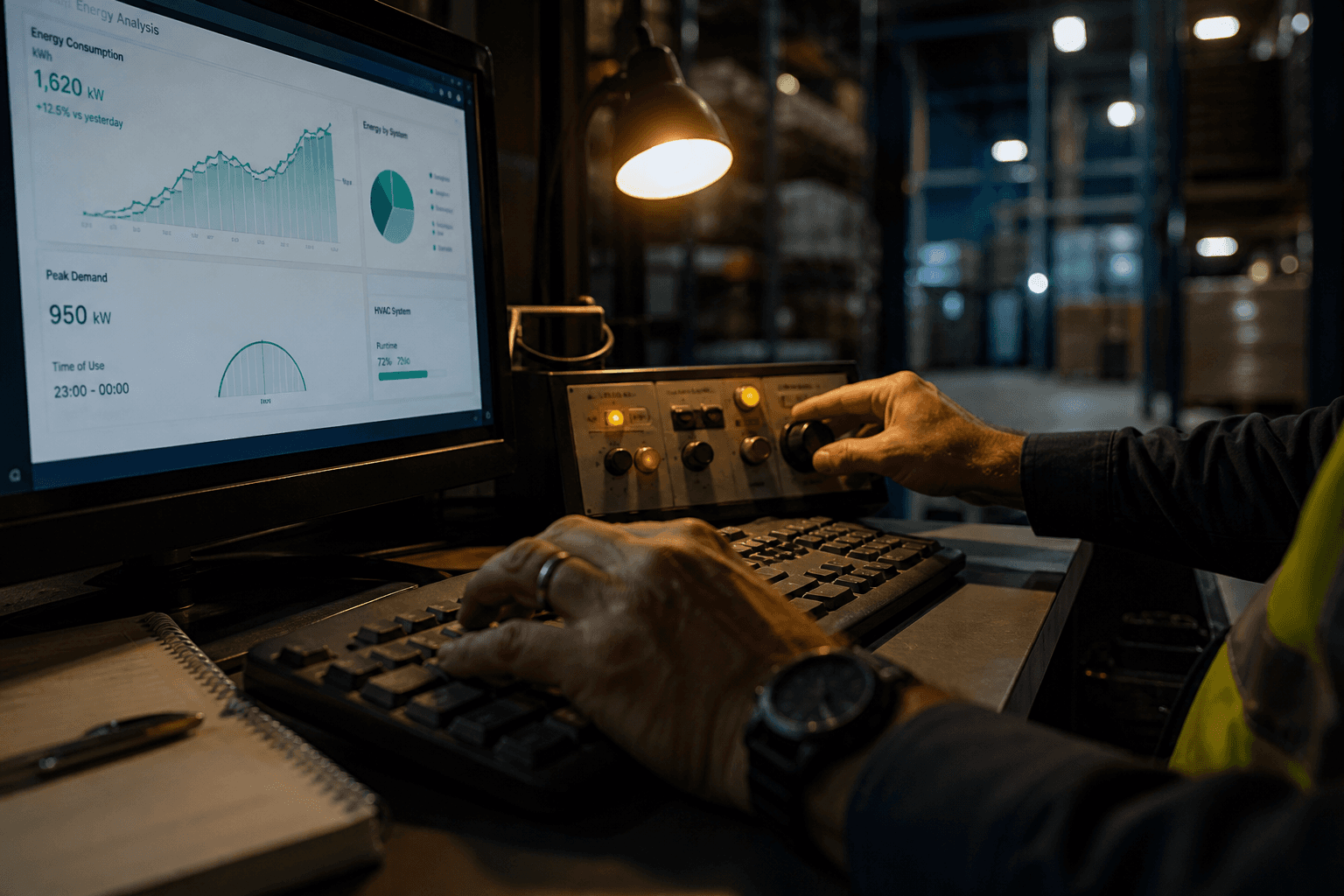
Most of the conversation around warehouse energy right now is about compliance — AASB S2 compliance for logistics operators, Scope 3 emissions in logistics, NGER reporting. That's important, but it misses a bigger and more immediate opportunity. AI-powered warehouse energy management is the use of machine learning and real-time sensor data to actively control HVAC, refrigeration, and lighting loads — reducing energy spend as an operational cost, not just a reporting line item.
For cold chain operators and large distribution centres, energy is often the second or third biggest controllable cost after labour and fleet. Yet most Australian warehouses still run these systems on fixed schedules, manual overrides, and reactive maintenance. This guide looks at where AI actually moves the needle on warehouse automation in Australia — separate from the emissions-reporting conversation we've covered elsewhere.
What is AI-powered warehouse energy management?
AI-powered warehouse energy management is a system that uses live data from meters, sensors, and building management systems to predict load, detect inefficiency, and automatically adjust equipment in real time. Unlike static building management systems (BMS) that follow fixed schedules, AI models learn from occupancy patterns, external temperature, throughput volume, and historical consumption to make continuous micro-adjustments — rather than relying on a facilities manager noticing a problem after the energy bill arrives.
This is distinct from emissions accounting. Emissions reporting under the NGER Scheme and Safeguard Mechanism tells you how much energy you used and what it cost in carbon terms, after the fact. It's a compliance framework administered by the Clean Energy Regulator — not a tool for reducing consumption. AI energy management sits upstream of that: it's about using less energy in the first place, which then makes your reporting numbers better as a byproduct. This is a useful distinction for any operator weighing up AI in logistics investment generally — cost reduction and compliance are related, but they're not the same project.
Why treat energy cost as separate from emissions reporting?
Energy cost reduction and emissions reporting solve different problems and often sit with different stakeholders. Reporting is usually owned by finance or compliance teams preparing for AASB S2 disclosures and Scope 3 supply chain reporting; energy cost is an operations and facilities problem that shows up directly on the P&L every billing cycle, regardless of whether a company has any reporting obligations at all.
Treating them as the same initiative tends to slow both down. A compliance-led project gets scoped around audit trails and disclosure formats, which is the right instinct for reporting but the wrong starting point for cutting a refrigeration bill. If your organisation is already building out emissions reporting capability for AASB S2, the energy-cost work is a natural adjacent step — but it deserves its own operational business case, measured in dollars saved, not tonnes disclosed.
It's also worth noting that government support for industrial energy efficiency and decarbonisation does exist in Australia — programs administered through bodies like the Australian Renewable Energy Agency (ARENA) and the Clean Energy Finance Corporation periodically fund industrial and commercial efficiency projects. Eligibility, scope, and funding amounts vary by round and change over time, so operators should check current program details directly with ARENA or the CEFC rather than relying on historical figures when building a business case.
Where do AI systems actually find savings in a warehouse?
AI systems find savings by identifying patterns in consumption data that are invisible to manual monitoring — equipment running when it doesn't need to, loads that could be shifted to cheaper tariff periods, or degradation that signals a maintenance issue before it becomes a failure. The three biggest opportunities in a typical distribution centre are HVAC, refrigeration, and lighting.
HVAC and dock-area climate control
Heating, ventilation and air conditioning in large DCs is usually zoned too coarsely and scheduled too conservatively, because getting it wrong (too hot, too cold) generates complaints fast. AI-based predictive control models can forecast occupancy and external conditions and pre-condition specific zones only when needed, rather than running entire bays on a blanket schedule. This is particularly relevant where dock doors cycle constantly and climate control is fighting outside air exchange most of the day.
Refrigeration and cold chain load management
Refrigeration is typically the largest single energy load in cold chain facilities, and compressors are often run at fixed set points regardless of actual product load or ambient conditions. Predictive load management uses sensor data (temperature, humidity, door-open frequency, product throughput) to adjust compressor cycling dynamically, flagging drift before it causes product risk or equipment strain. For temperature-controlled logistics operators, this is also where energy cost and product quality risk intersect — a compressor fault caught early by an anomaly-detection model is both a cost saving and a spoilage-prevention measure.
Lighting and demand response
Warehouse lighting is one of the easier wins because occupancy and throughput data already exists in most warehouse management systems (WMS) — it's just not connected to the lighting controls. AI-driven lighting systems can dim or deactivate zones based on real-time occupancy and pick activity, and can also participate in demand response programs, shifting non-critical load away from peak tariff windows.
How does this apply specifically to cold chain and large-DC operators?
Cold chain and large-DC operators face a different risk profile than general warehousing because energy failures carry product and compliance consequences, not just cost ones. A refrigeration fault isn't just a higher power bill — it's potential stock loss, customer claims, and food safety exposure. This makes predictive, always-on monitoring more valuable here than in dry-goods warehousing, where the downside of a missed anomaly is smaller.
Large DCs (10,000+ sqm) also tend to have more zones, more equipment diversity, and more legacy BMS infrastructure that was never designed to talk to each other. This is where legacy system modernisation in logistics becomes part of the energy conversation whether you planned it that way or not — you can't layer predictive control onto a building management system that can't expose its data. In practice, this means the first step for most operators isn't buying an AI platform, it's an honest audit of what your existing meters, sensors, and BMS can and can't tell you.
This is also where the work overlaps with broader digital transformation in Australian logistics. Operators modernising dispatch with route optimisation or document handling with document intelligence are often sitting on similar legacy-infrastructure problems — disconnected systems that hold useful data but were never built to share it. Energy management tends to surface the same gap from a different angle.
Where to start
For most mid-market operators, the sensible entry point isn't a full platform rollout — it's a structured assessment of what data you actually have, what it would take to connect your BMS and meters to a predictive model, and where the biggest, lowest-risk wins sit. That's the thinking behind our AI readiness assessment: a short, scoped engagement that tells you what's realistic before you commit to a bigger build.
If you're weighing up energy management against other AI priorities — route optimisation, document processing, or emissions reporting for AASB S2 — it's worth having that conversation as a whole rather than piecemeal. For more on how these pieces fit together, see more insights on our site, or get in touch to talk through where your facility actually stands.
Zero Footprint
The Zero Footprint team — AI modernisation for Australian logistics.