How AI Invoice Matching Catches Billing Errors Your Team Misses
Carrier invoices contain errors your team can't catch manually — duplicate charges, rate discrepancies, and phantom surcharges. AI invoice matching finds them automatically.
You're Paying More Than You Should
Here's a number that surprises logistics operators: 2-5% of carrier invoices contain errors — and the errors are almost always in the carrier's favour.
Duplicate charges, incorrect weight breaks, fuel surcharges applied to the wrong base rate, accessorial charges for services not rendered, and rate overrides that were agreed verbally but never applied to the billing system.
For a logistics company spending $5M per year on carrier services, that's $100,000-$250,000 in billing errors. Every year. Most of it goes undetected because manual invoice checking can't keep up.
Why Manual Checking Fails
Volume
A mid-market 3PL or freight forwarder might receive 500-2,000 carrier invoices per month from 50-200 different carriers. Each invoice has 10-50 line items. That's 5,000-100,000 line items to verify every month.

Complexity
Each carrier has different rate structures, surcharge rules, and billing formats. Rate cards change quarterly. Fuel surcharges update monthly. Accessorial charges have complex triggering conditions. No human can hold all of this in their head across 200 carriers.
Time Pressure
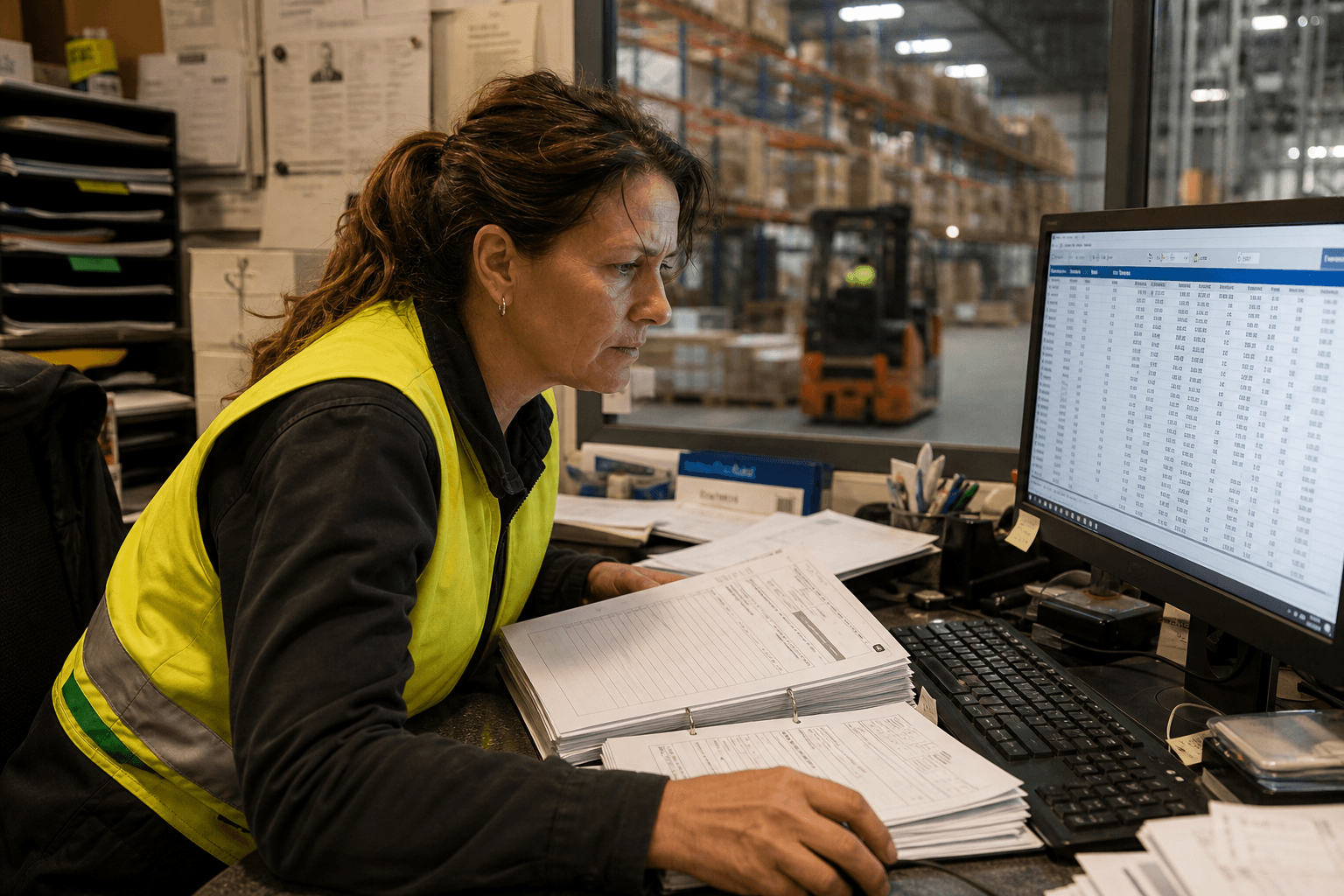
Invoices have payment terms. Your accounts payable team has a queue. There's pressure to process and pay — not to scrutinise every line item. Spot-checking 10-20% of invoices is the best most companies manage. The other 80% gets paid on trust.
How AI Invoice Matching Works
Step 1: Invoice Ingestion
Carrier invoices arrive via email, EDI, portal download, or API. The system reads each invoice (using OCR for PDF/image formats), extracts line items, and structures the data.
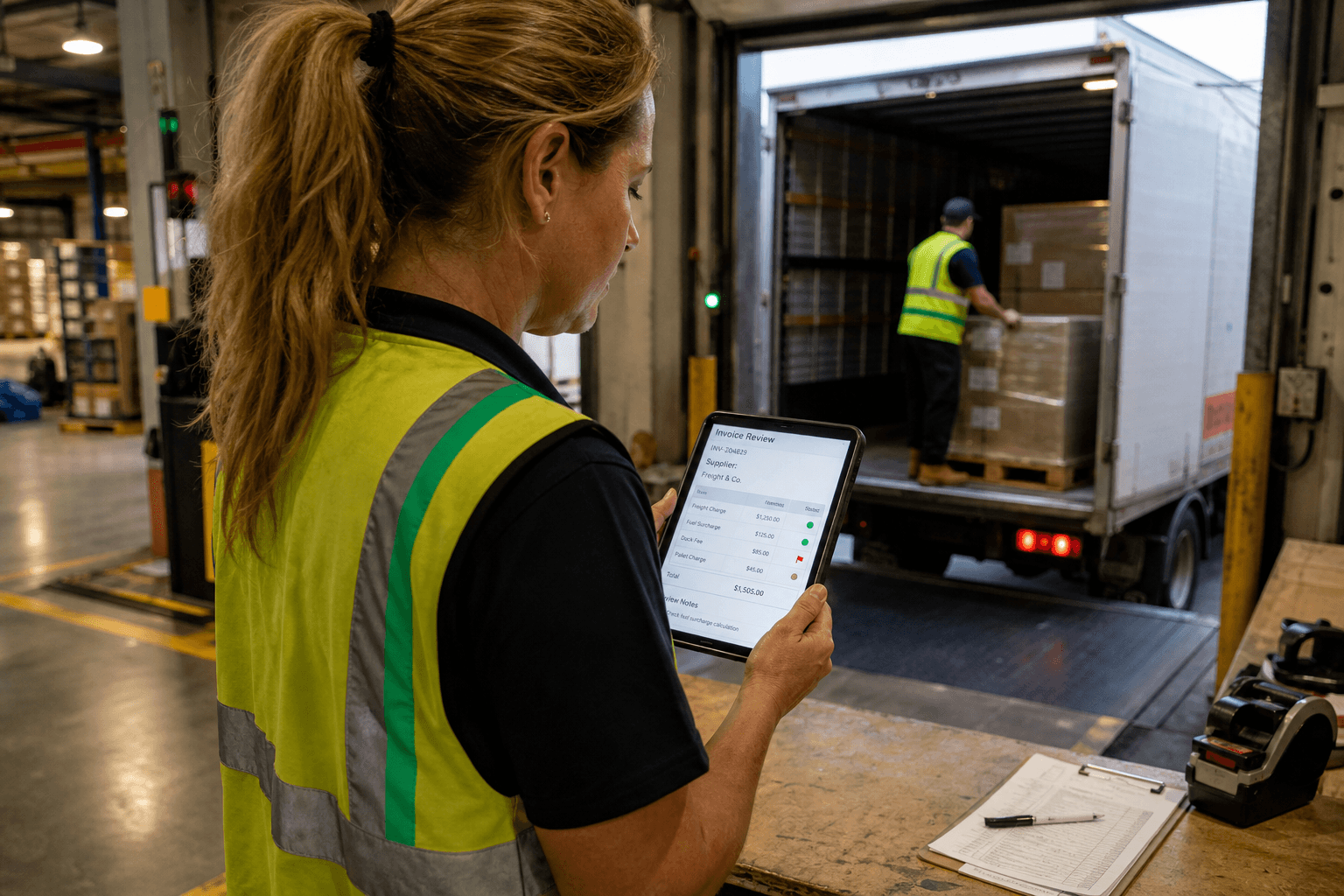
Step 2: Three-Way Match
Each invoice line is matched against:
- The rate card: Is the charged rate correct for this lane, weight break, and service level?
- The consignment record: Was this shipment actually performed? Do the weights, dimensions, and service type match?
- The proof of delivery: Was the shipment delivered successfully? Are accessorial charges (waiting time, re-delivery, tail-lift) supported by POD notes?
Step 3: Discrepancy Detection
The system flags specific discrepancy types:
Rate errors: Charged rate doesn't match the contracted rate for this lane/weight combination. Common when rate card updates aren't applied to the billing system.
Weight discrepancies: Invoiced weight differs from the weight recorded at dispatch or delivery. Often indicates billing based on estimated weight rather than actual.
Duplicate charges: Same consignment billed twice, or the same accessorial charged on both the line-haul and delivery invoices.
Phantom surcharges: Fuel surcharges, after-hours fees, or residential delivery charges that don't match the actual delivery circumstances.
Missing credits: Returns, short-ships, and service failures that should generate a credit note but didn't.
Step 4: Exception Queue
Flagged discrepancies go to a reviewer with full context — the invoice line, the rate card entry, the consignment record, and the specific rule that was violated. The reviewer approves, rejects, or escalates. Approved discrepancies become carrier queries.
What It Finds
In our experience implementing AI invoice matching for logistics companies:
| Discrepancy Type | Frequency | Average Value |
|---|---|---|
| Rate card errors | 1-3% of line items | $15-$50 per item |
| Weight discrepancies | 2-4% of line items | $10-$30 per item |
| Duplicate charges | 0.5-1% of invoices | $100-$500 per invoice |
| Phantom surcharges | 1-2% of line items | $20-$80 per item |
| Missing credits | 0.3-0.5% of shipments | $50-$200 per credit |
For a company processing $5M in carrier spend annually, AI invoice matching typically recovers $100,000-$250,000 per year — and that number tends to decrease over time as carriers learn their invoices are being scrutinised automatically.
Beyond Cost Recovery
The financial recovery is the headline number, but the operational benefits are equally valuable:
Faster processing: Invoice matching that took 3 people 3 days per week now takes 1 person 4 hours per week (reviewing exceptions only).
Carrier accountability: When carriers know every invoice line is being checked automatically, billing accuracy improves. We typically see carrier error rates drop by 50% within 6 months of implementation.
Rate compliance: The system constantly validates that contracted rates are being applied. Rate card updates are verified across all subsequent invoices. No more "we agreed on a new rate but the old one keeps appearing."
Audit readiness: Every invoice, every match, every discrepancy is logged with full audit trail. When auditors ask "how do you verify carrier invoices?" the answer is systematic, not "we spot-check."
Invoice matching is just one application of AI document intelligence that can transform your logistics operations. Our document intelligence solutions automate the processing and validation of shipping documents, invoices, and compliance paperwork. For companies looking to implement AI across their operations, our AI readiness assessment helps identify the highest-impact opportunities for automation.
Implementation
Week 1-2: Connect invoice sources (email, EDI, portals) and rate card data Week 3-4: Configure matching rules for your top 20 carriers (by spend) Week 5-6: Parallel run — system matches alongside your manual process for validation Week 7-8: Go live — manual checking stops, exception-based workflow begins Ongoing: Expand to remaining carriers, refine rules based on exception patterns
Most implementations are fully operational within 8 weeks and pay for themselves within the first quarter.
Find out how much you're overpaying →
Ready to stop overpaying on carrier invoices? Our AI document intelligence solutions can identify billing errors and discrepancies that manual processes miss, typically paying for themselves within months through recovered overcharges. Contact us to discuss how automated invoice matching can work for your logistics operation.
Zero Footprint
The Zero Footprint team — AI modernisation for Australian logistics.