AI Phone Answering for Australian Freight and 3PL Operations
AI phone answering is becoming a practical option for Australian freight carriers and 3PLs — handling status enquiries, booking confirmations, and after-hours calls without adding headcount. This guide covers how it works, what it can and can't handle, and what to consider before deploying it in a logistics operation.
Running freight and 3PL operations in Australia means phones that never stop ringing. Drivers calling in with delivery exceptions. Customers chasing ETAs. Brokers confirming bookings. Most operations handle this with a small team — or they miss calls entirely during peak hours, overnight, and weekends.
AI phone answering for freight is now a practical option for mid-market carriers and 3PLs. This guide covers how it works, where it fits in a logistics operation, and what to consider before deploying it.
What Is an AI Phone Answering Service for Freight?
An AI phone answering service is an automated system that handles inbound calls using voice AI — responding to caller questions, capturing booking details, providing shipment status updates, and routing complex enquiries to the right person. In freight and 3PL contexts, it connects to your TMS, WMS, or tracking systems to give callers real answers, not just a voicemail.
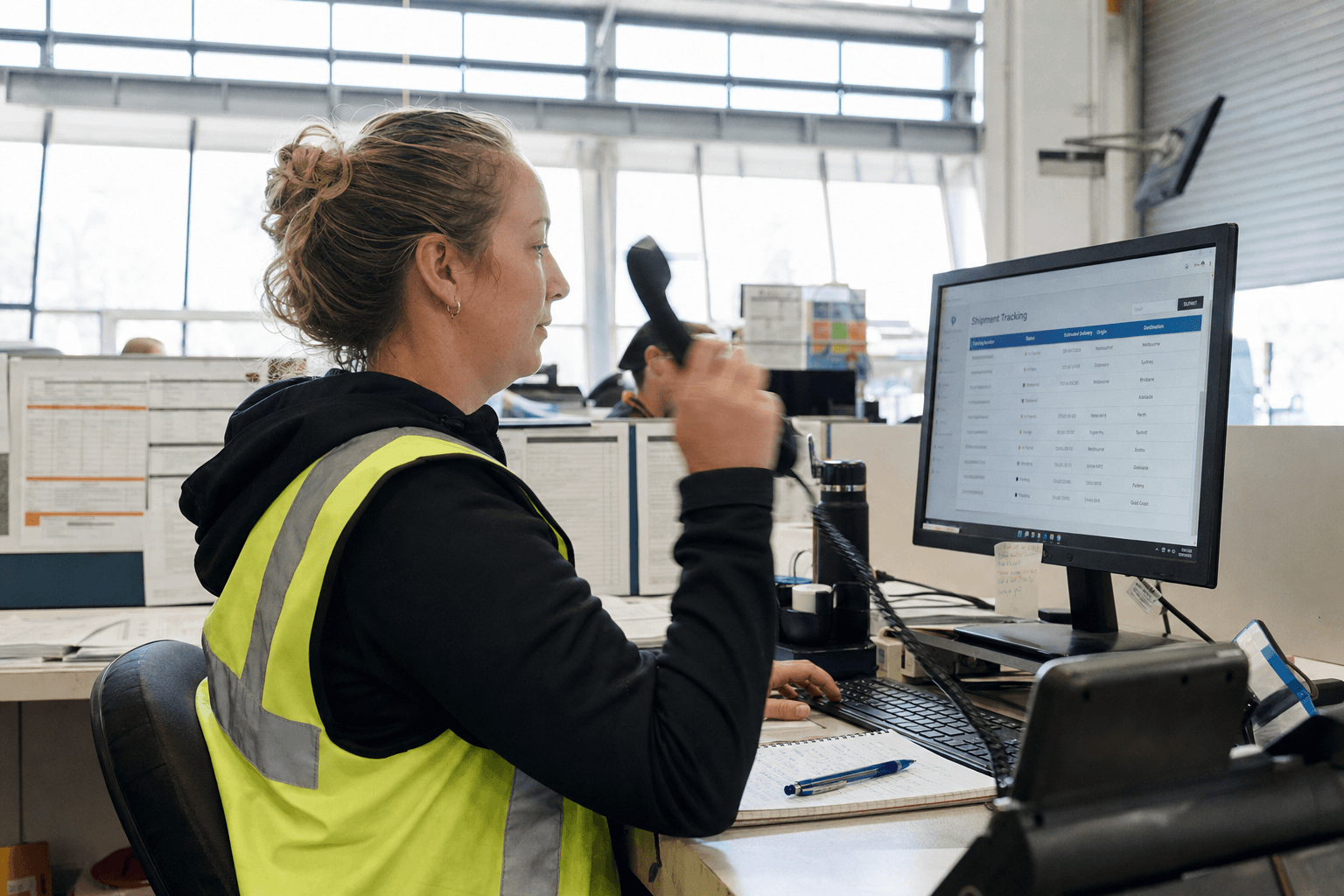
Modern voice AI differs from legacy IVR (interactive voice response) systems. Where IVR forces callers through rigid menus, voice AI understands natural speech — a driver saying "I'm at the depot but the gate's locked" or a customer asking "where's my pallet that was meant to arrive Tuesday" can be handled without a human on the other end.
Why Australian Freight Operations Are Looking at This Now
Several pressures are converging that make AI-powered phone handling worth evaluating for Australian carriers and 3PLs.
Labour cost and availability. Finding and retaining customer service staff in logistics is difficult. Wages have risen, and qualified people who understand freight terminology are hard to hire. Automating repetitive inbound call volume — status checks, booking confirmations, depot hours — reduces the burden on existing staff.
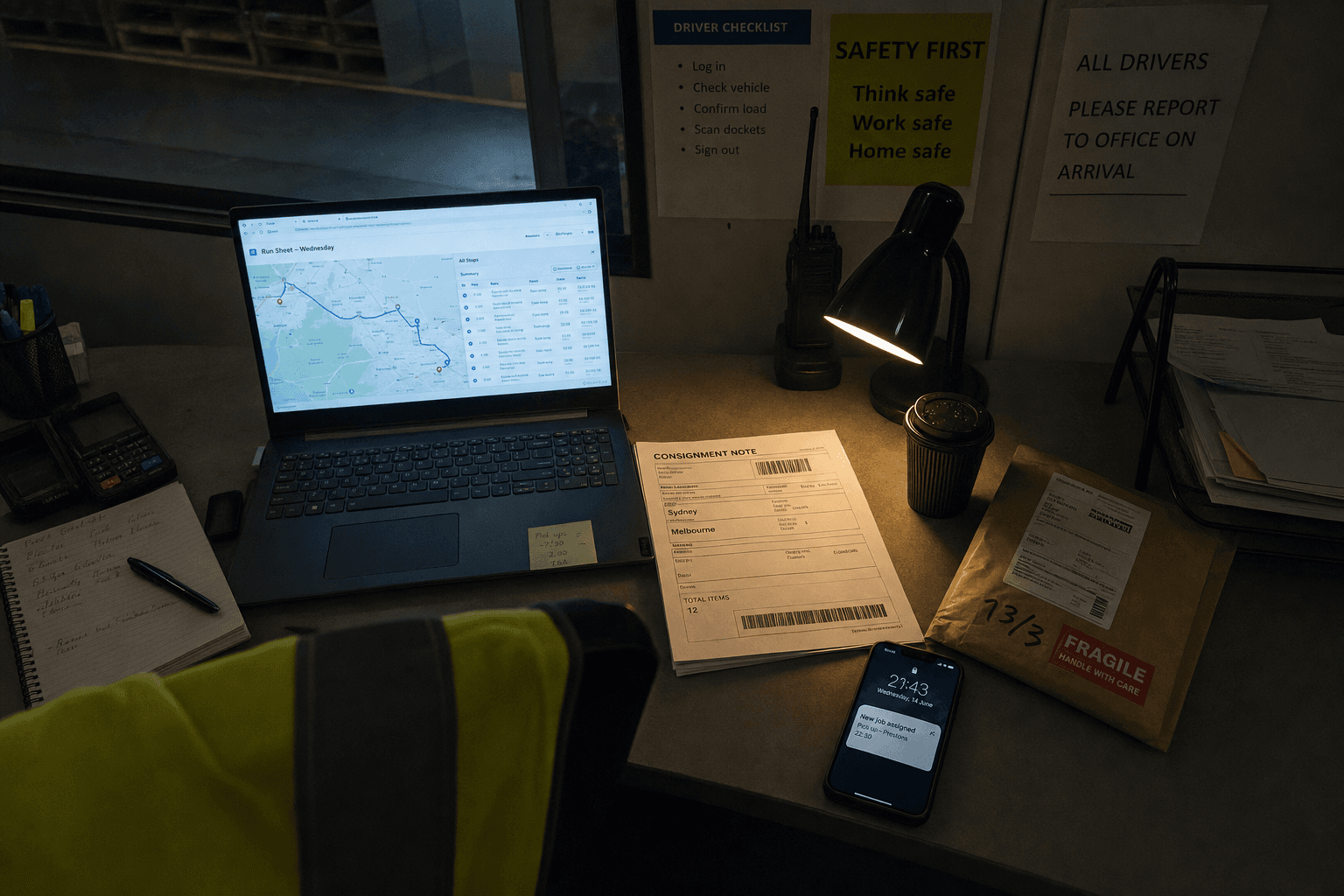
After-hours coverage. A refrigerated load arriving at midnight, a driver with a break-down at 6am on Saturday — freight doesn't stop at 5pm. AI phone systems can handle after-hours enquiries, log exceptions, and escalate genuine emergencies to an on-call team without staffing a full overnight shift.
Customer expectations. Shippers and consignees increasingly expect real-time information. If your competitors offer automated status updates and you still require customers to call and wait on hold, that's a visible service gap in tender evaluations.
Digital transformation pressure. Large retailers and FMCG customers are pushing their logistics providers toward digital communication channels. An AI phone layer is often part of a broader digital transformation in logistics, alongside EDI, API integrations, and real-time tracking.
What Can AI Phone Systems Handle in a Freight Context?
Not every call type is suited to automation. A practical deployment focuses on high-volume, repetitive enquiries where the answer can be pulled from a live data source.
| Call Type | AI-Suitable? | Notes |
|---|---|---|
| Shipment status / ETA enquiry | Yes | Requires TMS/tracking integration |
| Booking confirmation | Yes | Can confirm and send SMS/email receipt |
| Depot hours and address | Yes | Static or semi-static data |
| Proof of delivery request | Yes | Can trigger automated POD email |
| Driver check-in / arrival notification | Partially | Simple check-ins yes; complex exceptions need human |
| Freight claims and damage disputes | No | Requires human judgement and empathy |
| Rate negotiation | No | Commercial decision-making |
| Complex customs / compliance queries | No | Specialist knowledge required |
The goal is not to replace human communication entirely. It's to reserve your experienced staff for conversations that actually need them.
How Does Integration with TMS and WMS Work?
For a voice AI system to give useful answers in freight, it needs to connect to the systems where your data actually lives. That typically means:
- TMS integration for shipment status, ETAs, driver assignments, and booking details
- WMS integration for inventory queries, inbound receipts, and pick/pack status
- Tracking platforms for real-time GPS-based ETAs
- POD systems for automated proof of delivery retrieval
Integration complexity depends on the age and type of your systems. Modern SaaS TMS platforms (Freight2020, Visy, CargoWise) generally offer APIs that voice AI platforms can connect to. Legacy systems built on older architecture may require middleware or a data layer to expose the information the AI needs.
This is a critical scoping question before any deployment. An AI phone system that can't access live shipment data is limited to scripted responses — which is closer to IVR than true voice AI. If you're assessing your readiness for this kind of integration, our AI readiness assessment is a practical starting point.
Australian-Specific Considerations
Deploying voice AI in an Australian freight context involves some factors that don't apply to offshore implementations.
Australian accents and freight terminology. Voice AI systems trained primarily on North American or UK speech patterns can struggle with Australian regional accents, driver slang, and logistics-specific language. Testing with real callers from your actual customer and driver base — not just a standard demo — is essential.
Data residency. If your callers are providing shipment details, customer data, or personally identifiable information, you need to understand where that data is processed and stored. Australian Privacy Act obligations apply. Ensure your vendor can confirm Australian or local data residency, or that their data handling meets the APP (Australian Privacy Principles) requirements.
Telecommunications compliance. Automated voice systems in Australia must comply with ACMA (Australian Communications and Media Authority) rules, including disclosure requirements when a caller is speaking with an automated system rather than a human.
Multi-site and multi-state operations. Many Australian 3PLs operate across multiple states with different depot hours, contact numbers, and escalation paths. Your AI phone configuration needs to handle routing logic that reflects your actual operational structure — not a single-site default.
Building a Business Case
Before committing to a deployment, it's worth mapping the actual call volume and call type breakdown in your operation. A simple 30-day analysis of your inbound call log — by type, time of day, and resolution time — will tell you whether the automation opportunity is real.
The questions to answer:
- How many inbound calls per day/week are status or ETA enquiries?
- What percentage of calls arrive outside business hours?
- How long do customer service staff spend on repetitive call types?
- What's the cost of missed calls (lost bookings, dissatisfied customers)?
- What SLA obligations do you have around response times?
This analysis doesn't require AI to run — a week of call tagging by your team is enough to establish a baseline. That baseline is what makes a credible business case, and it's the kind of groundwork we help clients work through as part of an AI readiness assessment.
Implementation Approach: What to Expect
A realistic implementation timeline for an AI phone answering deployment in a mid-market freight or 3PL operation runs across several stages.
Discovery and scoping (2–4 weeks). Map call types, volumes, and current routing. Identify which systems hold the data the AI needs to access. Define escalation rules — what triggers a handoff to a human, and how.
Integration and configuration (4–8 weeks). Connect the voice AI platform to your TMS/WMS via API or middleware. Configure call flows for your specific operation. Build in escalation logic, after-hours routing, and multi-site handling.
Testing with real traffic (2–4 weeks). Pilot with a subset of call types or a single depot. Test against real callers, not just internal staff. Identify edge cases your initial configuration didn't cover.
Full deployment and monitoring (ongoing). Roll out across your operation. Monitor call resolution rates, escalation frequency, and caller satisfaction. Refine based on what the data shows.
A phased approach reduces risk. Starting with a single high-volume call type — shipment status enquiries, for example — before expanding to booking confirmations and driver check-ins gives your team time to adjust and gives the system time to be tuned to your specific patterns.
How This Fits with Broader Communication Automation
AI phone answering is one layer of customer communication automation. Most freight and 3PL operators who invest in voice AI are also looking at:
- Automated SMS and email notifications for shipment milestones (picked up, in transit, out for delivery, delivered)
- Document intelligence for automated processing of inbound booking requests, PODs, and freight invoices — see our document intelligence capability for how this works in practice
- Customer portals with self-service tracking and POD retrieval
- AI-assisted dispatch for route and load optimisation
These capabilities work better together than in isolation. A customer who receives proactive SMS updates is less likely to call for a status check — which reduces inbound call volume and makes the AI phone layer more effective. The whole system compounds.
Common Questions from Operations Teams
Will callers know they're talking to an AI? Under Australian regulations, automated voice systems must identify themselves as automated when asked. Best practice — and the only defensible approach — is to design your system to be transparent about its nature from the outset. Most callers are comfortable with voice AI for routine enquiries; the frustration comes when AI pretends to be human or fails to escalate when it should.
What happens when the AI can't answer? Every deployment needs a clear escalation path. During business hours, that's a live transfer to your team. After hours, it might be a callback request, an SMS to an on-call coordinator, or a message logged in your TMS for next-day follow-up. The escalation design is as important as the AI configuration itself.
What if our TMS data is unreliable? Voice AI is only as accurate as the data it can access. If your TMS has poor data quality — late status updates, missing ETAs, inconsistent driver check-ins — the AI will give callers inaccurate information, which damages trust. Data quality assessment should happen before deployment, not after.
Can it handle multiple languages? Some voice AI platforms support multilingual handling. In Australian freight, this is relevant for operations with significant numbers of callers from non-English speaking backgrounds. Check language support and accent handling before committing to a platform.
Is Your Operation Ready?
AI phone answering is a practical tool for the right operation — one with sufficient inbound call volume, systems that can be integrated, and a clear sense of which call types are worth automating. It's not a fit for every business at every stage.
The honest starting point is a clear-eyed look at your current call handling, your data systems, and the gap between what callers need and what your team can provide. That's the analysis that tells you whether the investment makes sense and what a realistic deployment looks like for your specific operation.
If you're exploring AI phone answering or broader customer communication automation for your freight or 3PL business, get in touch and we can work through whether it's the right fit and what implementation would actually involve.
Zero Footprint
The Zero Footprint team — AI modernisation for Australian logistics.