AI Readiness: How to Assess Your Logistics Operation in 5 Steps
Before investing in AI, you need to know where you stand. Here's a practical 5-step framework for assessing your logistics operation's readiness for AI adoption.
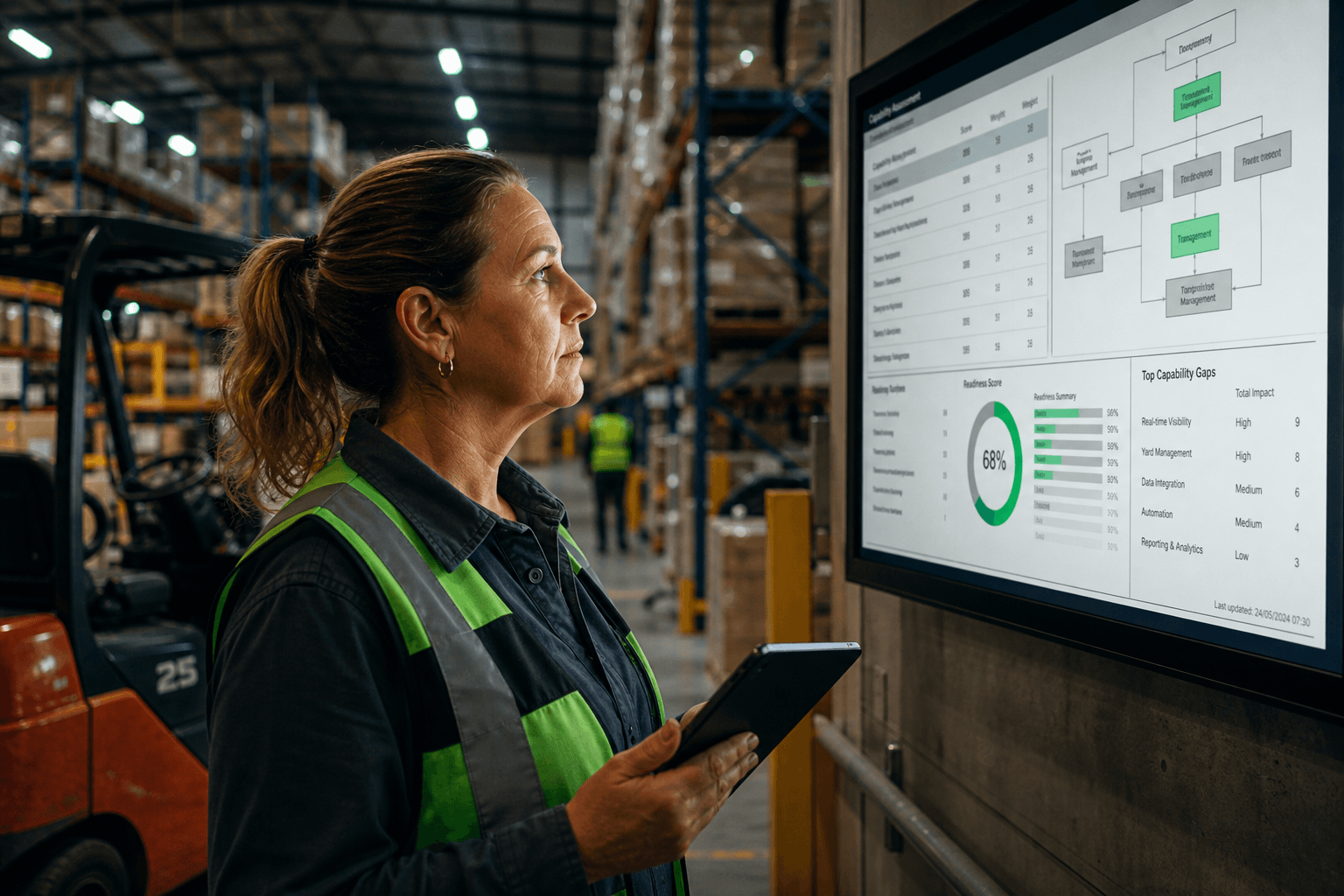
Before You Buy Anything, Assess Where You Stand
Every logistics company considering AI starts with the same question: "Where do we begin?"
The answer isn't "buy a platform" or "hire a data scientist." It's "understand what you have and what's possible." An AI readiness assessment is a structured way to answer that question — before you spend money on solutions that might not fit.
Here's a practical 5-step framework we use with logistics operators across Australia.
Step 1: Audit Your Data
AI runs on data. No data, no AI. But "having data" isn't binary — it's a spectrum.

What to Evaluate
Availability: What operational data do you actually collect? Common sources in logistics:
- TMS records (consignments, routes, rates)
- WMS records (inventory, picks, receipts)
- Fleet telematics (GPS, engine data, fuel consumption)
- Fuel card transactions
- Customer order data
- Financial records (invoices, payments, costs)
Quality: Data exists but is it usable? Check for:
- Completeness (what % of records have all required fields?)
- Accuracy (do TMS weights match actual weights?)
- Consistency (same customer in three systems with three different names?)
- Timeliness (is the data real-time, daily, weekly?)
Accessibility: Can you actually get to the data? Many legacy systems store data in proprietary formats with no export capability. Some systems have APIs; most don't. Understanding what's accessible determines what's possible.
Red Flags
- No centralised customer master data
- Paper-based processes with no digital trail
- Data locked in vendor-controlled systems with no export
- Different definitions for the same metric across systems
Green Flags
- Telematics data collected for 12+ months
- TMS with export/API capability
- Digital POD capture
- Fuel card data available electronically
Step 2: Map Your Systems
Draw a map of every system involved in your operations. For each system, document:
- What it does
- What data it holds
- How old it is
- Who maintains it
- What integration options exist (API, database, file export, nothing)
The Typical Logistics System Landscape
Most mid-market operators have 5-10 systems that don't talk to each other:
- TMS (transport management)
- WMS (warehouse management)
- ERP/Accounting
- CRM or customer portal
- Fleet telematics
- Fuel card platform
- HR/Payroll
- Document management (or email)
The integration gaps between these systems are where the biggest efficiency opportunities sit — and where AI can have the most impact.
What to Look For
- Single points of failure: Systems that only one person understands
- Manual bridges: Where humans are the integration layer (copying data between systems)
- Shadow systems: Spreadsheets and Access databases that fill gaps in the main systems
Step 3: Identify Your Pain Points (Honestly)
This is where you shift from technology inventory to business opportunity. For each operational area, ask:
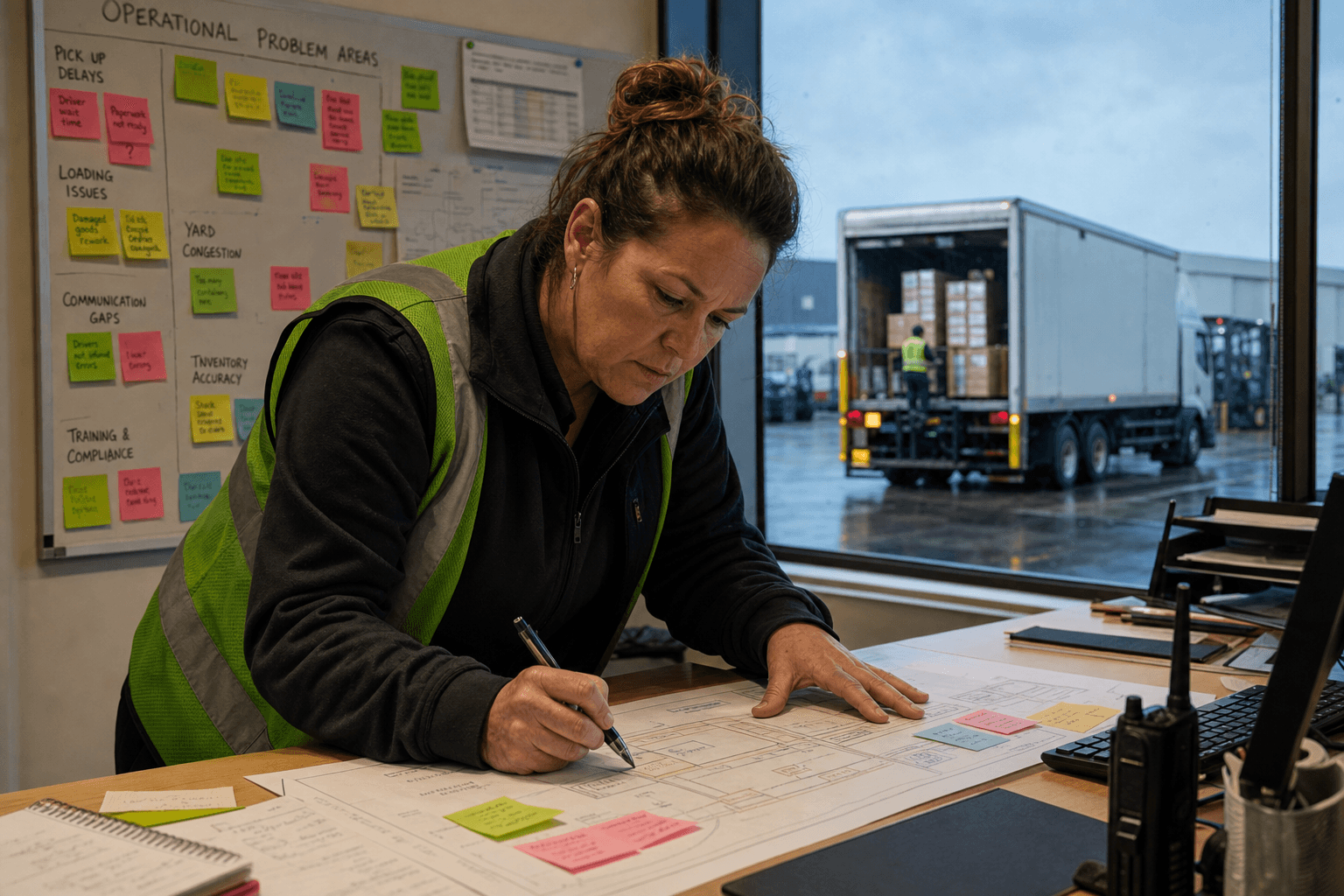
Where does your team spend time on work that doesn't require human judgement?
- Data entry between systems
- Invoice checking and reconciliation
- Report compilation
- Route planning by trial and error
- Chasing documents and status updates
Where do errors cost you money?
- Billing errors (undercharging or overcharging)
- Incorrect stock counts leading to overstocking or stockouts
- Delivery failures from poor route planning
- Compliance errors from manual reporting
Where are you losing contracts or customers?
- Can't provide real-time tracking
- Can't provide emissions data
- Can't integrate with customer systems
- Slower response times than competitors
Prioritisation Framework
Rank each pain point on two dimensions:
- Impact: How much does this cost (in money, time, or lost revenue)?
- Feasibility: Given your data and systems, how practical is an AI solution?
High impact + high feasibility = start here.
Step 4: Assess Your People
Technology is only half the equation. Your team needs to be ready to work differently.
Readiness Indicators
Leadership buy-in: Does your executive team understand AI as a tool (not magic)? Are they prepared to invest time, not just money?
Operational champions: Do you have people in operations who are curious about technology and willing to pilot new approaches? These champions are more important than any technical hire.
Change tolerance: How has your team responded to past technology changes? If the last WMS update caused six months of complaints, expect resistance. Plan for it.
Data literacy: Do your managers understand their KPIs? Can they explain what drives their costs? You don't need data scientists, but you need people who can ask good questions of data.
What You Don't Need
- A dedicated AI team (for most mid-market operators)
- Staff with programming skills
- A CDO or CTO (though a technology-literate GM helps)
What You Do Need
- One executive sponsor who owns the initiative
- One operational champion per area (logistics, warehouse, finance)
- A willingness to measure before and after
- Patience (AI projects take 8-16 weeks to deliver results, not 8 days)
Step 5: Build the Business Case
For each high-priority opportunity identified in Step 3, quantify:
Current Cost
- Staff hours spent on the manual process
- Error rates and cost of corrections
- Revenue at risk from capability gaps
- Opportunity cost (what could your team do instead?)
Expected Benefit
- Time savings (usually the easiest to quantify)
- Error reduction
- Revenue protection or growth
- Capacity increase without proportional cost increase
Investment Required
- Implementation cost (one-time)
- Ongoing running cost
- Staff time for implementation (don't underestimate this)
- Training and change management
ROI Timeline
For most logistics AI projects, expect:
- Route optimisation: 3-6 month payback
- Document automation: 6-9 month payback
- Emissions reporting: 6-12 month payback (plus revenue protection)
- System integration: 9-12 month payback
- Predictive maintenance: 12-18 month payback
An AI readiness assessment helps identify which solutions will deliver the biggest impact for your operation. Our AI readiness assessment service provides a structured framework to evaluate your current systems and data maturity. For operators looking to tackle specific challenges, we also offer targeted solutions like route optimisation and document intelligence that can integrate with existing workflows.
The Output
At the end of this assessment, you should have:
- A data inventory: What data you have, where it is, and how good it is
- A system map: Your technology landscape with integration gaps identified
- A prioritised opportunity list: Ranked by business impact and feasibility
- A people readiness assessment: What needs to change before technology changes
- A costed action plan: Top 2-3 opportunities with ROI projections and timelines
This isn't a document that sits on a shelf. It's the input for your first AI project — and a roadmap for the next 12-24 months.
Get a professional AI readiness assessment →
Ready to assess your logistics operation's AI readiness? We work with logistics operators across Australia to identify practical AI opportunities that deliver measurable results. Get in touch to discuss how our assessment framework can help you make informed decisions about AI investment.
Zero Footprint
The Zero Footprint team — AI modernisation for Australian logistics.