AI Readiness Assessment for Logistics: A Practical Framework
Before committing to any AI build, Australian logistics operators need to know whether their data, systems, processes, and team are ready. This framework covers the five dimensions of AI readiness — with a self-assessment benchmark you can apply to your own operation today.
AI Readiness Assessment for Logistics: A Practical Framework
An AI readiness assessment for logistics is a structured evaluation of your organisation's data, processes, technology, and people — carried out before committing to any AI build. For Australian carriers, 3PLs, and warehouse operators, it answers one practical question: where can AI deliver real value in your operation, and what needs to be in place before you start?
If you've looked at AI in logistics and wondered whether your business is ready, this framework gives you a starting point. It won't replace a proper assessment, but it will help you understand what one involves and where your gaps might be.
Why Logistics Operators Need a Readiness Assessment Before Jumping In
Most failed AI projects in logistics don't fail because the technology doesn't work. They fail because the operator wasn't ready — patchy data, unclear process ownership, or a system that couldn't connect to anything else. An AI readiness assessment surfaces these problems before they become expensive ones.
The logistics sector in Australia has particular characteristics that make this groundwork essential:
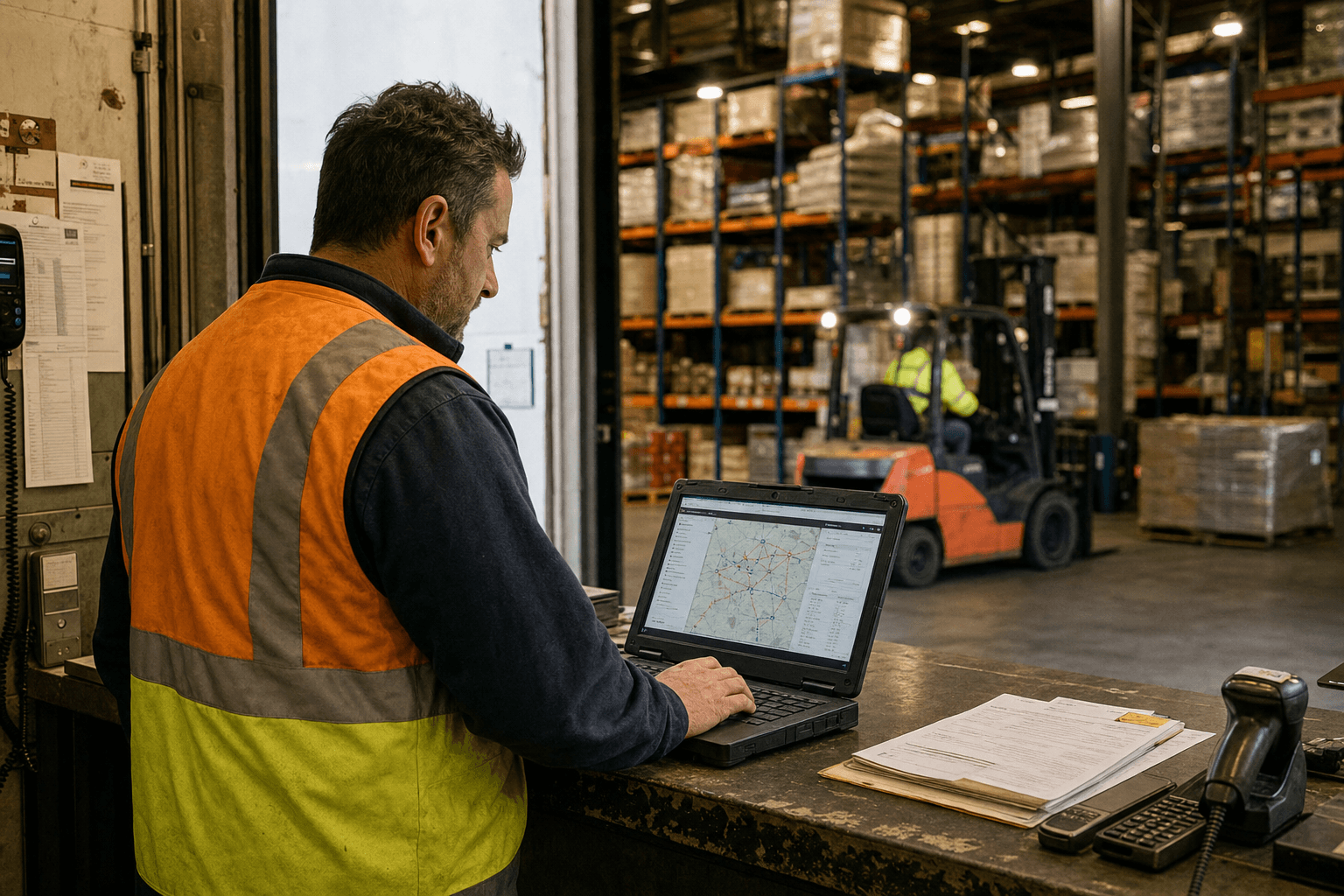
- Legacy systems are common. Many operators are running TMS or WMS platforms that are five or more years old, with limited API access and inconsistent data structures.
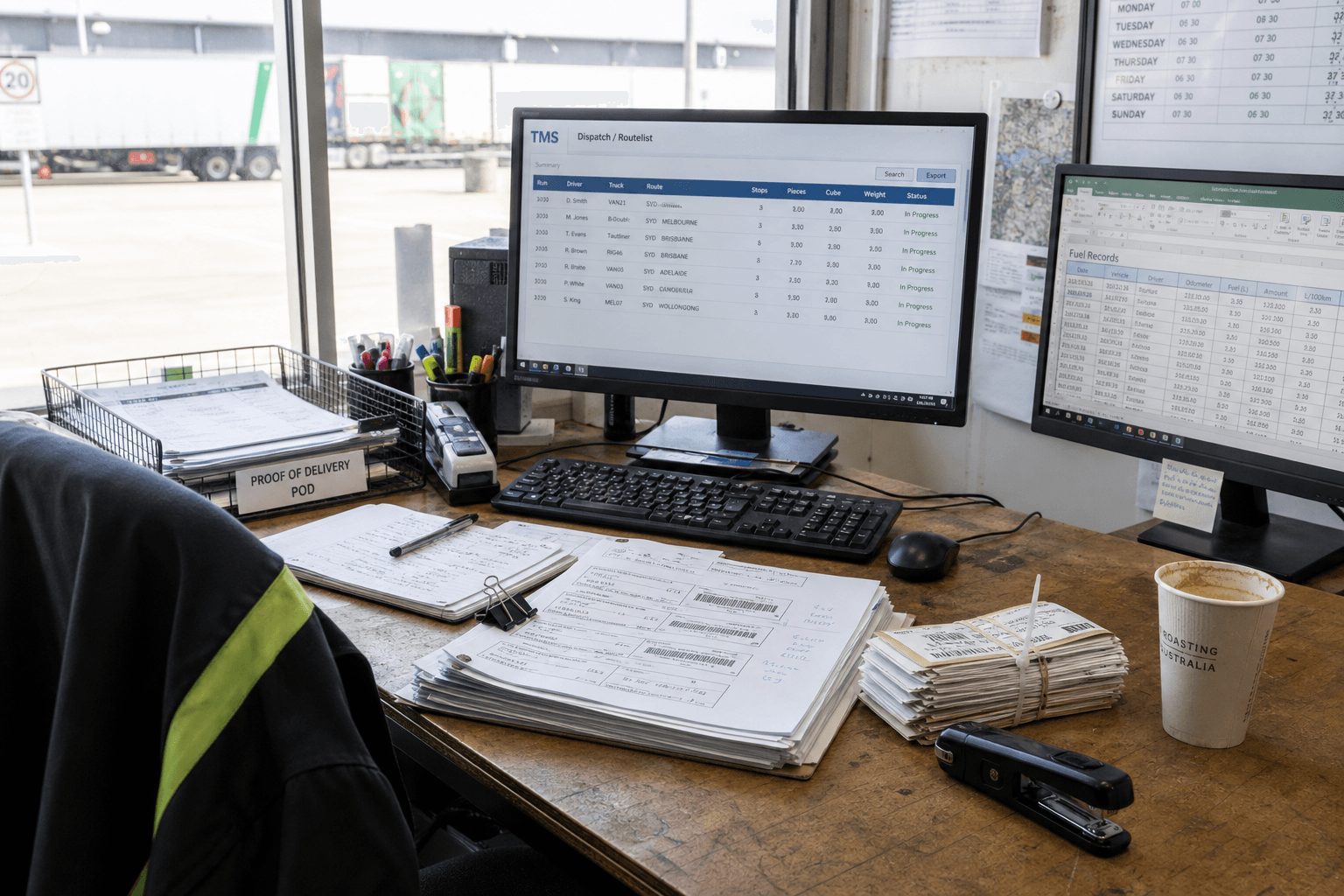
- Data is fragmented. Dispatch data lives in one system, proof-of-delivery in another, fuel records in a spreadsheet, and customer data in email threads.
- Teams are lean. Most mid-market operators don't have an internal data or engineering team. That shapes what's realistic to build and maintain.
- Compliance pressure is increasing. AASB S2 emissions reporting obligations are creating a new urgency around data capture and systems integration that didn't exist two years ago.
Skipping the readiness phase means you're building on an unknown foundation. That's a risk most operators can't afford.
The Five Dimensions of AI Readiness in Logistics
A thorough AI readiness assessment for logistics evaluates five dimensions. Each one contributes to whether an AI use case will succeed in your environment.
1. Data Readiness
Data readiness is the degree to which your organisation captures, stores, and can access the information needed to train and run AI models. This is the most critical dimension — AI without usable data is not possible.
What to assess:
- What operational data do you currently capture? (delivery times, route history, dwell times, load weights, fuel consumption, incident records)
- Where is it stored — TMS, WMS, spreadsheet, paper?
- How far back does clean, structured data go?
- Is data consistent across depots, fleets, or warehouse shifts?
- Who owns data quality in the business?
Common gaps found in Australian mid-market logistics:
- Paper PODs with no digital capture
- Inconsistent job codes between depots
- Fuel records in standalone spreadsheets not linked to vehicle IDs
- Customer data across multiple disconnected email inboxes
2. Process Readiness
Process readiness is the degree to which your core operational processes are documented, consistent, and measurable. AI augments processes — it doesn't replace undefined or inconsistent ones.
What to assess:
- Are dispatch, routing, warehousing, and invoicing processes documented?
- Do different sites or shifts run the same process differently?
- Where do manual handoffs create delays or errors?
- Which processes generate the most rework or customer complaints?
A process map of your highest-volume workflows is a useful output here. It shows which processes are AI-ready today and which need to be stabilised first.
3. Systems & Integration Readiness
Systems readiness is the degree to which your existing technology infrastructure can connect to and exchange data with new AI tools. No AI platform operates in isolation — it needs to read from and write to your existing systems.
What to assess:
- What TMS, WMS, ERP, or fleet telematics platforms are you running?
- Do they have APIs or data export capabilities?
- When are they scheduled for upgrade or vendor end-of-life?
- Can you access raw data, or only what the vendor surfaces in their UI?
- What integration work has been done before — and what happened?
| System Type | Common Integration Path | Key Risk |
|---|---|---|
| Modern TMS (API-enabled) | Direct API connection | Low |
| Legacy TMS (5+ years) | Database extract or middleware | Moderate |
| Spreadsheet-based dispatch | Manual ingestion pipeline | High |
| Paper-based processes | Digitisation required first | Very high |
| Fleet telematics (GPS) | API or CSV feed | Low–Moderate |
4. People & Change Readiness
People readiness is the degree to which your team has the awareness, willingness, and capacity to adopt AI-assisted tools. Technology adoption in logistics operations lives or dies on whether the team uses it.
What to assess:
- How have previous technology rollouts been received?
- Who are the informal leaders on the floor whose buy-in matters most?
- Is there a culture of process compliance, or do workarounds dominate?
- Does leadership have a clear, consistent message about why AI is being pursued?
- Who will own the AI tools after implementation — and do they have capacity?
This is the dimension most often underweighted by operators who focus heavily on the technology. If your dispatch team doesn't trust the tool or understand why it's there, utilisation will be low regardless of how good the underlying model is.
5. Strategic Alignment
Strategic alignment is the degree to which AI use cases connect directly to your business priorities — cost reduction, compliance, contract retention, or growth.
What to assess:
- What are your top three operational priorities for the next 12–24 months?
- Are there specific customer commitments or tender requirements driving technology investment?
- Do you have AASB S2 or NGER reporting obligations that require better data capture?
- Is the business planning to grow, sell, or raise capital — and how does AI fit that?
AI projects without a clear strategic link tend to stall after the initial build. Alignment ensures there's a sponsor, a budget rationale, and a reason to maintain momentum.
How to Score Your AI Readiness: A Self-Assessment Benchmark
Use the table below as a rough self-assessment across each dimension. This is a starting point — a full assessment goes deeper into your specific systems, data, and use cases.
| Dimension | Early Stage | Developing | Ready |
|---|---|---|---|
| Data | Paper-based or fragmented; no structured history | Digital capture in at least one system; some clean data history | Multi-system digital capture; 12+ months clean, structured data |
| Process | Undocumented; varies by person or site | Partially documented; core processes consistent | Fully documented; measurable; exceptions tracked |
| Systems | Legacy only; no API access | Mix of legacy and modern; limited integration | API-enabled systems; prior integration experience |
| People | Low tech adoption history; change resistance noted | Mixed adoption; some champions; leadership support unclear | Strong adoption history; clear owners; leadership committed |
| Strategy | No defined AI use case; exploratory only | Use case identified; business case incomplete | Use case tied to measurable business priority; budget allocated |
If most of your answers sit in the Early Stage column, that's not a reason to stop — it's a reason to plan the right sequence. Digitisation and data capture often need to come before AI build. That sequencing is one of the primary outputs of a professional readiness assessment.
If you're mostly in Developing, you're likely 4–12 weeks away from being able to start a focused AI pilot.
If you're mostly Ready, the question shifts from readiness to use case prioritisation and ROI modelling.
Which AI Use Cases Are Most Common in Australian Logistics?
Once readiness is established, the next question is where to start. The most commonly implemented AI use cases in Australian logistics operations fall into four categories.
Route Optimisation
AI-powered route optimisation uses historical delivery data, real-time traffic, vehicle constraints, and customer time windows to generate efficient daily run sequences. It reduces fuel consumption, improves on-time delivery rates, and reduces manual planning time. Our route optimisation service is designed specifically for mid-market carriers and fleet operators.
Readiness requirement: Clean address data, structured delivery history, telematics or GPS feed.
Emissions Intelligence
Emissions intelligence platforms capture fuel, route, and load data to calculate Scope 1 and Scope 3 emissions at shipment level. With AASB S2 climate reporting obligations now moving through Australian financial reporting requirements, this use case has moved from "nice to have" to operationally necessary for many operators. See our emissions reporting service for how this works in practice.
Readiness requirement: Fuel data by vehicle, delivery records, supplier data for Scope 3.
Document Intelligence
Document intelligence uses machine learning to extract, validate, and route data from unstructured documents — PODs, rate confirmations, freight invoices, customs declarations. It eliminates manual data entry and reduces invoice disputes. Our document intelligence service is built for logistics document types.
Readiness requirement: Digital document capture (scan or photo); volume of at least several hundred documents per month.
Warehouse Automation & Demand Forecasting
AI tools for warehousing include slotting optimisation, pick sequence modelling, labour forecasting, and inbound volume prediction. These are typically implemented after a readiness assessment confirms that WMS data quality and process consistency are sufficient.
Readiness requirement: WMS with transaction history; consistent SKU data; stable inbound/outbound process.
What Does a Professional AI Readiness Assessment Involve?
A professional AI readiness assessment for logistics typically runs over two to four weeks and produces a structured output that includes:
- Current state mapping — systems, data flows, key processes, and integration points documented
- Gap analysis — where data quality, process consistency, or systems access falls short of what's needed
- Use case prioritisation — ranked list of AI opportunities tied to your business priorities, with indicative effort and return
- Sequencing roadmap — what to do first, what to defer, and what foundational work needs to happen before AI build begins
- Indicative commercial model — what a phased implementation might cost and how it would be resourced
The output is practical and specific to your operation — not a generic framework slide deck. It gives you a clear decision point: proceed with build, sequence foundational work first, or deprioritise AI investment for now.
For operators who have been burned by previous IT projects, this structure matters. It means you're making commitments based on evidence, not vendor promises.
Common Questions About AI Readiness in Logistics
Does our data need to be perfect before we can start?
No. Most logistics operators we work with have imperfect data. The readiness assessment identifies what's usable, what needs cleaning, and what gaps need to be filled before specific use cases can go live. Perfect data is rarely the starting point — structured, consistent data is the goal.
How long does a readiness assessment take?
A structured AI readiness assessment for a mid-market logistics operator typically takes two to four weeks, depending on the number of sites, systems, and use cases in scope.
What if we're already mid-way through a technology upgrade?
That's common. The readiness assessment maps what's being replaced, what's staying, and where the AI use cases sit relative to your current roadmap. It helps you avoid building AI on systems you're about to decommission.
Can a small operator (50–100 employees) justify an AI investment?
It depends on the use case. Some AI applications — like document intelligence or route optimisation — deliver measurable value at relatively modest scale. Others, like warehouse demand forecasting, require higher transaction volumes. The readiness assessment is where that fit is determined.
Where to Go from Here
If you're exploring AI in logistics and want to understand where your operation sits against this framework, an AI readiness assessment is the right starting point. It's a contained, defined piece of work that gives you a clear picture of what's possible, what's not, and what to do first — without committing to a large implementation before you know the answers.
You can also browse our insights for more practical guidance on specific AI use cases in Australian logistics.
If you'd like to talk through whether an assessment makes sense for your business, get in touch. We'll have a straightforward conversation about your operation and tell you honestly whether this is the right time to move forward.
Zero Footprint
The Zero Footprint team — AI modernisation for Australian logistics.