Supply Chain Digital Transformation: A Melbourne Logistics Roadmap
Melbourne logistics operators face real pressure to modernise — from customer demands for real-time visibility to looming emissions reporting obligations. This roadmap covers how to build a practical digital transformation strategy without blowing your budget or disrupting day-to-day operations.
Supply Chain Digital Transformation: A Melbourne Logistics Roadmap
Digital transformation in logistics is not about chasing the latest technology trend. For Melbourne-based freight, 3PL, and warehouse operators, it is about solving specific operational problems — labour costs, customer visibility requirements, compliance obligations, and margin pressure — with tools that actually fit how your business runs.
This roadmap gives you a structured way to approach modernisation without overcommitting, burning out your team, or ending up with software nobody uses.
Why Melbourne Logistics Operators Are Feeling the Pressure Now
Melbourne is Australia's largest freight and logistics hub by volume, with the Port of Melbourne handling the majority of the nation's containerised imports. That concentration of activity creates competitive intensity — and it means that capability gaps between operators are more visible than ever.
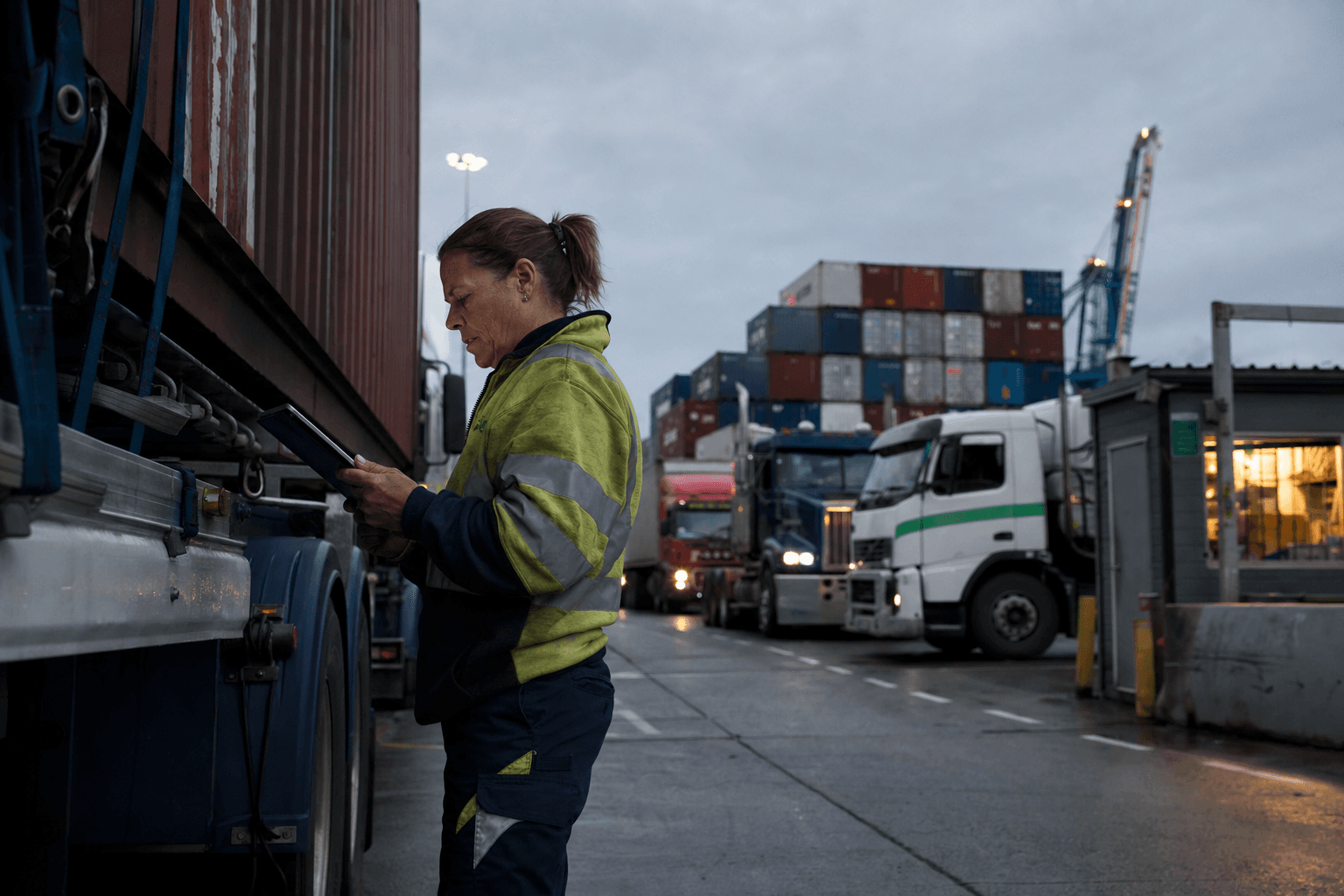
Several forces are converging at once:
- Customer requirements — Major retailers and manufacturers are demanding EDI connectivity, real-time shipment tracking, and API-based integrations as standard. Operators without these capabilities are losing tenders they would have won five years ago.
- Labour market pressure — Driver shortages and warehouse labour costs are squeezing margins. Automation and intelligent routing are moving from nice-to-have to necessary.
- Emissions reporting obligations — AASB S2 compliance logistics requirements are creating new data demands for carriers and 3PLs whose customers are listed entities or have supply chain reporting obligations under ISSB standards.
- Legacy system end-of-life — Many operators are running TMS and WMS platforms that are five to ten years old, with vendors winding down support or sunsetting products entirely.
None of these pressures is going away. The question is how to respond in a way that is measured and sustainable.
What Does Digital Transformation Actually Mean for a Logistics Operator?
Digital transformation in logistics is the process of replacing manual, paper-based, or disconnected systems with integrated digital tools that give operators real-time visibility, reduce administrative overhead, and enable data-driven decisions.
For most mid-market operators in Melbourne, this does not mean a rip-and-replace of every system. It means identifying the highest-cost manual processes and automating or augmenting them — starting with the ones that have clear, measurable payback.
Common starting points include:
- Automating document processing (PODs, BOLs, customs declarations)
- Optimising route planning and dispatch
- Capturing emissions data for Scope 3 reporting
- Improving warehouse throughput without adding headcount
Step 1: Assess Where You Actually Are
The most common mistake in logistics digital transformation is skipping the diagnostic phase and jumping straight to software selection. Operators end up buying platforms that do not match their data quality, their team's capability, or their actual workflow.
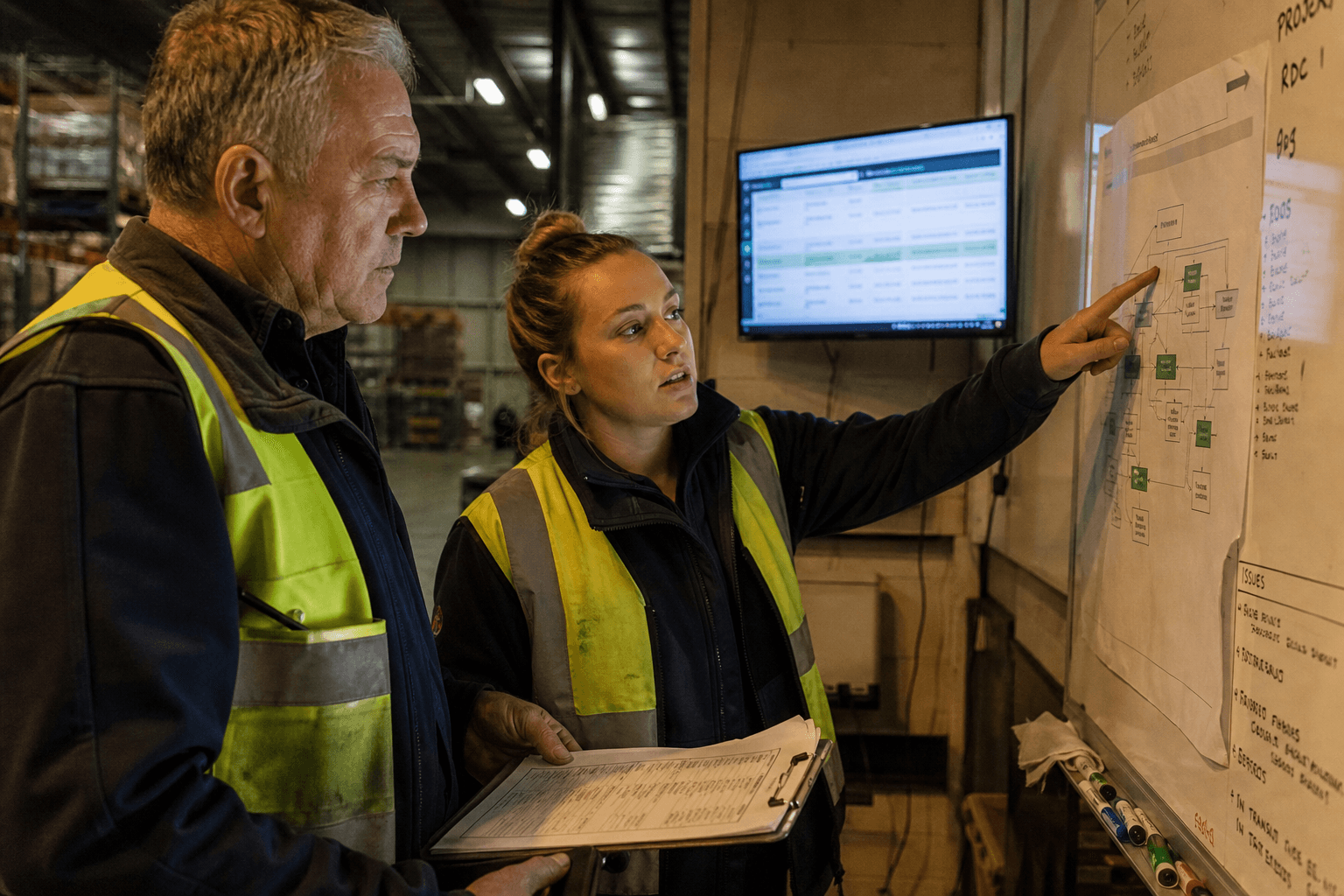
A structured AI readiness assessment maps your current systems, data flows, and operational processes before any technology decision is made. It identifies:
- Which manual processes are costing the most in labour hours or error rates
- Where your data is reliable enough to support AI or automation
- Which integrations are technically feasible with your existing TMS or WMS
- What your team's current capability and appetite for change looks like
This assessment typically takes two to four weeks and gives you a prioritised roadmap rather than a generic technology wishlist.
Step 2: Build a Technology Stack That Fits Your Operations
There is no universal technology stack for logistics. The right combination depends on your operation type, your customer mix, your existing systems, and your team's technical capacity.
That said, most Melbourne mid-market operators will need to address the following layers:
Core Systems Layer
| Layer | What It Does | Typical Gap |
|---|---|---|
| TMS | Transport planning, dispatch, carrier management | Legacy platform with no API, no real-time data |
| WMS | Inventory, pick/pack, labour management | Spreadsheet-based or basic off-the-shelf |
| ERP/Finance | Invoicing, cost allocation, P&L | Disconnected from operational systems |
Intelligence Layer (Where AI Adds Value)
Once your core systems are generating reliable data, AI and machine learning tools can be layered on top to drive decisions:
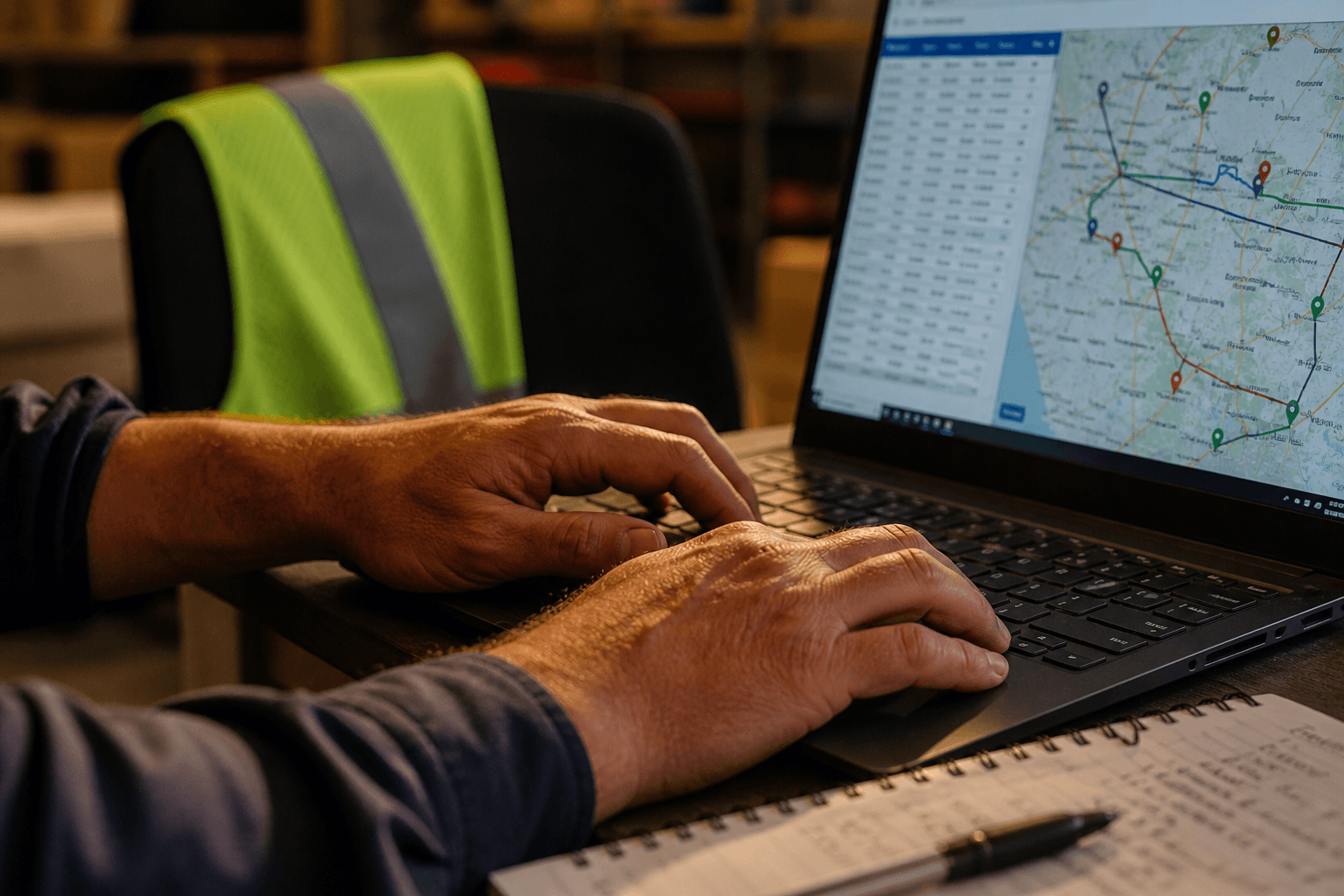
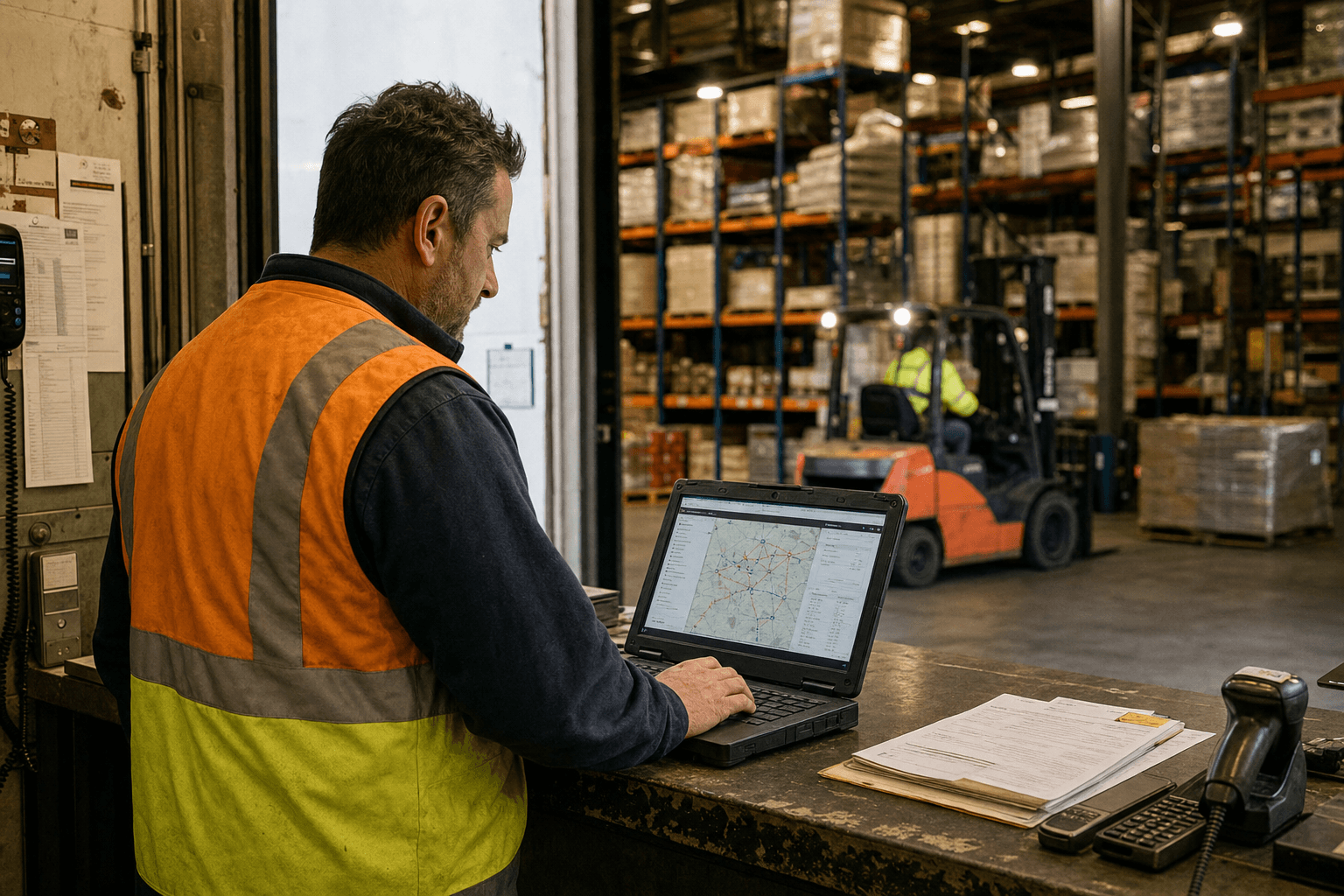
- Route optimisation — Dynamic route planning that accounts for traffic, time windows, vehicle capacity, and driver hours. For Melbourne operators running metro and regional runs, this reduces kilometres driven and improves on-time delivery rates.
- Document intelligence — Automated extraction and validation of data from PODs, BOLs, invoices, and customs documents. Reduces manual keying, speeds up billing cycles, and cuts error rates.
- Emissions tracking — Automated capture of Scope 1 and Scope 3 emissions data from fleet telematics, fuel records, and carrier data, structured for AASB S2 and NGER reporting.
- Demand forecasting — For warehouse operators, predictive models that inform labour scheduling, slot allocation, and inventory positioning.
Connectivity Layer
Modern customers expect EDI, API, and real-time tracking as standard. Building connectivity between your systems and your customers' platforms is often the single fastest way to protect and grow revenue.
Step 3: Prioritise Modules, Not a Full Platform Replacement
A full platform replacement — new TMS, new WMS, new ERP, all at once — is a high-risk, high-cost approach that most mid-market operators cannot absorb without significant disruption. It is also rarely necessary.
A modular approach targets the highest-value problem first, delivers measurable results, and builds internal confidence before the next investment.
A typical sequencing for a Melbourne freight operator might look like:
- Month 1–3: AI readiness assessment and data infrastructure baseline
- Month 3–6: Route optimisation deployed for metro fleet
- Month 6–9: Document intelligence for POD and invoice processing
- Month 9–12: Emissions data capture and Scope 3 reporting for key customers
- Year 2: Warehouse automation module or demand forecasting
This sequencing is not fixed — it depends on where your biggest operational pain sits and what your customers are asking for. The point is to build progressively rather than trying to transform everything simultaneously.
Step 4: Manage Change Before It Manages You
The most technically sound implementation will fail if your team does not understand why it is happening or how it changes their day.
Change management in logistics is straightforward, but it requires deliberate effort:
Be direct about the why. Drivers, dispatchers, and warehouse staff are not naive. If the project is about reducing costs or meeting a customer requirement, say so. People respond better to honesty than to corporate messaging about "innovation" and "digital journeys".
Involve the people closest to the work. Dispatchers know where route planning breaks down. Warehouse team leaders know which processes create the most friction. Their input shapes better implementations and their buy-in speeds adoption.
Set expectations about the transition period. New systems always have a learning curve. Productivity dips in the first few weeks are normal. Operators who plan for this avoid panic decisions to revert to old processes.
Designate internal champions. One or two people per team who understand the new system and can support colleagues informally are worth more than formal training sessions.
Step 5: Train for How People Actually Work
Staff training is frequently underfunded in technology projects. A two-hour vendor webinar is not sufficient for a dispatch team running 200 jobs a day.
Effective training for logistics operations looks like:
- Role-specific, not system-generic — Drivers need to know how the app works on their phone. Dispatchers need to know how to handle exceptions. Managers need to know what the dashboards mean. These are different training needs.
- On-the-job, not just in a classroom — Train people in the actual environment where they will use the system, during shifts, not just in a conference room.
- Ongoing, not one-off — System updates, new features, and staff turnover all require continuous training support. Build this into your operating model from the start.
- Documented in plain language — Quick reference guides, short videos, and checklists in plain Australian English. Not vendor manuals.
Step 6: Address Emissions Reporting as a Commercial Imperative
For Melbourne logistics operators, emissions reporting is no longer purely a compliance question. It is becoming a commercial one.
Major shippers — retailers, manufacturers, FMCG companies — are required to report Scope 3 emissions under AASB S2 and ISSB frameworks. Their Scope 3 includes the freight they purchase from you. If you cannot provide verified emissions data, you become a liability in their supply chain rather than an asset.
NGER reporting logistics obligations already apply to larger operators. But the AASB S2 compliance logistics timeline means mid-market carriers will face customer-driven data requests well before any regulatory threshold applies to them directly.
Building emissions data capture into your digital transformation roadmap now — rather than retrofitting it later — is significantly more efficient. Fleet telematics, fuel management systems, and carrier data are all sources that can be structured and automated with the right intelligence layer.
Competitive Positioning in the Melbourne Logistics Market
Melbourne's freight market is competitive, and the digital capability gap between operators is widening. Operators who have invested in route optimisation, real-time visibility, and emissions reporting are winning tenders that their competitors are not even shortlisted for.
The competitive advantage of digital transformation is not primarily cost reduction — though that matters. It is the ability to credibly respond to enterprise customer requirements:
- Can you provide a real-time tracking API?
- Can you report on Scope 3 emissions per shipment?
- Can you integrate with our procurement or ERP system?
- Can you demonstrate on-time delivery performance with data?
Operators who can answer yes to these questions are better positioned for long-term contracts, higher-margin accounts, and the kind of customer relationships that survive rate negotiations.
For operators thinking about positioning for acquisition or private equity investment, digital maturity is also a material factor in valuation. A business running manual processes on legacy systems carries a higher operational risk profile than one with clean data, integrated systems, and automated reporting.
What to Avoid in Your Digital Transformation
A few common pitfalls worth naming directly:
Buying software before solving the data problem. AI and automation tools are only as good as the data they run on. If your operational data is inconsistent, incomplete, or siloed, no platform will fix that — it will just fail more expensively.
Over-engineering the first phase. Start with the problem that costs the most or risks the most. Get that working before expanding scope.
Treating this as an IT project. Digital transformation in logistics is an operational project. The operations manager needs to own it, not the IT department or an external vendor.
Ignoring the integration question. Every new system needs to connect to something. Understand your integration requirements before you sign a contract.
Building a Roadmap That Reflects How Your Business Actually Runs
Every logistics operation has its own mix of customers, routes, facilities, and people. A digital transformation roadmap that works for a cold chain operator in Laverton is not the same as one for a 3PL running a shared-user facility in Dandenong South.
The roadmap has to start from your specific operational reality — not a vendor's standard implementation guide.
For more perspectives on how Melbourne and Australian logistics operators are approaching modernisation, take a look at our insights.
Getting Started
If you are a Melbourne logistics operator exploring what digital transformation looks like for your business, the most useful first step is understanding where you are starting from.
Our AI readiness assessment is designed for operations like yours — mid-market, legacy systems, real operational complexity. It gives you a clear picture of where to invest first and what the realistic payback looks like.
If you would like to talk through your situation, get in touch. No pitch, no pressure — just a straightforward conversation about what is actually feasible for your operation.
Zero Footprint
The Zero Footprint team — AI modernisation for Australian logistics.