Legacy TMS Modernisation in Australia: A Practical Guide
Legacy TMS modernisation is one of the most consequential technology decisions an Australian transport operator can make. This guide covers migration strategies, AI integration options, cost-benefit frameworks, and realistic timelines for mid-market carriers and 3PLs.

Legacy TMS Modernisation in Australia: A Practical Guide
Legacy system modernisation in logistics is one of the most consequential decisions an Australian transport operator can make. Your transport management system touches every part of the business — dispatch, compliance, invoicing, customer visibility — and when it starts failing you, the cost shows up everywhere: in manual workarounds, staff frustration, and bids you lose because you can't demonstrate the capabilities a customer requires.
This guide covers how Australian carriers and 3PLs are approaching legacy TMS modernisation in 2024 and beyond: what triggers the decision, how to evaluate migration strategies, and where AI integration fits into the picture.
What Is a Legacy TMS and When Does It Become a Problem?
A legacy TMS is any transport management system that was deployed more than five years ago, runs on-premise infrastructure, lacks open APIs, or is no longer actively developed by its vendor. Many Australian operators are running systems built in the early 2010s — or earlier — that were fit for purpose then but now sit at the centre of a web of spreadsheet workarounds and manual re-keying.
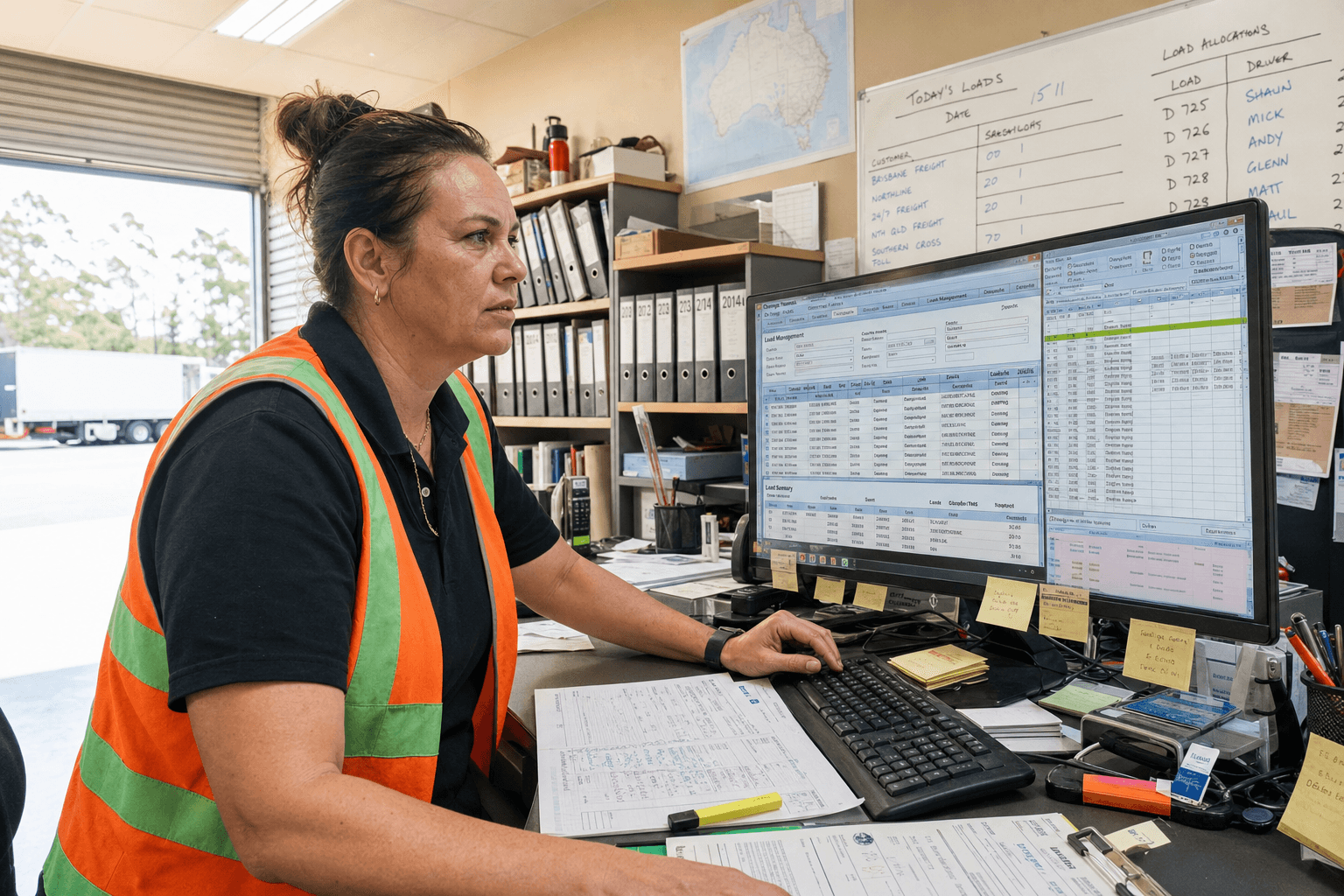
The system itself may still technically function. The problem is what it can't do:
- Real-time tracking and customer visibility portals
- API integration with customer ERP and WMS platforms
- Automated emissions data capture for AASB S2 / NGER reporting
- Dynamic route optimisation using live traffic and load data
- Digital document management (ePOD, eBOL, automated invoicing)
When your largest customer asks for an EDI connection or a real-time tracking feed and your TMS can't support it, the gap stops being an IT issue and becomes a revenue issue.
Common Triggers for Legacy TMS Modernisation in Australia
Australian logistics operators typically reach a modernisation decision point when one or more of the following occurs:
| Trigger | What It Means Operationally |
|---|---|
| Vendor end-of-life notification | No more patches, support, or development. Security risk increases. |
| Customer requiring digital capabilities | EDI, real-time tracking, API connectivity demanded in new contracts. |
| Lost tender due to technology gap | Bid scored poorly on digital maturity criteria. |
| AASB S2 / NGER reporting obligations | No automated emissions data capture; manual carbon accounting fails audit. |
| Labour cost pressure | Manual dispatch and data entry no longer economically viable. |
| M&A activity | Acquirer wants to consolidate onto a modern platform. |
| Warehouse throughput plateau | TMS/WMS integration failures are limiting fulfilment capacity. |
If two or more of these apply to your business, you are likely already past the point where incremental workarounds are the right answer.
What Are the Main TMS Migration Strategies?
There is no single right path for legacy TMS modernisation. The correct strategy depends on your current system's limitations, your integration complexity, your team's change tolerance, and your timeline.
1. Lift and Shift to Modern SaaS TMS
This approach replaces your legacy system with a contemporary cloud-based TMS platform. It is the fastest path to modern functionality and removes on-premise infrastructure overhead. The trade-off is that off-the-shelf SaaS platforms are designed around generalised workflows — they may not reflect how your business actually runs without significant configuration or custom development.
Best suited to: Operators with relatively standard freight workflows, small IT teams, and a clear vendor end-of-life forcing function.
2. Modular Augmentation (Extend, Don't Replace)
This strategy keeps your existing TMS as the core record system and layers purpose-built modules on top of it via API or middleware. You might add an AI-powered route optimisation layer, a document intelligence module for automated POD processing, or an emissions intelligence platform — without ripping out the system your dispatchers already know.
Best suited to: Operators where the core TMS data is reasonably clean, workflows are stable, and the gaps are specific and well-defined.
3. Phased Replacement
A phased approach migrates functionality lane by lane, depot by depot, or module by module over 12–24 months. It reduces operational risk by avoiding a single big-bang cutover and allows lessons from early phases to improve later ones. It requires more project discipline and longer elapsed time.
Best suited to: Multi-site operators, those with complex integrations, or businesses where continuous operation cannot tolerate significant downtime.
4. Custom Build on Modern Infrastructure
Some operators with genuinely unusual workflows — specialised cold chain operations, project logistics, niche intermodal configurations — find that no commercial TMS adequately supports their model. In these cases, a purpose-built system on modern cloud infrastructure may be the right call. This carries the highest upfront cost and longest build time but delivers precise fit.
Best suited to: Operators where the operational model is the competitive advantage and commercial platforms require too many compromises.
How Does AI Integration Fit Into TMS Modernisation?
AI in logistics is not a separate project that happens after your TMS is modernised. The two are connected — and the modernisation process is often the right moment to design AI capability in from the start.
Here is where AI adds practical value in a modernised TMS environment:
Route Optimisation
AI-powered route optimisation uses real-time traffic data, driver hours, vehicle capacity, and customer time windows to dynamically generate optimal run sheets. Static routing logic in legacy systems typically cannot respond to day-of changes — AI-based routing can reoptimise within minutes when a vehicle goes off-road or a new urgent pickup is added.
Document Intelligence
Document intelligence automates the extraction and processing of freight documents — PODs, invoices, CMRs, customs declarations — reducing manual data entry and accelerating billing cycles. In a modernised TMS environment, this means documents flow from field to finance without human handling at each step.
Emissions Intelligence
With AASB S2 and NGER reporting obligations now affecting a broader range of Australian transport operators, automated emissions data capture is increasingly non-negotiable. A modern TMS that captures telematics, fuel, and load data creates the foundation for accurate Scope 3 emissions reporting. Our emissions reporting module is designed to connect directly to this data layer.
Predictive Maintenance and Fleet Utilisation
AI models trained on telematics and service history data can flag vehicles approaching maintenance thresholds before breakdowns occur. This reduces unplanned downtime and improves fleet utilisation — both direct cost levers.
Cost-Benefit Framework: How to Assess the Investment
The financial case for legacy TMS modernisation is rarely simple. Costs are visible upfront; benefits accumulate over time and are sometimes hard to attribute. Here is a practical framework for building the business case.
Direct Cost Inputs
- Software licensing or development costs (one-off and recurring)
- Implementation and integration services
- Data migration and cleansing
- Training and change management
- Parallel running costs during transition
Benefit Categories to Quantify
| Benefit Category | How to Measure It |
|---|---|
| Labour reduction in dispatch and data entry | Hours per week × fully loaded cost |
| Fuel and kilometres saved through route optimisation | Fleet fuel spend × estimated reduction % (use conservative estimates from your own trial) |
| Reduction in billing cycle time | Days to invoice × financing cost of working capital |
| Compliance risk reduction | Cost of potential audit findings, penalties, or lost contracts |
| New contract wins enabled by digital capability | Estimated annual revenue × win rate improvement |
| Reduced IT infrastructure and support costs | On-premise hosting and maintenance vs. SaaS subscription |
A defensible business case uses conservative estimates and a 3–5 year payback horizon. If the numbers only work under optimistic assumptions, that is a flag to revisit scope or sequencing.
What Australian Operators Often Underestimate
- Data quality work. Most legacy TMS migrations uncover data issues that require significant cleansing effort before the new system can be trusted.
- Integration complexity. Connecting to customer ERPs, telematics platforms, and government portals takes longer and costs more than initial estimates typically allow.
- Change management. Dispatcher and driver adoption determines whether the investment pays off. Technology without behaviour change delivers a fraction of the expected value.
What Does a Realistic Migration Timeline Look Like?
For a mid-market Australian carrier (50–200 vehicles, 2–5 depots), a modular augmentation or phased replacement typically runs across the following phases:
Phase 1 — Assessment and architecture (4–8 weeks) Document current state, map data flows, identify integration points, define future-state requirements. This is where a structured AI readiness assessment pays for itself — it surfaces the issues that would otherwise derail implementation.
Phase 2 — Foundation build (8–16 weeks) Core TMS configuration or custom module development. Integration with telematics, WMS, and finance systems. Data migration and cleansing.
Phase 3 — Pilot deployment (4–8 weeks) Run the new system in parallel at one depot or on one lane. Validate data quality, resolve integration issues, and collect dispatcher feedback.
Phase 4 — Full rollout and optimisation (8–16 weeks) Deploy across remaining depots. Embed AI modules. Refine routing models, document workflows, and reporting dashboards.
Total elapsed time for a project of this scale typically runs 9–18 months depending on complexity and internal resourcing. Operators who try to compress this timeline by skipping the assessment or parallel-run phases tend to pay for it later.
Questions to Ask Before You Start
Before committing to a modernisation approach, operations leaders should be able to answer the following:
- What does our current TMS data quality look like? Can we trust the records that will migrate?
- Which integrations are business-critical and which are nice-to-have?
- What is the real cost of staying on the current system for another 12–24 months?
- Do we have the internal project capacity to drive this, or do we need an implementation partner?
- What does the vendor's development roadmap look like, and does it match our direction?
- How will we measure success at 6, 12, and 24 months post-implementation?
If any of these questions produce a blank look from the team, that is a signal that the assessment phase needs to happen before any vendor conversations begin.
How Zero Footprint Approaches Legacy TMS Modernisation
We work with Australian carriers, 3PLs, and warehouse operators who are navigating legacy modernisation without a large internal IT team. Our approach starts with understanding how your operation actually runs — not how a software vendor thinks it should — before recommending a migration path.
Every engagement begins with an AI readiness assessment that maps your current data environment, integration landscape, and operational workflows. From there, we design and build the components your business needs — whether that is modular AI augmentation on top of an existing TMS, a phased replacement, or purpose-built tooling for a specialised operation.
We do not sell platforms. We build solutions that fit your freight.
For more on how we work and other topics relevant to Australian logistics operators, visit our insights.
If you are working through a legacy TMS decision — or have already started and run into complexity — get in touch. We can walk through your current environment and help you work out what the right path forward looks like.
Zero Footprint
The Zero Footprint team — AI modernisation for Australian logistics.