From 12 Minutes to 90 Seconds: Automated Customs Processing
A customs broker processing 800+ declarations per week cut processing time from 12 minutes to 90 seconds per declaration. Here's exactly how automated customs processing works.
12 Minutes Per Declaration, 800 Times Per Week
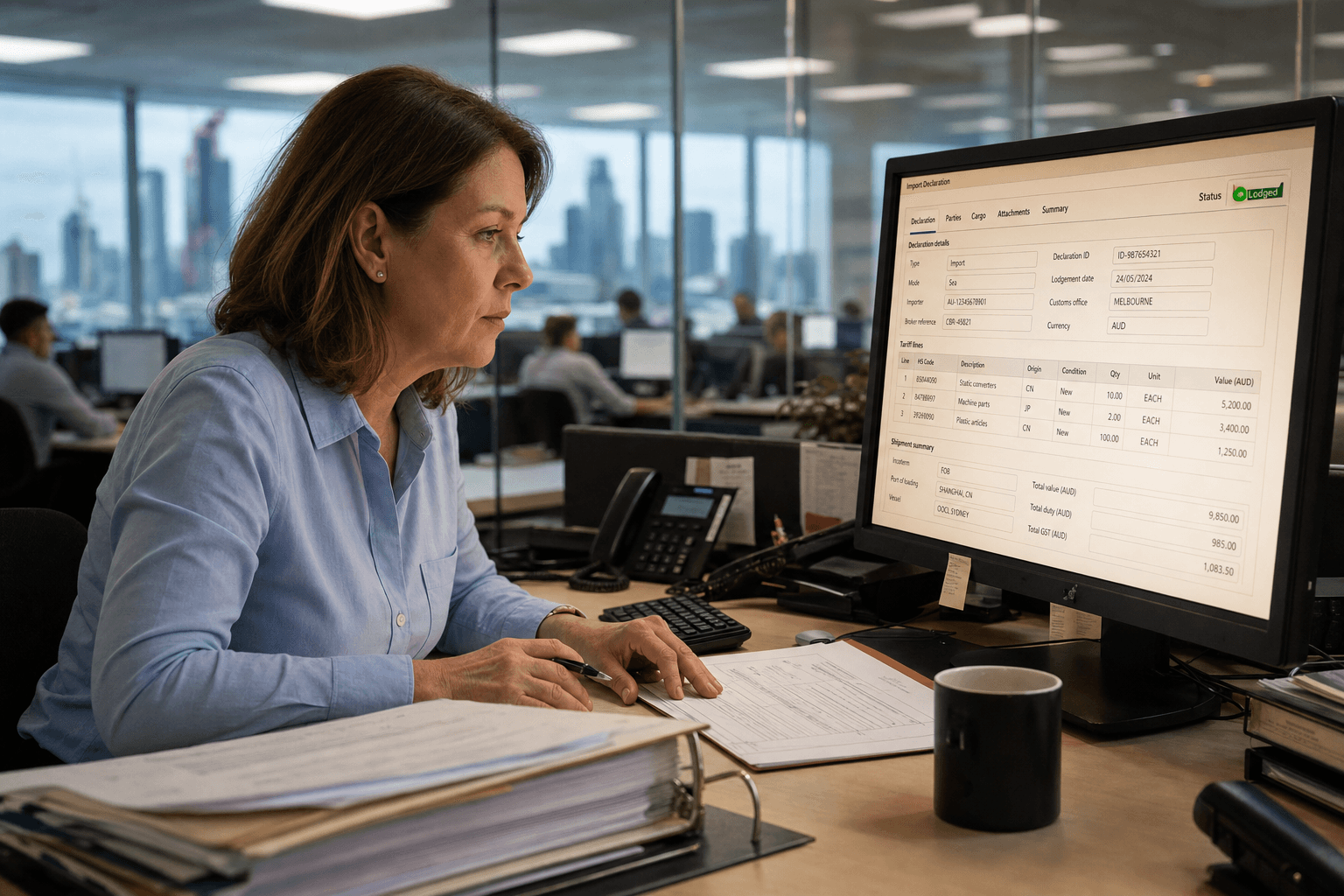
A customs broker in Melbourne processes over 800 import declarations per week. Each declaration requires reading a stack of documents — commercial invoice, packing list, bill of lading, certificate of origin — extracting dozens of data points, classifying goods against the tariff schedule, and lodging electronically with the Australian Border Force.

Their experienced staff could process a straightforward declaration in 12 minutes. Complex ones took 25-30 minutes. With 800+ per week, they needed 15 full-time staff just to keep up. During peak periods (pre-Christmas, end of financial year), they'd fall behind, incurring storage charges for cargo sitting at the wharf.
The Automation Project
What We Built
An automated customs processing pipeline that handles the entire workflow from document receipt to ABF lodgement:
Document intake: Commercial invoices, packing lists, BOLs, and certificates arrive via email from importers and freight forwarders. The system watches designated inboxes and processes attachments automatically.
Document classification: AI identifies each document type and links related documents to the same shipment. A commercial invoice, packing list, and BOL arriving in three separate emails at different times are automatically grouped.
Data extraction: Key fields are extracted from each document:
- Commercial invoice: supplier, buyer, goods description, quantity, value, currency, Incoterms
- Packing list: package count, weights (gross/net), dimensions, marks and numbers
- Bill of lading: vessel, voyage, port of loading/discharge, container numbers
- Certificate of origin: country of origin, preference claim
Tariff classification: This is the hardest part. The system suggests tariff codes based on goods descriptions, using a combination of historical classification data and AI text analysis. For commonly imported goods (where the broker has classified the same or similar items before), accuracy exceeds 95%. For novel goods, the system provides top-3 suggestions with confidence scores.
Validation and compliance: Extracted data is checked against ABF requirements, sanction lists, and import permit requirements. Missing information or compliance flags are raised before lodgement.
Lodgement preparation: The system formats data for ICS (Integrated Cargo System) lodgement, including all required fields, tariff classifications, and duty calculations.
Human review: A qualified customs broker reviews the prepared declaration on screen, makes any corrections, and approves for lodgement. For straightforward declarations, this review takes 60-90 seconds. The broker's expertise is focused on exceptions and complex classifications, not data entry.
What Changed
| Metric | Before | After |
|---|---|---|
| Average processing time | 12 minutes | 90 seconds (review) |
| Staff required | 15 | 6 |
| Throughput capacity | 800/week (at limit) | 2,000+/week |
| Data entry errors | 3-4% | <0.5% |
| Tariff classification accuracy | 98% (human) | 95% (auto) + human review |
| Peak period delays | Regular | Eliminated |
The Numbers
Annual labour saving: 9 fewer staff × $65,000 loaded cost = $585,000/year
Error reduction: Fewer ABF queries, fewer amended declarations, fewer penalty risks. Estimated saving: $40,000/year
Capacity increase: Can handle 150% more volume without hiring. Revenue growth enabled without proportional cost growth.
Peak period performance: No more cargo sitting at the wharf because the team can't process fast enough. Estimated storage charge saving: $60,000/year
Total annual benefit: ~$685,000 against a one-time implementation cost of $120,000 and annual running cost of $25,000.
How Tariff Classification Works
Tariff classification is where most customs automation projects succeed or fail. The Australian Harmonised Tariff has 8,000+ line items, and classifying goods correctly requires understanding both the goods and the tariff rules.
The Approach
Historical matching: For goods the broker has classified before, the system finds the most similar historical classification. If the broker classified "polyester fabric, printed, width >150cm" as 5407.52 last month, the same goods from a different supplier get the same suggestion.
AI text analysis: For goods without an exact historical match, the system analyses the description against tariff heading notes and section rules. It considers:
- What the goods are made of (material composition)
- What the goods are used for (end use)
- How the goods are presented (form, packaging)
Confidence scoring: Each suggestion comes with a confidence score. High confidence (>90%): the broker sees a green indicator and typically approves in seconds. Medium confidence (70-90%): yellow indicator, broker reviews the suggestion and alternatives. Low confidence (<70%): red indicator, broker classifies manually with the system's suggestions as a starting point.
Learning loop: Every human correction improves the model. After 6 months of operation, the system had seen enough corrections to push overall classification accuracy from 92% to 96%.
The Broker's Role Changes
This is important: automation doesn't replace customs brokers. It changes what they do.

Before: 80% of a broker's time was data entry and straightforward classifications. 20% was complex work — tariff disputes, compliance issues, trade agreement analysis.
After: Brokers spend nearly all their time on complex, high-value work. They review automated declarations (90 seconds each), focus on difficult classifications, handle ABF queries, and advise clients on compliance strategy.
The result: brokers are more engaged (no more mindless data entry), clients get better advice (brokers have time for it), and the business handles more volume without more staff.
Document intelligence systems can extract data from invoices, packing lists, and certificates of origin in seconds, eliminating manual data entry. Our document intelligence solutions handle complex trade documents with high accuracy, while custom AI systems can be tailored to specific customs workflows and compliance requirements.
Getting Started
If you're a customs broker or freight forwarder considering automation:
- Start with your highest-volume, most repetitive document type — usually commercial invoices for import declarations
- Measure your current baseline — time per declaration, error rate, staff hours
- Expect a 3-month ramp — accuracy improves as the system learns your specific goods and tariff patterns
- Keep your experienced brokers — they become reviewers and exception handlers, not data entry operators
The technology is mature enough for production use today. The question is whether you're ready to change the workflow.
Discuss customs automation for your operation →
Ready to automate your customs processing workflows? We help businesses implement document intelligence and automation systems that deliver measurable time savings. Contact us to discuss how we can streamline your customs operations.
Zero Footprint
The Zero Footprint team — AI modernisation for Australian logistics.