Recovering Demurrage and Detention Costs With AI
Demurrage and detention charges are among the most commonly missed revenue recovery items in freight forwarding, largely because the evidence needed to dispute them is scattered across systems. AI-driven document capture and contract-term matching can close that gap before dispute windows close.
Freight forwarders handle hundreds of container movements a month, and buried inside those movements are demurrage and detention charges that are often wrongly billed, disputed late, or never queried at all. This is one of the more persistent forms of revenue leakage in logistics — not because the charges are complicated, but because the paperwork needed to prove or disprove them is scattered across emails, PDFs, and container tracking portals that don't talk to each other. AI-driven document capture and contract-term matching is changing how forwarders approach this problem, turning a manual, reactive process into something closer to continuous monitoring.
What Are Demurrage and Detention Charges?
Demurrage is a fee a shipping line charges for keeping a container at the port or terminal beyond the agreed free time. Detention is a separate fee charged when a container is kept outside the terminal — at a customer's warehouse or depot, for example — beyond its allotted free period. Both are governed by free-time terms set out in the carrier's tariff or the specific service contract, and both are routinely disputed in container shipping because free-time windows, public holidays, and exemption clauses vary by carrier, port, and contract.
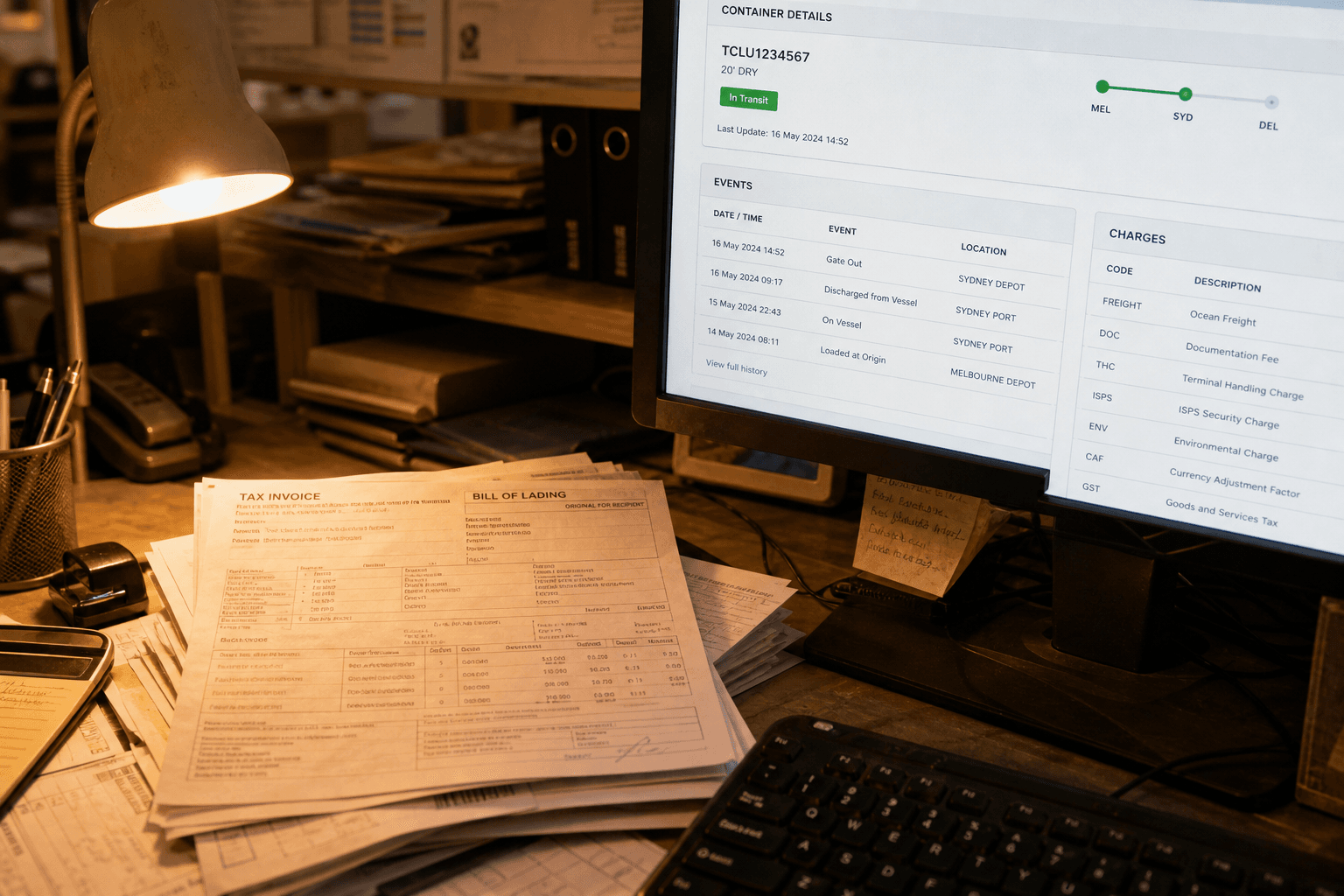
For Australian freight forwarders moving containers through ports like Melbourne, Botany, or Brisbane, the free-time clock starts and stops based on events recorded in multiple systems: vessel discharge, gate-in/gate-out scans, empty return receipts, and customer pickup confirmations. If any one of those timestamps is missing, delayed, or inconsistent with the carrier's own records, a charge that should be waived often isn't — and a charge that should be billed back to a customer is missed entirely.
Why Do Freight Forwarders Miss Recoverable Charges?
Most missed recoveries come down to one thing: the data needed to evidence a dispute is harder to assemble than the time allowed to raise it. Carrier invoices, container tracking events, and contract terms typically sit in different formats and different systems, and matching them manually under a tight dispute window is slow, error-prone, and easy to deprioritise when operations teams are under pressure.
This is a symptom of a broader issue across the logistics sector: many mid-market operators are still running legacy transport management systems that were never built for real-time event capture or cross-system reconciliation. These systems tend to produce exactly the kind of fragmented, inconsistent data that makes demurrage and detention disputes hard to evidence — invoices land in one inbox, gate events sit in a terminal portal, and the contract terms that actually determine what's owed are filed away in a shared drive. The result is a reconciliation process that depends on someone remembering to check, rather than a system designed to flag discrepancies automatically.
How Does AI Improve Demurrage and Detention Recovery?
AI document intelligence addresses this by extracting structured data — container numbers, dates, charge codes, free-time clauses — from carrier invoices, bills of lading, and contracts, regardless of format, and matching it automatically against the applicable free-time terms. Instead of a person manually cross-referencing a PDF invoice against a contract clause, the system flags the discrepancy and assembles the supporting evidence for a dispute in one step.
The practical value isn't that AI invents new recovery opportunities — it's that it closes the gap between when a disputable charge arrives and when someone has time to notice it. That matters because most carriers impose short windows for raising demurrage and detention disputes, and charges that aren't queried within that window are generally treated as accepted. Our work on document intelligence for logistics operators focuses on exactly this kind of structured extraction and matching — pulling the right fields out of unstructured documents and routing them into a workflow someone can act on before the dispute window closes.
Manual Reconciliation vs AI-Assisted Recovery
The comparison below is qualitative rather than based on invented percentages, since actual recovery rates vary significantly by carrier mix, contract terms, and volume.
| Factor | Manual Reconciliation | AI-Assisted Recovery |
|---|---|---|
| Invoice and contract matching | Manual, ad hoc, often skipped under time pressure | Automated extraction and matching against contract terms |
| Dispute window management | Relies on staff noticing charges in time | Flags disputable charges as they arrive |
| Evidence assembly | Compiled manually per dispute | Assembled automatically from linked source documents |
| Audit trail | Inconsistent, email-based | Structured, traceable record of every decision |
| Scalability across carriers | Limited by staff capacity | Consistent regardless of volume |
What Does an AI-Enabled Recovery Workflow Look Like?
A practical workflow starts with capturing every carrier invoice, container event, and relevant contract clause in one structured system, then automatically comparing billed charges against the free-time terms that actually apply. Exceptions — a charge that falls outside agreed free time, or one missing a supporting event — are routed to the right person with the evidence already attached, rather than left for someone to dig up later.
This doesn't require ripping out existing TMS or carrier portals. In most cases, AI can be layered on top of the systems a forwarder already uses, handling the extraction, normalisation, and matching work without a full platform replacement. That's a meaningful distinction for operators who've been burned by long, disruptive system overhauls in the past — the goal is to fix the data problem, not force a change of core systems.
Where Does This Fit Into Broader Operations Modernisation?
Demurrage and detention recovery is rarely a standalone project — it usually surfaces as one symptom of a wider data visibility problem that also affects customer reporting, cost allocation, and compliance obligations. Forwarders evaluating this kind of automation are often also looking at how their legacy systems handle event data more broadly, which is where a structured readiness review helps before committing to any specific build.
If you're assessing where AI can realistically plug into your existing systems — whether that's charge recovery, document processing, or operational reporting — an AI Readiness Assessment is a practical starting point. It maps your current data flows and flags the highest-value, lowest-disruption places to start. You can also browse our insights for more on how AI is being applied across Australian logistics operations.
If you're exploring how to reduce revenue leakage from demurrage and detention charges, we can help assess whether your current systems are set up to catch them.
Zero Footprint
The Zero Footprint team — AI modernisation for Australian logistics.