Fixing Master Data Before AI Adoption in Freight Networks
Duplicate customer records, inconsistent addresses and mismatched rate codes quietly undermine AI, route optimisation and emissions reporting across multi-depot freight networks. Here's a practical approach to fixing master data before building any AI module.

Most mid-market carriers and 3PLs don't have an AI problem — they have a data problem wearing an AI costume. Before any route optimisation engine, emissions calculator or document intelligence tool can deliver reliable output, the underlying master data has to be trustworthy. In multi-depot networks running legacy TMS/WMS platforms, that's rarely the case.
This matters because AI models are only as good as the records they're built on. Duplicate customer accounts, inconsistent depot and site codes, mismatched rate tables, and addresses that don't match between systems all quietly corrupt the calculations AI is meant to improve. Fixing this isn't glamorous work, but it's the work that determines whether an AI initiative succeeds or quietly fails six months after go-live.
What is master data in a freight and logistics context?
Master data is the core set of reference records a logistics business depends on to run operations — customer accounts, depot/site codes, vehicle and asset identifiers, rate cards, consignment and BOL numbering conventions, and address records. It sits underneath every transaction: every booking, every dispatch, every invoice. When master data is wrong, every transaction built on top of it inherits the error.
In a single-depot business, master data problems are usually visible and self-correcting — someone notices a duplicate customer and merges it. In a multi-depot network, the same customer might be entered three different ways across three different sites, each with its own historical quirks, and nobody owns the reconciliation.
Why does poor master data undermine AI readiness in logistics?
Poor master data undermines AI because models trained or run on fragmented records produce outputs that look precise but are quietly wrong — a route optimisation engine that doesn't recognise two addresses as the same site, or an emissions calculator that double-counts a shipment because it exists as two separate consignment records. The AI isn't broken; the inputs are.

This is the core reason an ai-readiness-assessment starts with data, not algorithms. You can build a sophisticated model, but if it's fed duplicate customer records or inconsistent rate codes, the business case collapses the first time someone cross-checks the output against what they know to be true on the ground.
What are the common master data problems in multi-depot networks?
The most common issues are duplicate customer records created across depots, inconsistent address formatting between booking and delivery systems, mismatched rate codes for the same customer or lane, and depot/site codes that don't align between the TMS, WMS and finance systems. Each of these compounds the others.
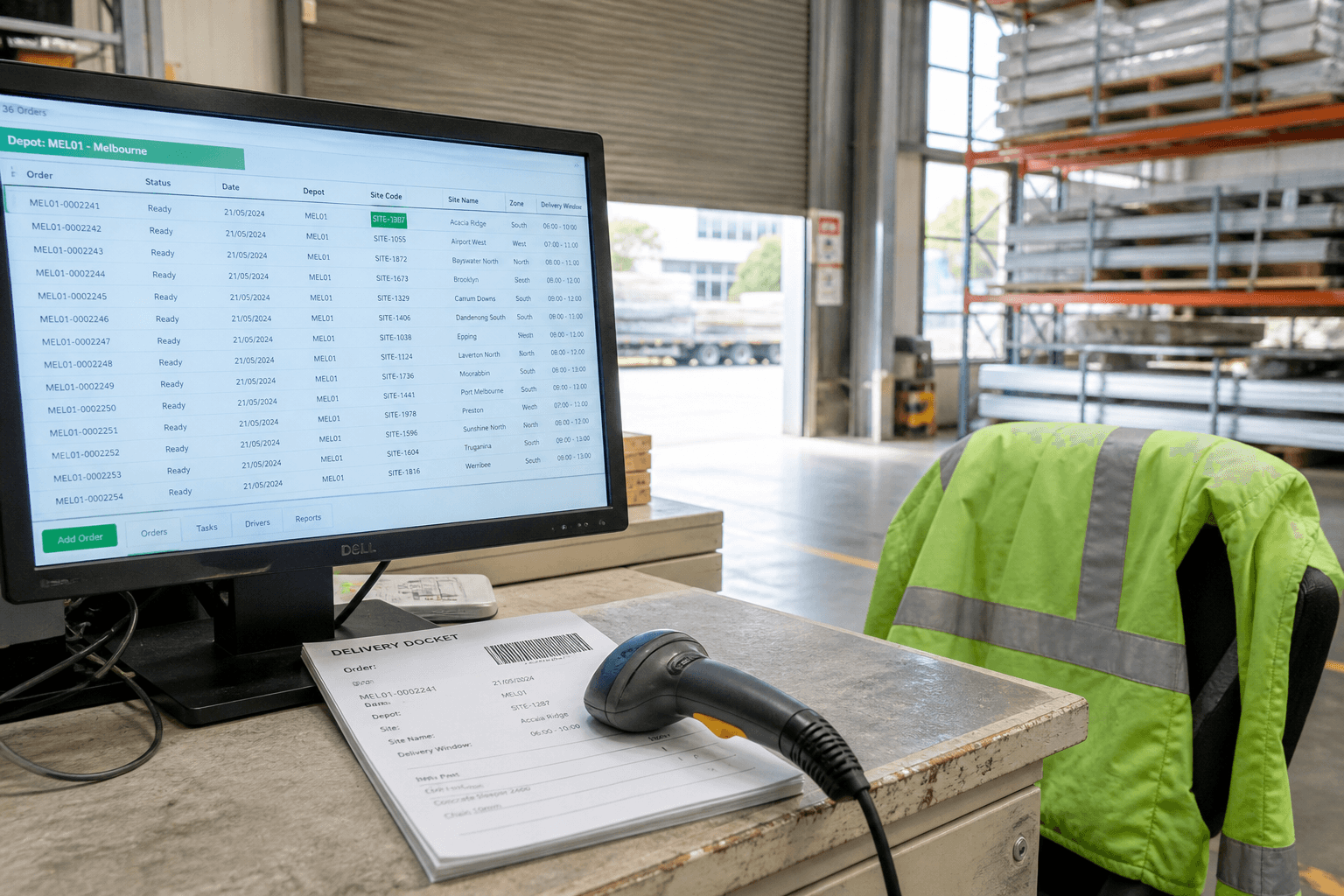
Specific patterns we see repeatedly in Australian mid-market freight and 3PL operations:
- Duplicate customer records: the same customer onboarded separately at each depot, sometimes under slightly different trading names, with no shared customer ID across the network.
- Inconsistent addresses: delivery addresses entered freeform by dispatchers, with no standardisation against a validated address database (Australia Post's PAF, for example), making it impossible for a route optimisation engine to reliably geocode every stop.
- Mismatched rate codes: the same lane or customer attracting different rate codes depending on which depot processed the booking, which distorts cost-per-shipment analysis and any AI model trying to learn from historical pricing.
- Divergent site/depot codes: a depot referred to by one code in the TMS, another in the WMS, and a third in finance reporting — a problem that becomes critical when trying to produce a consolidated Scope 3 emissions figure across the network.
- Inconsistent consignment/BOL numbering: different numbering conventions across depots make it hard to reconcile a single shipment's full journey, undermining both operational visibility and audit trails.
How does master data quality affect Scope 3 emissions and AASB S2 reporting?
Master data quality directly determines whether Scope 3 emissions calculations are defensible under audit. If a shipment exists as two separate records across depots, emissions may be double-counted; if depot and vehicle identifiers don't reconcile with fuel and telematics data, the underlying activity data used for emissions reporting is unreliable from the start.
For finance teams preparing for AASB S2 and NGER reporting obligations, this is not a minor technical detail — it's an audit risk. The Clean Energy Regulator and the Australian Accounting Standards Board expect emissions disclosures to be traceable to source data. Fragmented master data makes that traceability difficult to demonstrate. Our emissions-reporting work with carriers typically starts by reconciling exactly this kind of record-level inconsistency before any emissions figure is finalised.
Fragmented versus standardised master data: a practical comparison
| Dimension | Fragmented (typical legacy state) | Standardised (AI-ready state) |
|---|---|---|
| Customer records | Duplicated per depot, no shared ID | Single customer ID across all depots and systems |
| Addresses | Freeform text, inconsistent formatting | Validated against a standard address database |
| Rate codes | Vary by depot for the same lane/customer | Centralised rate table, depot-agnostic |
| Depot/site codes | Different codes across TMS, WMS, finance | Common code set mapped across all systems |
| Consignment/BOL numbering | Inconsistent conventions per depot | Unified numbering with full shipment traceability |
| Route optimisation output | Unreliable geocoding, duplicate stops | Accurate stop sequencing and lane analysis |
| Emissions reporting | Risk of double-counting, weak audit trail | Traceable activity data, audit-ready |
This isn't a before/after built on invented percentages — it's a description of the structural difference between data that AI can use reliably and data that will quietly undermine it.
What does a practical data-cleaning approach look like before building an AI module?
A practical approach starts with an audit of every system of record, followed by deduplication, standardisation against a single reference structure, and validation against real operational use cases — not a one-off cleanup, but a repeatable process the business can sustain.
In practice, this typically runs in four stages:
- Audit and map: Identify every system touching customer, address, rate and depot data — TMS, WMS, finance, telematics — and map how each represents the same real-world entity differently.
- Deduplicate and standardise: Merge duplicate customer and vehicle records, apply a consistent address standard, and agree a single depot/site code structure across the network.
- Govern: Assign ownership for ongoing data quality — who approves a new customer record, who maintains the rate table, who reconciles new depot codes. Without this, the cleanup degrades within months.
- Validate against use cases: Test the cleaned data against the actual AI use case — run a sample route optimisation or emissions calculation and check the output against what operations and finance teams know to be true.
This sequencing matters. Businesses that skip straight to building a model on uncleaned data tend to discover the problem only once the output is already being used for customer commitments or compliance reporting — a much more expensive point to find out.
When should data cleaning happen relative to AI module builds?
Data cleaning should happen before or alongside the first AI module build, not after. Attempting to layer route-optimisation or document-intelligence tools (for consignment note and BOL reconciliation, for example) onto unreconciled master data generally means rebuilding the data layer later anyway — at a higher cost, with less trust from the operations team who've already seen the model get it wrong once.```
This is also why document intelligence tools, which extract and reconcile data from consignment notes, BOLs and invoices, are often a practical entry point: they expose exactly where master data is inconsistent across depots, because mismatches surface automatically during extraction and matching.
How does Zero Footprint approach master data remediation?
We treat master data remediation as the first deliverable of any engagement, not a side effect of it. Our ai-readiness-assessment is built around this: a structured review of how customer, address, rate and depot data actually looks across your systems, followed by a practical remediation plan sequenced against the AI use case you actually care about — whether that's route optimisation, emissions reporting, or warehouse throughput.
We don't start with the model. We start with whether the data underneath it can be trusted by the people who'll have to defend its output — to a customer, an auditor, or your own operations team. You can read more approaches like this on our insights page.
If you're exploring how clean, consistent master data could support AI adoption across your depot network, get in touch — we're happy to talk through what a readiness assessment would look like for your systems.
Zero Footprint
The Zero Footprint team — AI modernisation for Australian logistics.