AI Fleet Replacement Planning for Ageing Truck Fleets
Replacing an ageing truck fleet is a capital decision, not a gut call. This guide walks through how AI-driven TCO modelling, NHVR compliance windows, and emissions targets combine to inform smarter fleet renewal timing.
Deciding when to replace an ageing truck is one of the biggest capital calls an operations leader makes — and one of the easiest to get wrong. Replace too early and you waste residual asset value. Replace too late and rising maintenance costs, compliance risk, and emissions exposure quietly erode your margin. This guide sets out a practical, AI-informed approach to fleet capital replacement planning for Australian carriers and 3PLs running ageing fleets.
What is AI-assisted fleet capital replacement planning?
Fleet capital replacement planning is the process of deciding when to retire, refinance, or replace vehicles based on their total cost of ownership over time, rather than a fixed age or odometer trigger. AI-assisted planning adds structured, data-driven forecasting — pulling together maintenance history, fuel and emissions data, utilisation patterns, and compliance deadlines into a single model that estimates the point at which a vehicle's running cost outweighs the cost of replacing it. The output isn't a single number — it's a range of scenarios an operations leader or CFO can weigh against cash flow and market conditions.
This is distinct from predictive maintenance, which forecasts when a component is likely to fail. Capital replacement planning asks a different question: at what point does keeping this vehicle in the fleet stop making financial sense at all?
When should you replace an ageing truck?
There is no universal age or kilometre threshold that applies across all fleets — the right answer depends on duty cycle, route profile, maintenance spend trajectory, and what the vehicle is actually being asked to do. A truck running short metro last-mile routes wears differently to one doing long-haul linehaul work, and a model that treats them the same will mislead you.
What an AI-driven model can do is flag the inflection point — the point where maintenance cost per kilometre, downtime frequency, and fuel efficiency start trending against the vehicle faster than the fleet average. Rather than replacing on a blanket cycle (say, every seven years regardless of condition), operators can sequence renewal decisions vehicle-by-vehicle, prioritising the assets that are actually dragging on performance.
How does total cost of ownership modelling work for truck fleets?
Total cost of ownership (TCO) modelling is the practice of estimating every material cost associated with owning and operating a vehicle over its service life — acquisition cost, finance cost, fuel, maintenance and repairs, downtime, insurance, residual value, and compliance cost — and comparing that against the TCO profile of a replacement asset. For an ageing fleet, the model typically shows maintenance and downtime costs climbing as a share of total spend, while fuel efficiency and residual value decline.
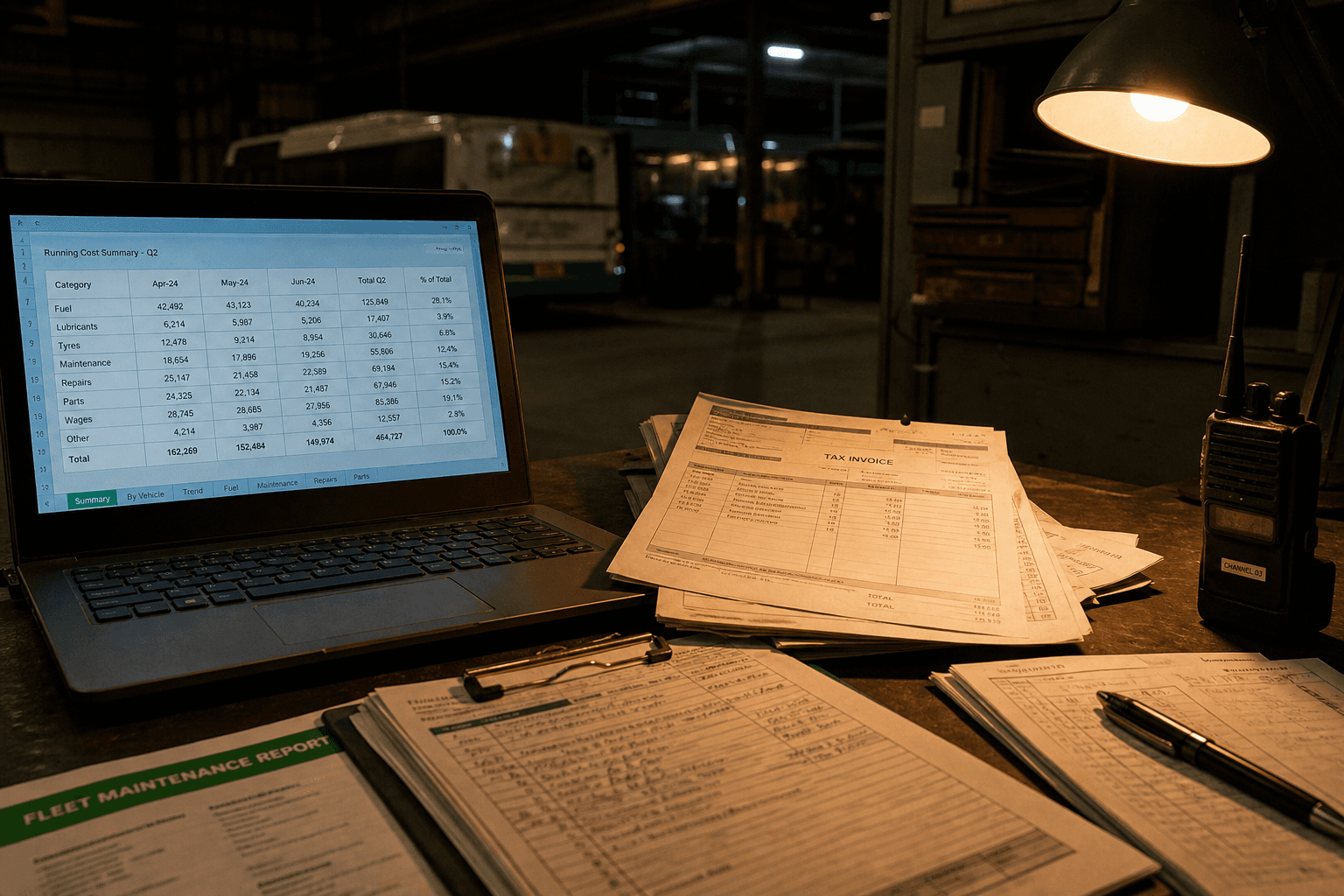
An AI-assisted version of this model ingests maintenance invoices, telematics and fuel data, and workshop records on an ongoing basis rather than relying on an annual manual review. This matters because manual TCO reviews tend to lag — by the time a spreadsheet review surfaces a problem fleet, the cost has often already been absorbed for a full budget cycle. Document intelligence tools that extract structured data from maintenance invoices and workshop job cards can feed this kind of model without requiring a parallel data-entry exercise.
| Approach | Traditional fixed-cycle replacement | AI-informed TCO modelling |
|---|---|---|
| Replacement trigger | Fixed age or km threshold | Cost and performance inflection point, per vehicle |
| Data inputs | Odometer, rough maintenance log | Maintenance spend trend, fuel/emissions data, utilisation, compliance windows |
| Review frequency | Annual budget cycle | Continuous or quarterly |
| Compliance visibility | Reactive — surfaces at audit or inspection | Forward-looking, tied to known regulatory dates |
| Emissions reporting input | Manual estimate | Structured data feed for Scope 1/3 reporting |
How do NHVR compliance windows affect replacement timing?
Heavy vehicle compliance obligations under the Heavy Vehicle National Law, administered by the National Heavy Vehicle Regulator (NHVR), add real deadlines to what might otherwise be a purely financial decision. Mass, dimension, and maintenance management accreditation schemes, roadworthiness inspection cycles, and any upcoming changes to vehicle standards can all shift the economics of keeping an older vehicle on the road. A truck that's due for a significant compliance-driven overhaul — a brake system upgrade, for example, or an inspection failure requiring substantial rectification — is a strong candidate for replacement rather than repair, and a capital planning model should treat known NHVR dates as explicit inputs, not afterthoughts.
Operators should check current requirements directly via the NHVR (nhvr.gov.au), since compliance obligations and inspection regimes are periodically updated.
How do emissions targets factor into fleet renewal decisions?
Emissions reporting obligations are increasingly a genuine input into replacement timing, not just a compliance afterthought. For larger operators, AASB S2 climate-related disclosure requirements (aligned with the International Sustainability Standards Board framework) are bringing forward the need to quantify Scope 1 and Scope 3 emissions with an auditable trail — and an ageing, fuel-inefficient fleet is a direct contributor to that number. Separately, National Greenhouse and Energy Reporting (NGER) obligations, administered by the Clean Energy Regulator, already require many transport operators to report fuel and energy use annually.
A fleet renewal model that incorporates emissions data lets an operator see, vehicle by vehicle, how much of its reported footprint is attributable to older, less efficient assets — and model the emissions impact of a renewal decision alongside the financial one. This is where fleet capital planning and emissions reporting genuinely intersect: the same underlying data (fuel burn, utilisation, vehicle age) feeds both. If your business is working through AASB S2 or NGER obligations, our emissions reporting service is built around exactly this kind of data consolidation.
Building the business case: what does good data readiness look like?
An AI-assisted replacement model is only as good as the data behind it, and most mid-market fleets running legacy TMS or spreadsheet-based maintenance logs aren't yet in a position to run one well. Before investing in modelling capability, it's worth establishing whether your maintenance records, fuel data, and compliance documentation are structured and accessible enough to support it — or whether that foundational work needs to happen first. This is the kind of gap an AI readiness assessment is designed to surface: what data exists, where it sits, and what's missing before a capital planning model can be built on top of it.
It's also worth noting this sits alongside, not instead of, broader operational AI work. Fleets going through this exercise often find the same data foundations support other initiatives, including route optimisation and wider digital transformation efforts. For more on how these pieces connect, see our insights.
Get the data foundations right before you model the decision
Fleet renewal is a capital decision, and capital decisions deserve better inputs than an annual spreadsheet review and a gut feel about which trucks are "getting old." The operators making confident renewal calls are the ones who've already done the unglamorous work of consolidating maintenance, fuel, and compliance data into something a model can actually use.
If you're weighing fleet renewal timing and want a clear-eyed view of what your data can support, get in touch — we can help you work out what's realistic before you commit capital.
Zero Footprint
The Zero Footprint team — AI modernisation for Australian logistics.