Freight Cost Reduction Through AI: An Australian Carrier Guide
AI is helping Australian carriers cut freight costs by tackling the problems that matter most: empty kilometres, fuel waste, and manual planning overhead. This guide covers practical implementation across route optimisation, load consolidation, fuel management, and driver efficiency — without the hype.
Freight Cost Reduction Through AI: An Australian Carrier Guide
Freight margins in Australia are thin and getting thinner. Fuel prices fluctuate. Driver costs keep rising. Customers expect real-time visibility and on-time delivery, and they're not shy about switching providers if they don't get it.
AI in logistics is not a silver bullet, but applied to the right problems, it delivers measurable cost reductions. This guide walks through four areas where Australian carriers are using AI today — route planning, load consolidation, fuel management, and driver efficiency — and what practical implementation actually looks like.
Why Freight Cost Pressure Is Different in Australia
Australia's freight network has characteristics that make cost control harder than in comparable markets. Low population density across vast geography means long linehaul distances with thin freight density outside major corridors. The Melbourne–Sydney–Brisbane triangle concentrates volume, but regional and mining logistics involve serious dead-running exposure.
Add to that:
- Driver shortage: Transport and logistics is among Australia's most acute skills shortage sectors, according to the National Skills Commission.
- Fuel volatility: Diesel prices in Australia track global crude markets with limited hedging options for mid-market operators.
- Legacy systems: Many carriers with 50–200 vehicles are running TMS platforms that are five or more years old, with limited data output and no optimisation capability.
These conditions make AI-driven cost reduction not just appealing — for many operators, it's becoming a competitive necessity.
Route Optimisation: Cutting Empty Kilometres
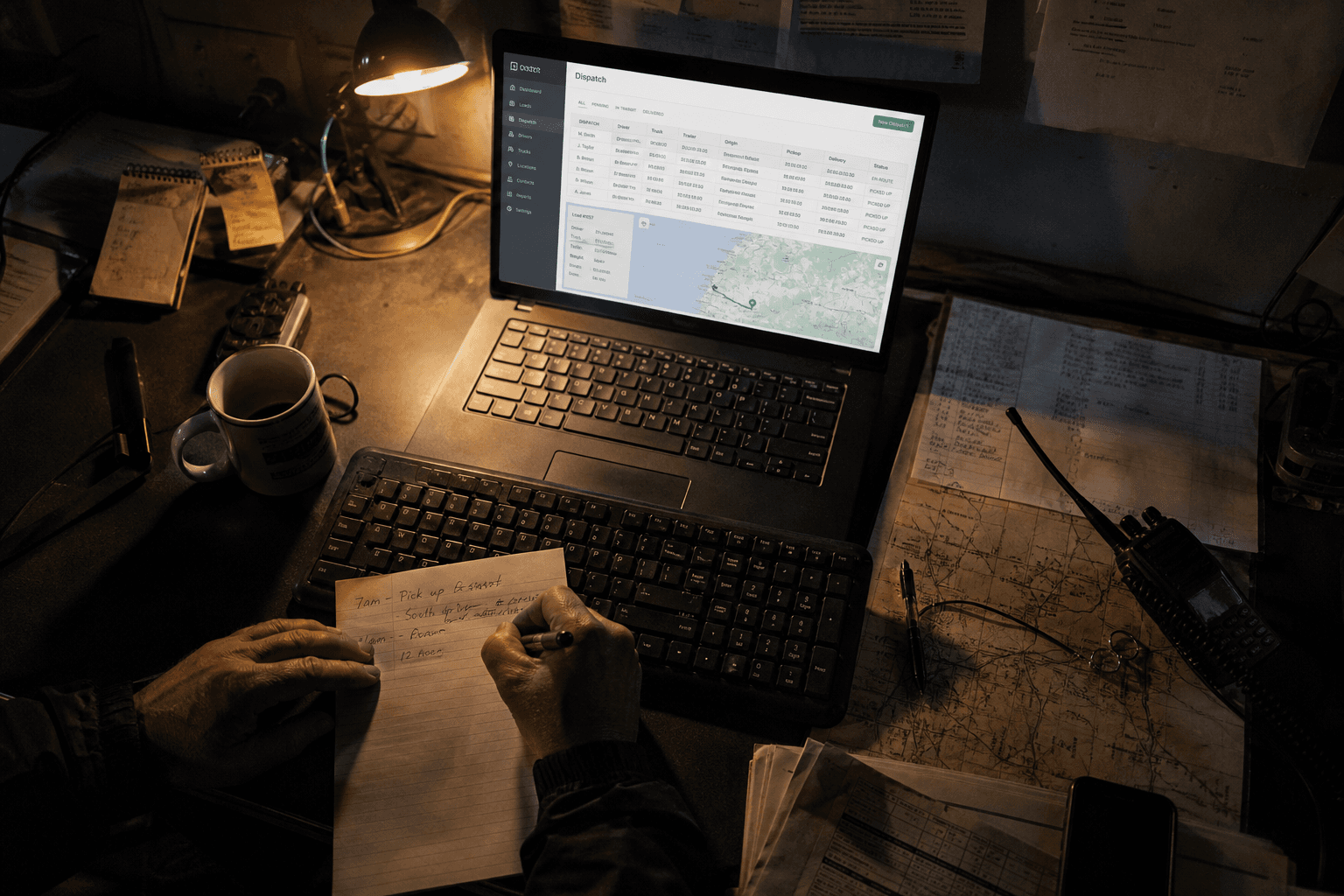
Route optimisation is the most mature application of AI in freight operations, and for most carriers, it's the highest-return place to start.
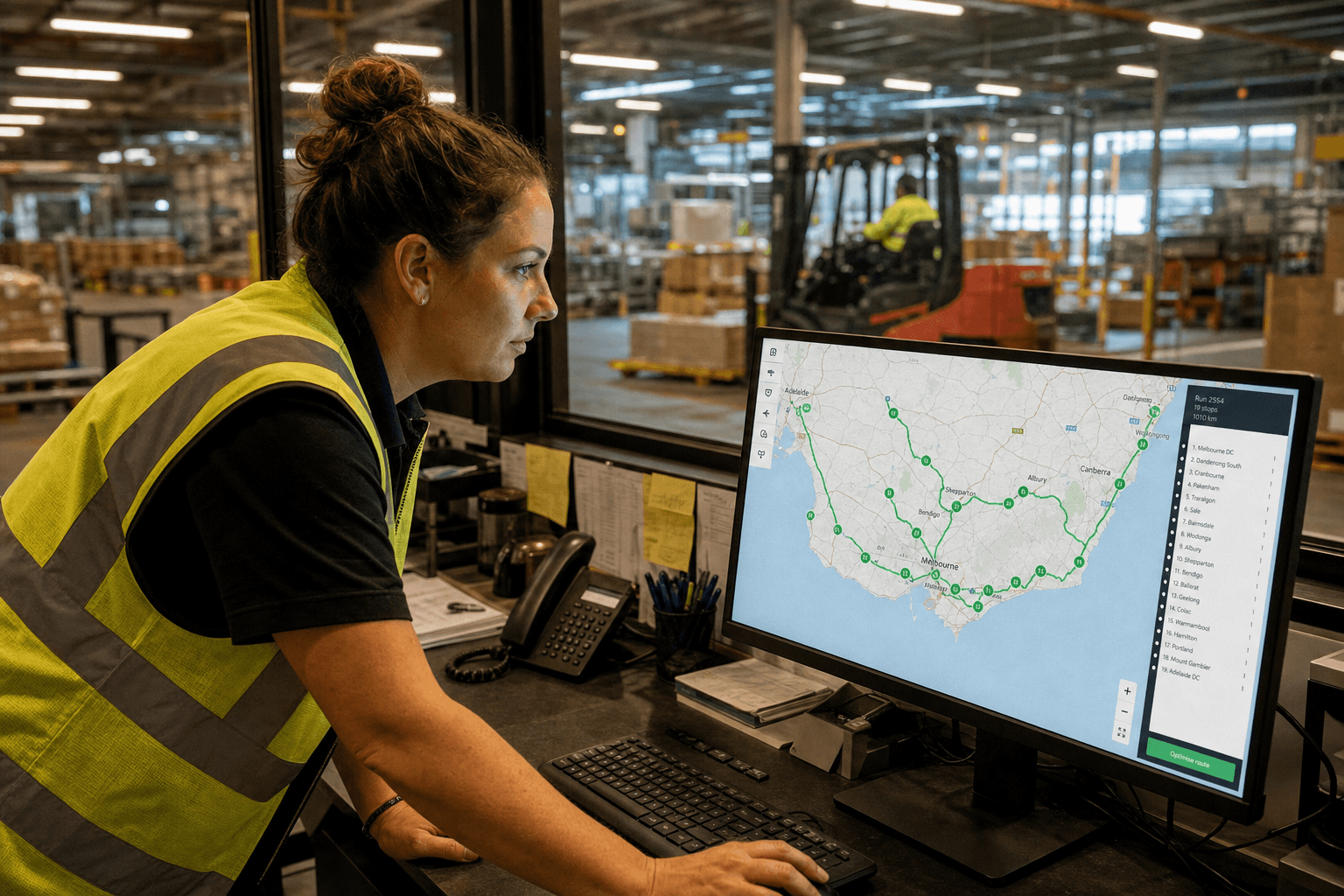
AI-powered route optimisation uses machine learning to analyse historical delivery data, traffic patterns, customer time windows, vehicle capacity, and driver hours to generate routes that are demonstrably better than what a human planner can produce manually at scale. The output is fewer kilometres travelled, lower fuel costs, and more deliveries per shift.
What It Actually Looks Like in Practice
For a carrier running 30+ vehicles out of a Melbourne distribution hub, route optimisation typically involves:
- Data integration: Connecting the TMS, order management system, and GPS fleet data into a single feed. This is often the hardest part for operators on legacy systems.
- Model configuration: Setting the constraints that matter — driver hours, vehicle load limits, customer delivery windows, road restrictions.
- Continuous learning: As the system processes more runs, it improves. Unusual traffic events, seasonal patterns, and customer behaviour all feed back into better future routes.
The gains from route optimisation are not limited to fuel. Planners spend less time manually building runs. Dispatchers field fewer exception calls. Drivers complete more drops per shift. The cost reduction compounds across the operation.
What Australian Operators Are Finding
Operators who have moved from manual route planning to AI-assisted planning commonly report reductions in total kilometres driven per delivery, alongside meaningful decreases in planning time. Industry reports from fleet management and TMS vendors in Australia consistently cite double-digit percentage improvements in vehicle utilisation as a realistic benchmark — though actual results vary significantly based on your starting point, freight type, and network density.
Load Consolidation: Filling the Gaps
Load consolidation is the practice of combining partial loads to maximise cubic and weight utilisation per vehicle movement. Most carriers know they have a utilisation problem. Fewer have a systematic way to fix it.
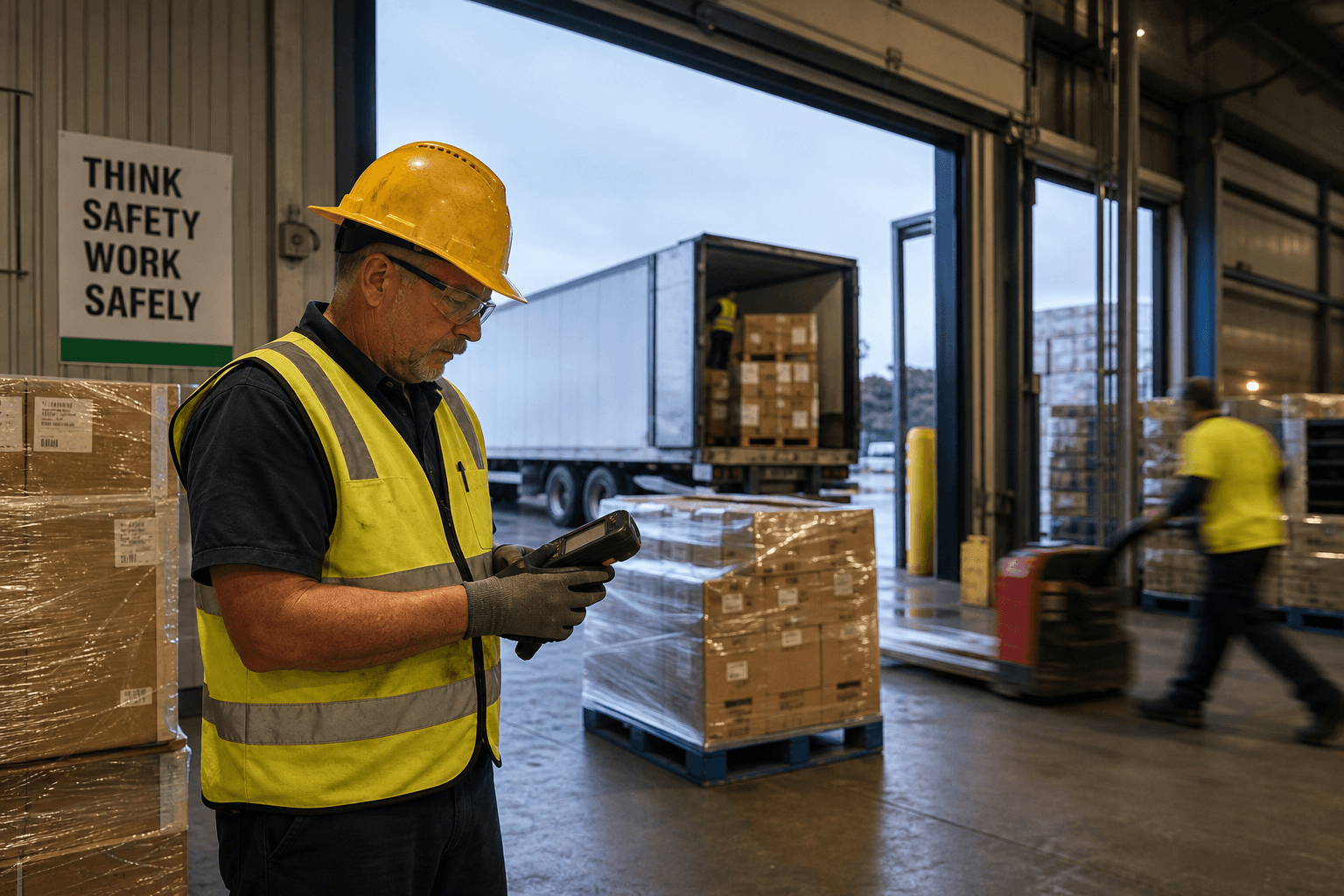
AI approaches load consolidation differently from traditional planning tools. Instead of optimising one load at a time, machine learning models can analyse order patterns across your full freight book — by lane, by customer, by day of week — and identify consolidation opportunities that a human planner won't spot when they're under time pressure.
Common Consolidation Problems AI Helps Solve
| Problem | Manual Planning Approach | AI-Assisted Approach |
|---|---|---|
| Partial LTL loads departing without consolidation | Planner judgement, time pressure | Automated matching across order pool before dispatch |
| Backloads running empty | Ad hoc spot-market search | Predictive identification of return freight opportunities |
| Seasonal demand spikes causing suboptimal loads | Reactionary, experience-based | Pattern recognition across prior years' data |
| Multi-stop city runs poorly sequenced | Experience + local knowledge | Constraint-based optimisation at scale |
For 3PLs managing multiple customers on shared transport networks, AI-driven consolidation can meaningfully reduce the cost-per-unit-moved. The key is having clean order data in a format the system can consume — which often requires some data infrastructure work upfront.
Fuel Management: Where AI Adds a Different Kind of Value
Fuel typically represents 25–35% of variable transport costs for Australian trucking operations, according to industry cost benchmarks from the Australian Trucking Association. Any systematic reduction in fuel consumption flows directly to the bottom line.
AI contributes to fuel management in two distinct ways:
1. Smarter Route and Load Decisions
This connects directly to route optimisation — fewer kilometres and better-loaded vehicles burn less fuel. But AI can also factor in fuel price differentials between locations, optimal refuelling points on long linehaul runs, and road gradient data to minimise fuel-intensive driving.
2. Driver Behaviour Analytics
Telematics data from modern fleet management systems captures acceleration events, braking patterns, idle time, and cruise control usage. AI models can process this data at scale — across your entire fleet, not just flagged vehicles — and identify which behaviours are driving excess fuel consumption.
This is less about surveillance and more about coaching. Drivers who receive regular, specific feedback on fuel-efficient driving consistently improve their scores over time. Fleet managers who have implemented structured telematics-based driver coaching programmes report measurable reductions in fuel spend per kilometre — though the magnitude depends heavily on the baseline behaviour profile of your fleet.
Driver Efficiency: Reducing Hidden Labour Costs
Driver costs are the largest fixed cost in most transport operations. But the issue isn't just hourly rates — it's how efficiently driving hours are used.
AI helps in several ways:
Predictive Scheduling
Historical delivery data reveals patterns that human schedulers don't always act on: which runs consistently run long, which customers cause dwell time, which routes have traffic windows that make morning starts significantly faster than afternoon starts. AI scheduling tools surface these patterns and build them into roster planning.
Real-Time Exception Management
When a driver is running behind, AI-assisted dispatch can automatically re-sequence remaining stops, alert affected customers, and flag whether a second vehicle is needed — without the dispatcher having to manually work through it.
Reducing Non-Driving Time
Document handling is a surprising time sink in many transport operations. Drivers waiting for paperwork, manually completing paper PODs, or dealing with discrepancies at delivery all chip away at productive hours. Document intelligence tools that automate POD capture, BOL processing, and exception flagging can recover meaningful time per run.
Where to Start: A Practical Implementation Path
The common mistake is trying to implement everything at once. Most successful AI implementations in Australian logistics start narrow and expand.
Step 1: Understand your data baseline AI is only as good as the data it runs on. Before you evaluate any AI tooling, you need to know what data you have, where it lives, and how clean it is. This is the purpose of an AI readiness assessment — it gives you an honest picture of where you stand before you commit budget.
Step 2: Pick one high-value problem For most carriers, that's route optimisation or load consolidation. Choose the one where you have the most visibility into current waste. That's where the ROI case will be strongest and clearest.
Step 3: Integrate data, don't just bolt on software Off-the-shelf route optimisation software works better when it's fed clean, real-time data from your TMS, WMS, and telematics. The integration layer is unglamorous but critical.
Step 4: Train and embed, don't just deploy The technology is only part of the equation. Planners and dispatchers need to understand the output and trust it enough to act on it. Change management is not optional.
Step 5: Measure, iterate, and expand Set baseline KPIs before go-live — kilometres per delivery, load factor, fuel per kilometre, planning time. Track them weekly. Use the data to make the case for the next module.
A Note on AASB S2 and Emissions Reporting
Freight cost reduction and emissions reduction are increasingly the same project. Fewer kilometres, better-loaded vehicles, and more fuel-efficient drivers all reduce your Scope 1 emissions. If your business is approaching AASB S2 compliance obligations — or if customers are asking you to report on your Scope 3 supply chain emissions contribution — the data infrastructure you build for AI-driven cost reduction is the same infrastructure you'll need for credible emissions reporting.
That's worth factoring into your business case when you're sizing the investment.
Frequently Asked Questions
Does AI route optimisation work for regional and outback routes?
Yes, though the configuration is different. Regional and long-haul routes benefit from AI that factors in fuel stop placement, driver fatigue regulations, and weather-related road closures — constraints that urban delivery optimisation tools often don't handle well. The key is selecting or configuring a solution that understands Australian geographic and regulatory conditions, not a generic international product.
What data do I need to get started with AI freight optimisation?
At minimum: historical delivery records (origin, destination, time, weight/volume), vehicle specs, driver hours records, and telematics data if available. You don't need perfect data. But you need enough volume and enough structure for a model to learn from. An AI readiness assessment will tell you exactly what you have and what gaps need addressing.
How long before we see cost reductions?
Route optimisation typically delivers measurable improvements within weeks of go-live, once integration is complete. Load consolidation improvements take longer — usually a few months — because the model needs time to learn your freight patterns. Fuel and driver efficiency programmes typically show results over a three to six month horizon as coaching embeds.
Will my drivers push back?
Some will, initially. The most effective approach is to involve drivers in the rollout, frame it as a tool that helps them — not monitors them — and tie any performance feedback to coaching rather than discipline. Driver buy-in is a genuine implementation risk that deserves as much attention as the technical integration.
The Bottom Line
AI-driven freight cost reduction is not theoretical for Australian carriers. The technology is mature enough, the data infrastructure requirements are achievable for mid-market operators, and the cost pressure is real enough that the ROI case is increasingly straightforward to build.
The operators who are moving now are building advantages in planning efficiency, utilisation, and cost-per-kilometre that will be difficult for slower-moving competitors to close.
For more perspectives on where the market is heading, see our insights on AI adoption across Australian logistics.
If you're looking at freight cost reduction and want a clear picture of where AI can actually move the needle in your operation, we can help. Our AI Readiness Assessment gives you a practical starting point — based on your data, your systems, and your freight profile — not a generic roadmap.
Zero Footprint
The Zero Footprint team — AI modernisation for Australian logistics.