Document Intelligence for Freight Operations: Beyond Manual Data Entry
Manual document processing is one of the most persistent operational drains in Australian freight. Document intelligence — AI that automatically extracts, classifies, and validates data from bills of lading, freight invoices, and customs documents — can eliminate the majority of manual keying and reduce billing errors. This article explains how IDP works, what affects accuracy, and how to approach implementation for a legacy freight operation.
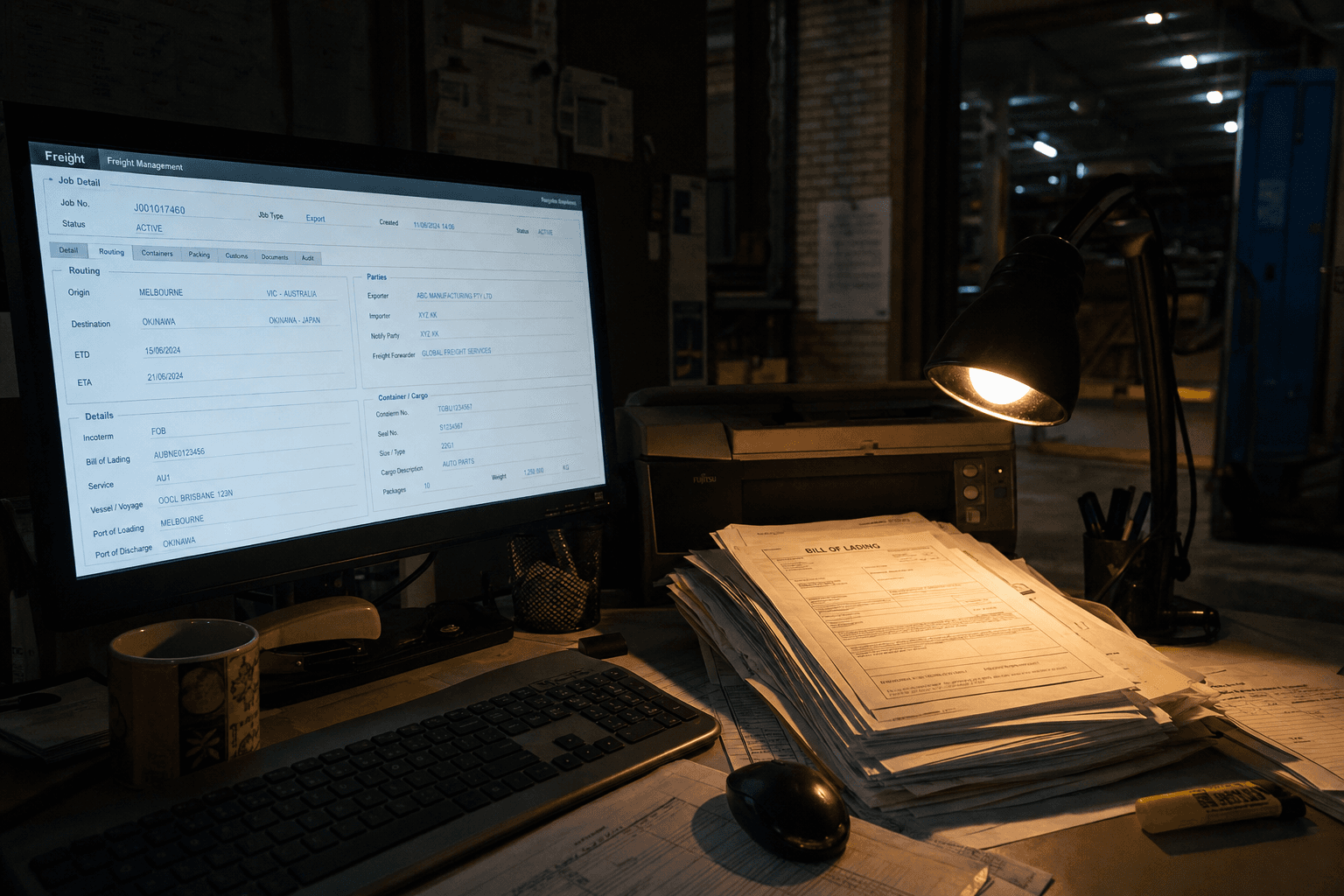
Manual document processing is one of the most persistent operational drains in Australian freight. A mid-sized carrier or 3PL might handle hundreds of bills of lading, proof of delivery documents, customs declarations, and freight invoices every single day — and most of that volume is still managed by staff keying data into a TMS or WMS by hand.
The direct costs are real: labour time spent on data entry that adds no operational value, billing disputes caused by transcription errors, freight releases held up by slow processing, and no clean data trail for audit or analytics. Document intelligence is the category of AI that addresses this directly.
What Is Document Intelligence?
Document intelligence is a category of AI technology that automatically extracts, classifies, and validates data from unstructured documents — PDFs, scanned images, emails, and paper forms — and pushes structured data into downstream business systems.
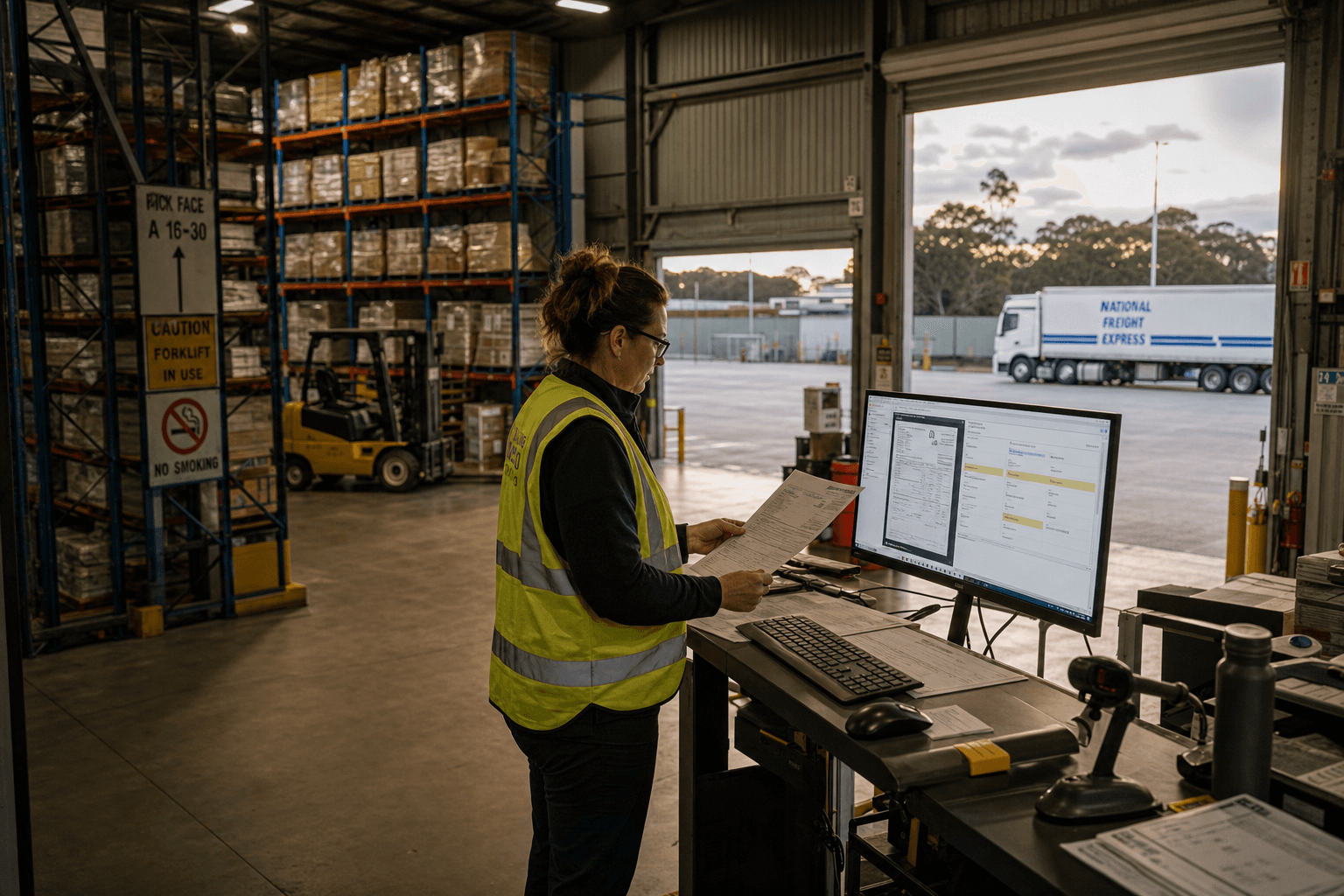
In a freight context, that means taking a scanned bill of lading and automatically identifying the consignee, origin, destination, commodity, weight, and freight terms — without anyone typing a single field.
Modern intelligent document processing (IDP) systems combine several layers of technology:
- OCR (Optical Character Recognition) to convert images of text into machine-readable characters
- Document classification models to identify what type of document has been received
- Field extraction to locate and pull specific data fields from each document type
- Validation rules to check extracted data against expected formats, known values, or cross-referenced records
- An integration layer to push clean, structured data into your TMS, WMS, ERP, or accounting system
Cloud platforms including Google Cloud Document AI, Microsoft Azure Form Recognizer, and AWS Textract provide pre-trained models that can be fine-tuned for specific freight document types.
Which Documents Are Typically Automated First?
The highest-value starting points for most Australian freight operators fall into three categories.
Bills of Lading (BOLs) are the backbone of freight documentation. Every shipment generates one, and the data they contain — shipper, consignee, commodity, weight, dimensions, special handling — needs to flow into your TMS quickly and accurately. Manual BOL keying is slow and error-prone, particularly when you are dealing with multiple document formats from different shippers.
Freight invoices are where billing errors compound fast. Reconciling carrier invoices against load records manually takes significant staff time, and discrepancies often go unnoticed until they become disputes. Automated extraction and matching can flag variances before they become problems.
Customs and trade documents — including import declarations, certificates of origin, and dangerous goods documentation — carry compliance obligations. Errors or delays in processing these documents can hold freight at the border, with direct cost implications.
Proof of delivery (POD) documents close the loop on completed shipments. Automated POD matching against open consignments accelerates invoicing and reduces the manual follow-up cycle.
What Affects Accuracy?
IDP accuracy is not uniform. Several factors influence how reliably an AI model extracts data from freight documents.
| Factor | Impact on Accuracy |
|---|---|
| Document quality (resolution, scan clarity) | High — poor scans reduce confidence significantly |
| Handwritten fields | High — handwriting recognition is less reliable than printed text |
| Standardised vs. non-standard layouts | Medium — consistent templates improve model performance |
| Document type (BOL vs. customs declaration) | Medium — some document types have more variable formats |
| Language and character set | Low to Medium — non-English documents may require separate model training |
Pre-trained models handle common freight document formats reasonably well out of the box. Unusual formats, non-standard layouts, or heavily handwritten documents typically require custom model training to reach reliable confidence levels.
A practical approach is to configure confidence thresholds: documents the model extracts with high confidence are processed automatically, while lower-confidence extractions are flagged for a human review step. This hybrid approach maintains accuracy while still eliminating the majority of manual keying.
The Integration Question
Document automation that stops at data capture is a limited solution. The real operational value comes when extracted data flows directly into the systems that drive decisions.
For a freight operator, that means BOL data feeding your TMS load creation workflow, invoice data feeding your billing reconciliation process, and POD data triggering your invoicing cycle — automatically, without a manual handoff at each step.
This is where integration architecture matters. A standalone document scanning tool that exports a spreadsheet for a staff member to then re-enter into a TMS has not solved the problem — it has just moved the bottleneck.
When document intelligence is connected to broader operational workflows, the downstream benefits multiply. Structured data from freight documents can feed route optimisation models, support emissions calculations for AASB S2 reporting, and provide the clean data foundation that operational analytics requires.
What Does Implementation Look Like?
For Australian freight operators running legacy TMS or WMS platforms, the practical starting point is a contained, high-value document problem. BOL processing, POD matching, and invoice reconciliation are common entry points because the document volumes are high, the current manual cost is visible, and the downstream systems that need the data are already defined.
A structured implementation typically moves through these phases:
1. Document audit and scoping — Identify which document types, volumes, and source formats are in scope. Understand what data fields need to be extracted and where they need to go.
2. Model selection and configuration — Select the appropriate base model (pre-trained cloud platform or purpose-built freight model), configure extraction fields, and establish validation rules specific to your document types.
3. Integration build — Connect the extraction pipeline to your downstream systems. This is where the operational value is unlocked or lost depending on how well the integration is designed.
4. Confidence threshold and exception workflow — Define what confidence level triggers automatic processing versus human review, and build the exception handling workflow so staff are only touching genuinely ambiguous documents.
5. Testing and calibration — Run against a representative sample of real documents, review extraction accuracy, and tune the model or validation rules before going live.
An AI readiness assessment is a useful first step if you are not yet sure which document problems represent the highest-value starting point for your operation.
Common Misconceptions
"We already have a TMS, so this should be easy to add." Most legacy TMS platforms were not built with modern API integration in mind. Connecting an IDP pipeline to a legacy system requires careful integration work. It is achievable, but it is not a plug-and-play configuration.
"AI will read everything perfectly." Confidence varies by document quality and format. A well-designed IDP system handles high-confidence extractions automatically and routes exceptions to human review — it does not eliminate human judgement entirely, it focuses it where it is actually needed.
"Document automation is a standalone project." Document intelligence delivers the most value when it is treated as a data infrastructure layer that feeds operational workflows — not an isolated productivity tool. The clean, structured data generated by document automation is an asset for analytics, reporting, and AI-driven decision-making across the business.
Is Document Intelligence Right for Your Operation?
If your team is spending meaningful hours each week manually keying data from freight documents, chasing missing information, or manually reconciling invoices against load records, document intelligence is worth evaluating seriously.
The technology is mature, the cloud platforms are proven, and the integration patterns for connecting to TMS and WMS systems are well understood. The question is less "does this technology work" and more "what is the right scope and sequence for our specific operation."
For more on how AI is being applied across Australian logistics operations, browse our insights.
If you are exploring document intelligence for your freight operation — whether that is BOL processing, invoice reconciliation, or customs document handling — we can help you scope the right starting point. The conversation starts with understanding your document volumes, formats, and the systems you need to connect to.
Zero Footprint
The Zero Footprint team — AI modernisation for Australian logistics.