Total Cost of Ownership: AI-Powered vs Manual Logistics Operations
Mid-market Australian logistics operators must weigh the total cost of ownership between AI-powered and manual systems. Understanding the long-term financial implications helps operators make informed decisions about technology investment.
Total Cost of Ownership: AI-Powered vs Manual Logistics Operations
Mid-market Australian logistics operators face a critical decision: continue with manual processes or invest in AI-powered systems. Understanding the total cost of ownership helps evaluate the long-term financial implications of this choice, particularly for operations managing complex routing, high document volumes, or regulatory compliance requirements.
Understanding True TCO in Logistics Operations
Total cost of ownership in logistics operations encompasses all direct and indirect costs over a system's lifecycle. This includes initial implementation, ongoing maintenance, labour costs, error-related expenses, and opportunity costs from inefficiencies.
For Australian operators managing 50-500 employees and fleets of 20+ vehicles, the TCO calculation must account for:
- Implementation and integration costs
- Training and change management expenses
- Ongoing software licensing and maintenance
- Labour cost variations
- Error reduction and quality improvements
- Scalability and growth capacity
Implementation Costs: AI vs Manual Systems
AI-Powered Implementation
AI implementation for mid-market operators requires careful budget planning. According to the Australian Bureau of Statistics, businesses investing in advanced technologies typically allocate between 2-5% of annual revenue for digital transformation initiatives.
Implementation typically covers:
- System integration and data preparation
- Custom model development for specific workflows
- Staff training and change management
- Initial consulting and setup
Most operators start with focused implementations like route optimisation or document processing rather than full-scale transformation.
Manual System Costs
While manual operations appear cost-free, they require significant ongoing investment:
- Additional staff for data entry and processing
- Supervisory overhead for quality control
- Paper-based systems and physical storage
- Redundant processes to catch errors
These hidden costs compound over time as business scales, particularly given Australia's tight labour market conditions.
Labour Cost Analysis
Manual Operations Scaling
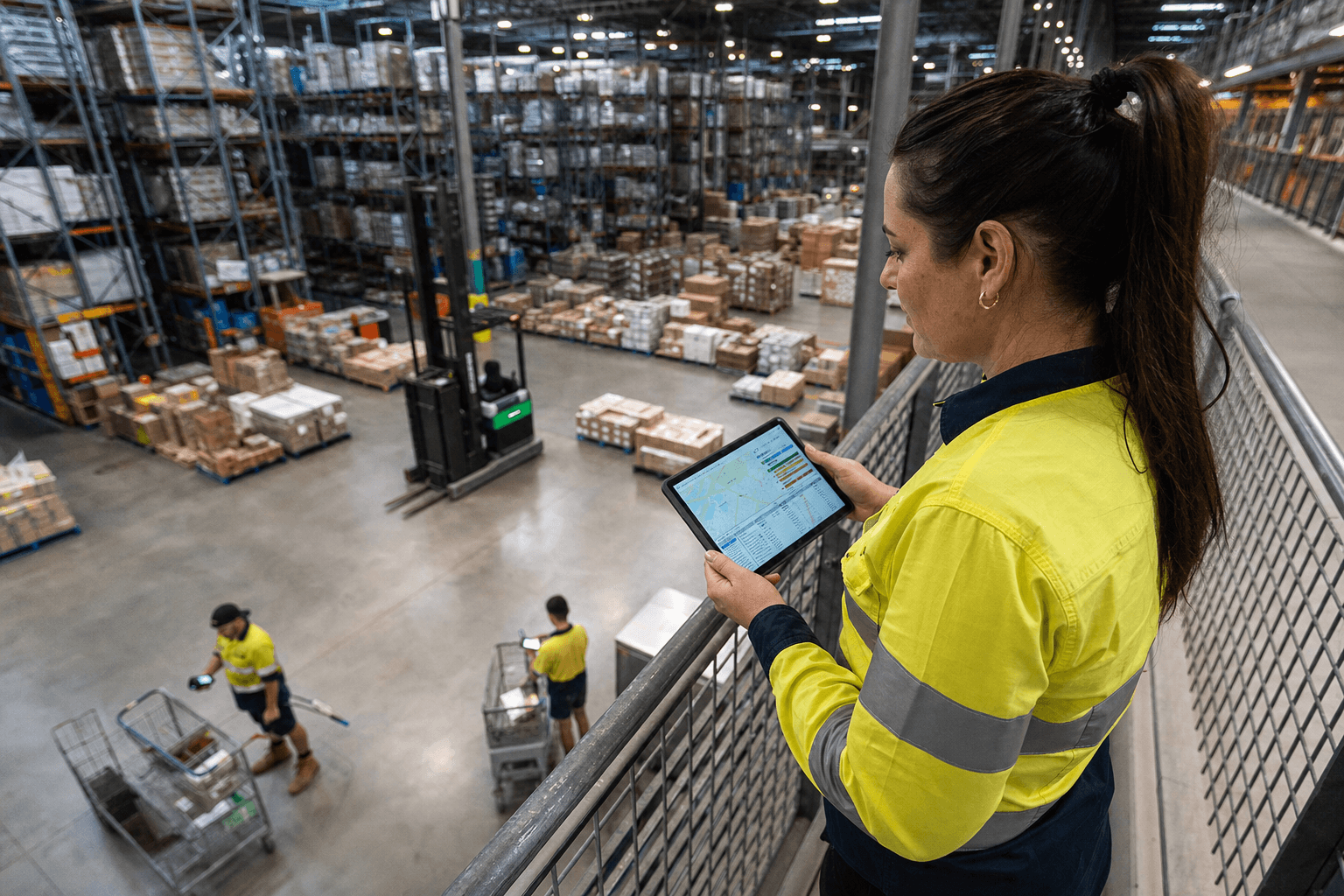
Manual logistics operations face linear labour scaling challenges. Each new route, warehouse zone, or customer typically requires proportional staff increases. The Fair Work Commission's annual wage reviews consistently show upward pressure on logistics wages, making manual scaling increasingly expensive.
Operations managers frequently report that administrative tasks consume substantial portions of their working time, limiting focus on strategic activities and business development.
AI-Powered Efficiency Gains
AI systems enable non-linear scaling where technology handles volume increases without proportional staff growth. Key areas include:
- Automated dispatch and route planning
- Intelligent document processing
- Predictive maintenance scheduling
- Real-time exception handling
This scaling efficiency becomes particularly valuable for operators experiencing rapid growth or seasonal volume fluctuations.
Error Reduction and Quality Improvements
Manual Process Challenges

Manual logistics processes face inherent accuracy limitations across data entry, routing decisions, and inventory management. Industry research suggests that human error rates in data-intensive processes typically range from low single digits to higher percentages depending on complexity and fatigue factors.
These errors create cascading effects:
- Customer service issues and potential lost accounts
- Redelivery costs and fuel waste
- Inventory discrepancies and stock-outs
- Compliance reporting inaccuracies
AI Accuracy Improvements
Properly implemented AI systems demonstrate substantial accuracy improvements in logistics applications. Machine learning models, when trained on quality datasets, consistently outperform manual processes in pattern recognition and decision-making tasks.
This improvement translates to:
- Higher customer satisfaction and retention
- Reduced fuel and labour costs from routing errors
- More accurate inventory and compliance reporting
- Lower insurance and risk management costs
Scale Effects and Growth Capacity
Manual Operations Limitations
Manual systems face natural capacity constraints as operations grow. Common bottlenecks include:
- Dispatch planning complexity overwhelming human cognitive capacity
- Quality control becoming increasingly difficult at scale
- Knowledge dependence on key personnel creating risk
- Inability to process real-time data effectively
These limitations often force operators to choose between growth and operational quality.
AI Scalability Advantages
AI systems handle complexity increases without proportional cost growth. They enable:
- Dynamic routing optimisation across hundreds of stops
- Real-time decision making at operational speed
- Consistent quality regardless of volume
- Knowledge retention independent of staff turnover
For Australian logistics operators facing driver shortages and skilled labour constraints, these scalability advantages provide significant competitive benefits.
Long-Term ROI Considerations
Implementation Phase
The initial implementation period typically shows net costs as organisations invest in AI systems while maintaining parallel manual processes during transition. However, early wins in specific areas often demonstrate value within months rather than years.
Efficiency Realisation Phase
As systems mature and staff adapt to new processes, operators typically observe:
- Staff can focus on higher-value activities
- Error rates decrease measurably
- Process efficiency improvements compound
- Customer satisfaction metrics improve
Compound Benefits Phase
Established AI implementations typically provide substantial value through:
- Reduced labour costs relative to manual scaling requirements
- Improved customer retention and new business wins
- Enhanced regulatory compliance capabilities
- Greater operational flexibility and responsiveness
Making the TCO Decision
When AI Investment Makes Sense
AI implementation typically provides positive returns for operators with:
- Complex routing requirements across multiple daily routes
- High-volume document processing needs
- Regulatory compliance pressures including emissions reporting
- Growth plans requiring operational scaling
Risk Mitigation Strategies
Successful AI implementations often use phased approaches:
- Start with high-impact, low-risk applications
- Build internal capabilities gradually
- Maintain manual backup systems during transition
- Focus on change management and staff training
Many operators begin with an AI readiness assessment to identify the highest-value implementation areas and develop realistic TCO projections based on their specific operational context.
Beyond Cost: Strategic Advantages
While TCO analysis focuses on quantifiable costs, AI adoption provides strategic advantages that manual operations cannot match:
- Competitive positioning for technology-aware customers
- Data insights enabling better business decisions
- Regulatory compliance capabilities for AASB S2 and NGER requirements
- Operational resilience during staff shortages or market disruptions
For Australian logistics operators evaluating AI adoption, the TCO analysis should consider both immediate financial impacts and long-term strategic positioning. The companies that invest thoughtfully in AI capabilities today position themselves advantageously for tomorrow's increasingly complex logistics environment.
Ready to understand your specific TCO scenario? Get in touch to discuss how AI implementation could impact your operations.
Zero Footprint
The Zero Footprint team — AI modernisation for Australian logistics.