Logistics AI ROI Benchmarks: What Australian Operators See
Concrete ROI benchmarks for logistics AI in Australia. Investment ranges, annual savings, and payback periods for route optimisation, document intelligence, emissions tracking, and more.
Beyond the Hype: What Actually Pays Off
There's no shortage of AI promises in logistics. "Cut costs by 40%." "Transform your operations." "Unlock the power of your data." What's harder to find is specific, Australian-relevant data on what AI investments actually return.
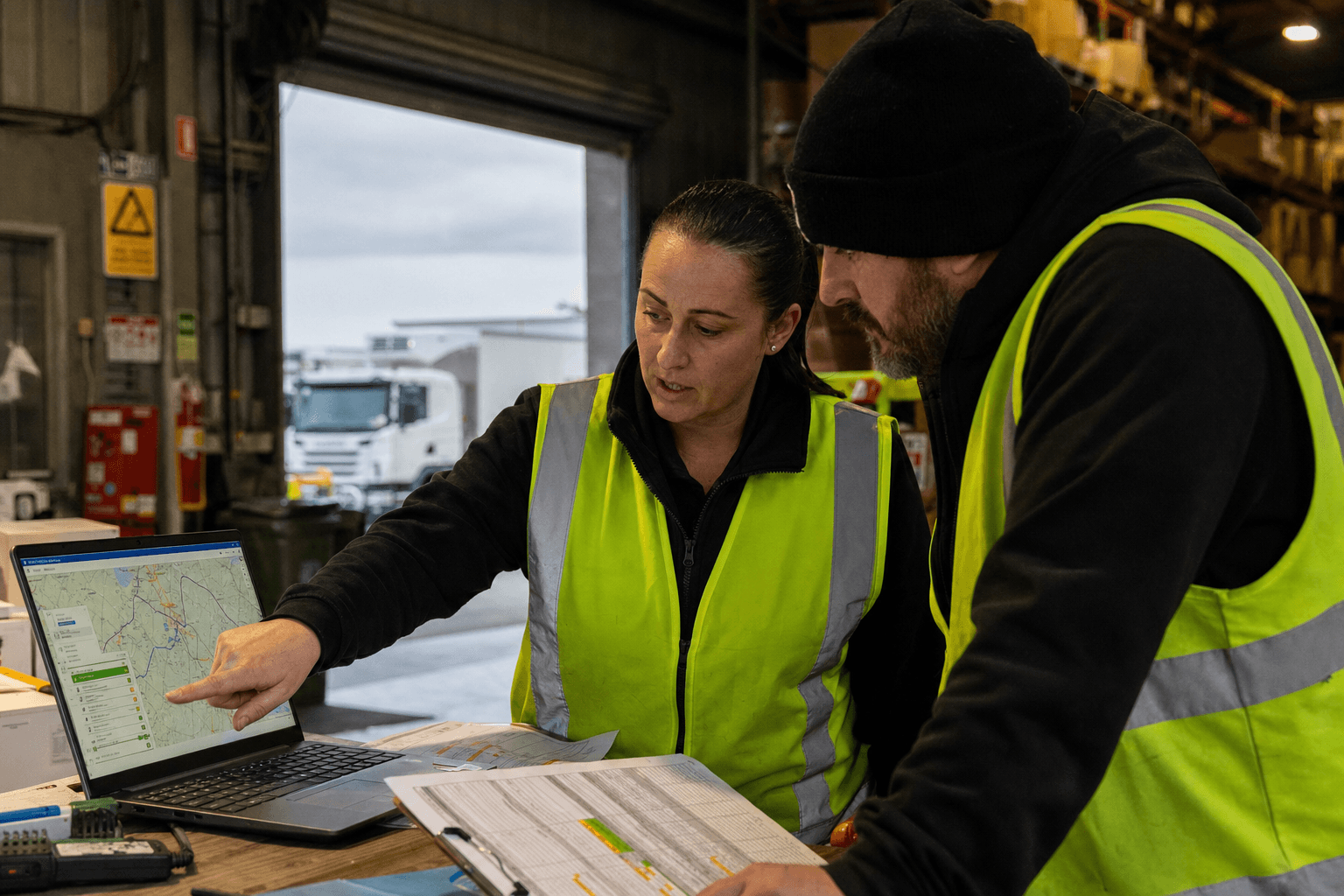
We've compiled ROI benchmarks across seven logistics AI use cases, drawing on published industry data and our direct experience implementing these solutions for Australian mid-market operators. The numbers are ranges because every operation is different — but the patterns are consistent.
The Benchmarks
1. Route Optimisation
| Metric | Range |
|---|---|
| Investment | $80,000-$150,000 |
| Annual saving | $200,000-$600,000 |
| Payback period | 3-6 months |
| Primary saving | 15-25% fuel cost reduction |
| Secondary saving | 20-33% more drops per run, reduced overtime |
What drives the variance: Fleet size is the biggest factor. A 50-vehicle metro fleet saves $200K-$300K. A 200-vehicle fleet saves $500K+. Linehaul operations see lower percentage savings but higher absolute numbers per vehicle.
Lowest-risk entry point for most operators. The data requirements are modest (delivery addresses, vehicle specs, driver shifts), and the results are visible within weeks.
2. Document Intelligence
| Metric | Range |
|---|---|
| Investment | $40,000-$120,000 |
| Annual saving | $150,000-$400,000 |
| Payback period | 4-8 months |
| Primary saving | 85-95% reduction in manual data entry |
| Secondary saving | Error rate drops from 3-5% to <0.5% |
What drives the variance: Document volume and complexity. A customs broker processing 800+ declarations/week sees faster payback than a carrier processing 50 BOLs/day. Semi-structured documents (handwritten PODs) take longer to automate than structured ones (invoices).
3. Invoice Auditing
| Metric | Range |
|---|---|
| Investment | $30,000-$80,000 |
| Annual saving | $100,000-$250,000 |
| Payback period | 3-6 months |
| Primary saving | Recovery of 2-5% carrier billing errors |
| Secondary saving | 80% reduction in invoice checking time |
What drives the variance: Annual carrier spend is the multiplier. At $3M spend, recovery is $60K-$150K. At $10M spend, recovery is $200K-$500K. The investment is roughly the same regardless of spend volume.
Often the fastest payback of any logistics AI project. The cost recovery starts immediately and the investment is modest.
4. Emissions Tracking Automation
| Metric | Range |
|---|---|
| Investment | $80,000-$200,000 |
| Annual saving | $60,000-$150,000 |
| Revenue protection | $500,000+ per retained contract |
| Payback period | 6-12 months (on direct savings) |
What drives the variance: Number of data sources (fleet GPS, fuel cards, subcontractor count) and reporting complexity. The direct cost saving is moderate, but the revenue protection from meeting customer emissions data requirements can dwarf the investment.
Increasingly non-optional. The ROI calculation for emissions tracking is shifting from "nice to have" efficiency gain to "must have" contract retention.
5. Demand Forecasting
| Metric | Range |
|---|---|
| Investment | $60,000-$150,000 |
| Annual saving | $100,000-$300,000 |
| Payback period | 6-12 months |
| Primary saving | 15-30% improvement in resource utilisation |
| Secondary saving | Reduced overstaffing, fewer missed SLAs |
What drives the variance: Quality and length of historical data. Models need 12+ months of order history to produce reliable forecasts. Operators with clean, granular data see results faster.
6. Predictive Maintenance
| Metric | Range |
|---|---|
| Investment | $50,000-$120,000 |
| Annual saving | $150,000-$400,000 |
| Payback period | 6-12 months |
| Primary saving | 70-80% reduction in unplanned breakdowns |
| Secondary saving | 15-25% parts cost reduction, improved vehicle availability |
What drives the variance: Fleet size and existing telematics infrastructure. If you already have telematics, the incremental investment is lower. If you need to instrument the fleet first, add $500-$1,500 per vehicle.
7. Legacy System Integration
| Metric | Range |
|---|---|
| Investment | $60,000-$200,000 |
| Annual saving | $80,000-$200,000 |
| Payback period | 9-15 months |
| Primary saving | Elimination of manual data transfer between systems |
| Secondary saving | Real-time visibility, customer API capability, faster invoicing |
What drives the variance: Number of systems, integration complexity, and the state of the legacy systems. A TMS with database access integrates faster than one with no API and no database access.
Often the prerequisite for other AI projects. Until your systems share data, AI has nothing to work with.
The Summary Table
| Use Case | Investment | Annual Saving | Payback |
|---|---|---|---|
| Route optimisation | $80K-$150K | $200K-$600K | 3-6 months |
| Document intelligence | $40K-$120K | $150K-$400K | 4-8 months |
| Invoice auditing | $30K-$80K | $100K-$250K | 3-6 months |
| Emissions tracking | $80K-$200K | $60K-$150K + revenue | 6-12 months |
| Demand forecasting | $60K-$150K | $100K-$300K | 6-12 months |
| Predictive maintenance | $50K-$120K | $150K-$400K | 6-12 months |
| Legacy integration | $60K-$200K | $80K-$200K | 9-15 months |
Where to Start
Ranked by speed to ROI:
- Invoice auditing — lowest investment, fastest payback, immediate cost recovery
- Route optimisation — highest absolute savings, proven technology, 3-6 month payback
- Document intelligence — significant labour saving, visible improvement in weeks
- Emissions tracking — increasingly mandatory, protects revenue from contract requirements
- Demand forecasting — requires good historical data, strong ROI once the model is trained
- Predictive maintenance — strong ROI but requires telematics infrastructure
- Legacy integration — longest payback but unlocks everything else
For most mid-market operators, the optimal path is: start with one of the top three, prove the ROI in 3-6 months, then use the results to justify investment in the next use case.
The Compounding Effect
Second and third AI projects deliver faster ROI than the first. Why:
- Data is cleaner — the first project forced you to clean your data
- Systems are connected — integration work from the first project carries over
- Team is trained — your people know how to work with AI tools
- Trust is established — leadership has seen results and supports further investment
The first project is the hardest. Everything after it is easier and faster.
Before diving into AI investments, most operators benefit from understanding their current capabilities and readiness through an AI readiness assessment. The highest-return applications we see locally are route optimisation and document intelligence, which typically deliver measurable results within the first year of implementation.
Methodology
Benchmarks are based on:
- Project data: Zero Footprint's implementations with Australian mid-market logistics operators ($20M-$500M revenue)
- Industry research: Published studies from logistics industry bodies and technology providers
- Wage data: ABS average weekly earnings with superannuation and overhead adjustments
- Fuel data: Current Australian diesel and petrol prices as of Q1 2026
Ranges reflect the variation between operators. Investment figures include implementation, testing, and training. Annual savings are steady-state (typically reached 3-6 months after go-live). All figures are AUD.
Find out which use case delivers the fastest ROI for your operation →
Want to understand what AI ROI you could realistically expect for your specific operation? We can walk through your current processes and identify the highest-impact opportunities based on your scale and challenges. Get in touch for a practical assessment of your AI investment options.
Zero Footprint
The Zero Footprint team — AI modernisation for Australian logistics.