AI Adoption in Australian Logistics: 2026 Benchmark Report
The first comprehensive benchmark of AI adoption across Australian logistics. Adoption rates by segment, barriers, demand triggers, and ROI data — assembled from industry research and operator data.

Key Findings
- 50% of Australian fleet managers now use some form of AI tooling — up from an estimated 30% in 2023, but still leaving half the market untapped.
- The mid-market gap is real. Enterprise operators (>$500M revenue) show 70%+ AI adoption. Mid-market operators ($20M-$500M) sit at 25-35%. Small operators trail at 15-20%.
- Legacy systems remain the top barrier. 60% of supply chain leaders cite legacy infrastructure as their primary obstacle to digital transformation.
- AASB S2 is the catalyst. Mandatory Scope 3 reporting is driving the most urgent technology investments, with FY26 thresholds already in effect.
- ROI is proven but unevenly captured. Only 40% of operators report measurable AI improvements — the other 60% invested without a clear implementation plan.
Market Context
Australian logistics is a $158 billion industry projected to reach $275 billion by 2035 (5.7% CAGR). Road freight accounts for 67.1% of revenue. The courier, express, and parcel segment is the fastest growing at 4.92% CAGR, driven by $69 billion in annual online spending.
Victoria's freight sector alone is valued at $36 billion, with Melbourne's western logistics corridor (Truganina, Derrimut, Laverton) hosting the highest density of distribution centres in the state.
AI Adoption Scorecard
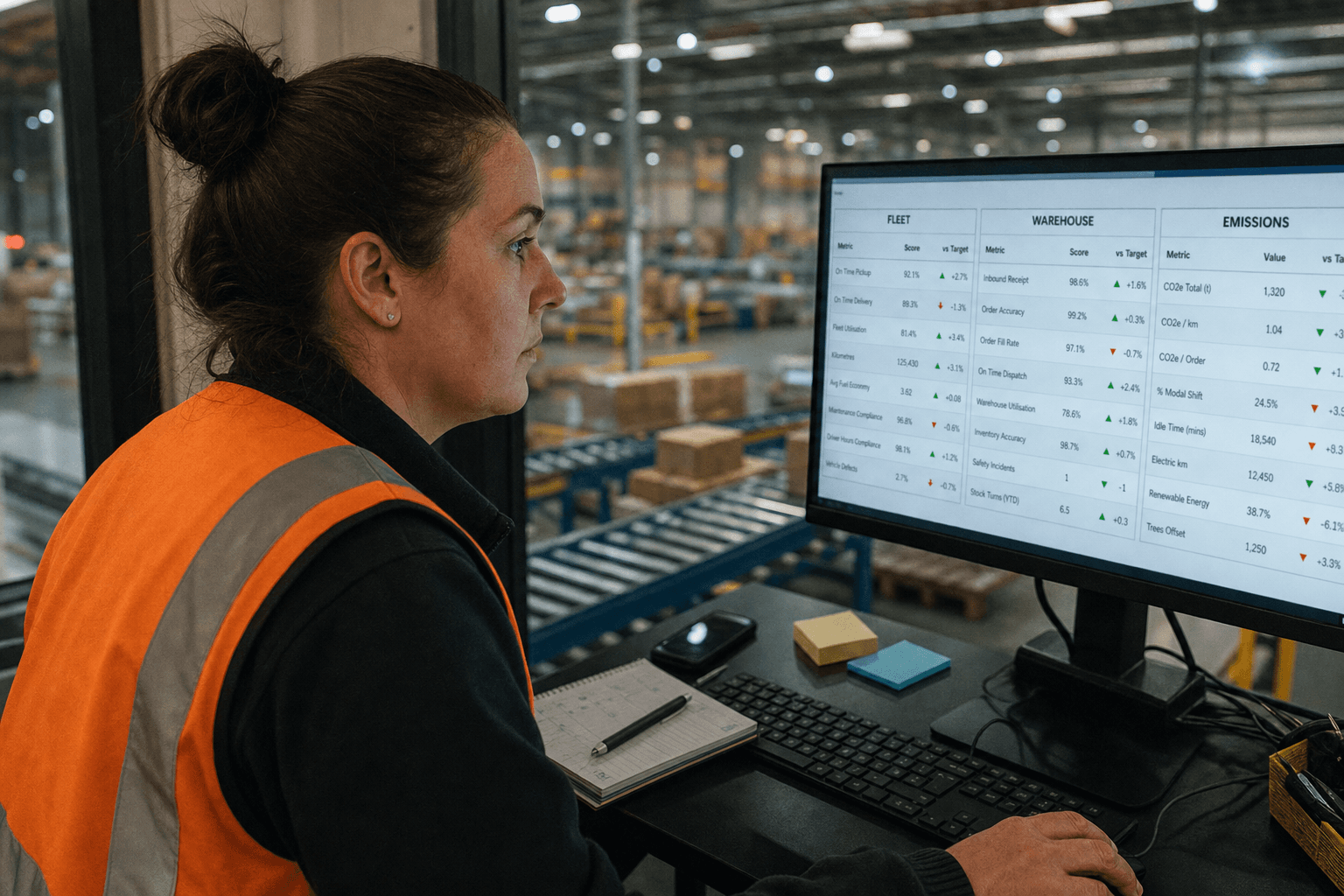
We assessed AI adoption across six operational areas based on published industry research, operator surveys, and our direct experience working with Australian logistics companies.
| Operational Area | Estimated Adoption Rate | Maturity Level |
|---|---|---|
| Fleet management & telematics | 50% | Established — GPS and basic analytics widespread, AI-driven optimisation emerging |
| Warehouse automation | 35% | Growing — pick-to-light and automated sorting in large DCs, AI-driven slotting rare in mid-market |
| Document processing | 25% | Early — OCR used by customs brokers and large forwarders, mid-market still manual |
| Emissions tracking | 15% | Nascent — driven entirely by AASB S2 compliance pressure, most operators starting from zero |
| Demand forecasting | 30% | Growing — large 3PLs using forecasting models, mid-market relying on historical averages |
| Legacy modernisation | 20% | Early — most mid-market operators still running 10-15 year old TMS/WMS with no API capability |
Adoption by Company Segment
| Segment | Revenue Range | Estimated AI Adoption | Characteristics |
|---|---|---|---|
| Enterprise | >$500M | 70%+ | Internal tech teams, dedicated budgets, systematic adoption |
| Mid-market | $20M-$500M | 25-35% | No internal tech teams, limited budgets, ad-hoc adoption |
| SME | <$20M | 15-20% | Using off-the-shelf platforms with built-in AI features |
The mid-market represents the largest underserved segment. These operators have complex enough operations to benefit from AI but lack the internal capability or consulting budgets to implement it.
Top 5 Barriers to AI Adoption
| Rank | Barrier | Prevalence | Impact |
|---|---|---|---|
| 1 | Legacy systems | 60% of leaders cite as top barrier | Can't integrate modern AI tools with 10-15 year old TMS/WMS |
| 2 | Workforce readiness | 74% say workforce isn't ready | Technology outpaces adoption capability |
| 3 | Unclear ROI | 40% can't measure AI improvements | Investment without implementation plan |
| 4 | Budget constraints | Significant for mid-market | $500K consulting engagements don't fit $20M-$500M companies |
| 5 | Data quality | Pervasive but underestimated | AI needs clean, accessible data — most operators have neither |
Five Demand Triggers Driving Adoption in 2026
1. Mandatory Scope 3 Emissions Reporting (AASB S2)
The single largest catalyst. Reporting thresholds are pulling in progressively more entities:
| Financial Year | Revenue Threshold | Estimated Entities | Status |
|---|---|---|---|
| FY26 | >$500M | ~400 | Now in effect |
| FY28 | >$200M | ~1,180 | 18 months away |
| FY29 | >$50M | ~2,860 | 30 months away |
For logistics companies, Scope 3 emissions represent 70-90% of total carbon footprint — subcontractors, fuel suppliers, and downstream transport. Even operators below the threshold are being asked for per-shipment emissions data by customers who are reporting.
2. Labour Shortages
Persistent driver, warehouse, and technician shortages continue to push hourly rates up and throughput down. The average age of a heavy vehicle driver in Australia is 47. Automation isn't replacing workers — it's filling gaps that can't be filled any other way.
3. Legacy System End-of-Life
60% of operators cite legacy systems as their top barrier. Systems built 10-15 years ago are reaching end-of-life: vendors have stopped supporting them, security patches aren't available, and they can't integrate with modern tools or customer requirements.
4. Customer Expectations
B2B customers now expect consumer-grade visibility: real-time tracking, API integration, per-consignment reporting. Operators who can't provide these capabilities are being excluded at the RFP stage.
5. Government Incentives
Multiple grant programs are reducing the cost barrier:
- AI Adopt Program: $3-5M grants for SME AI adoption
- CRC-P Round 19: Up to $3M for AI-focused industry projects
- Victorian Freight Sector Innovation Fund: $8M for low-emission tech and digital tools
ROI Benchmarks by Use Case
Based on published industry data and our experience with Australian mid-market operators:
| Use Case | Typical Investment | Annual Saving | Payback Period |
|---|---|---|---|
| Route optimisation | $80K-$150K | $200K-$600K | 3-6 months |
| Document intelligence | $40K-$120K | $150K-$400K | 4-8 months |
| Invoice auditing | $30K-$80K | $100K-$250K | 3-6 months |
| Emissions tracking | $80K-$200K | $60K-$150K + revenue protection | 6-12 months |
| Demand forecasting | $60K-$150K | $100K-$300K | 6-12 months |
| Predictive maintenance | $50K-$120K | $150K-$400K | 6-12 months |
What This Means for Operators
The gap between AI leaders and laggards is widening. Companies that adopted early are seeing compounding returns — better data, better models, better decisions. Those that haven't started face a harder transition later, with worse data, less time, and customers who've already moved to more capable providers.
The practical starting point for most mid-market operators: pick one high-ROI use case (route optimisation, document intelligence, or invoice auditing), prove the value in 3-6 months, then expand.
Understanding where your organisation sits on the AI adoption curve requires honest assessment of current capabilities and infrastructure readiness. Our AI readiness assessment helps logistics operators identify practical next steps, while our legacy modernisation services address the infrastructure barriers that prevent 60% of supply chain leaders from moving forward.
Methodology
This benchmark draws on published industry research (Transport & Logistics Industry Skills Council, Australian Logistics Council, CSIRO), government data (ABS, Clean Energy Regulator), and Zero Footprint's direct experience working with Australian logistics operators. Adoption rates are estimates based on available data and should be treated as indicative ranges rather than precise figures. We've disclosed our methodology to ensure transparency and invite correction where better data is available.
Discuss what these benchmarks mean for your operation →
Ready to benchmark your AI readiness against industry peers? Our team works with Australian logistics operators to develop practical AI implementation roadmaps that deliver measurable ROI. Get in touch to discuss how these findings apply to your operation.
Zero Footprint
The Zero Footprint team — AI modernisation for Australian logistics.