AI-Assisted Certificates of Origin for Freight Forwarders
AI-assisted document intelligence helps Australian freight forwarders cut manual re-keying and flag rules-of-origin errors before a Certificate of Origin is submitted. Here's how it works under AANZFTA, and what to check before adopting it.
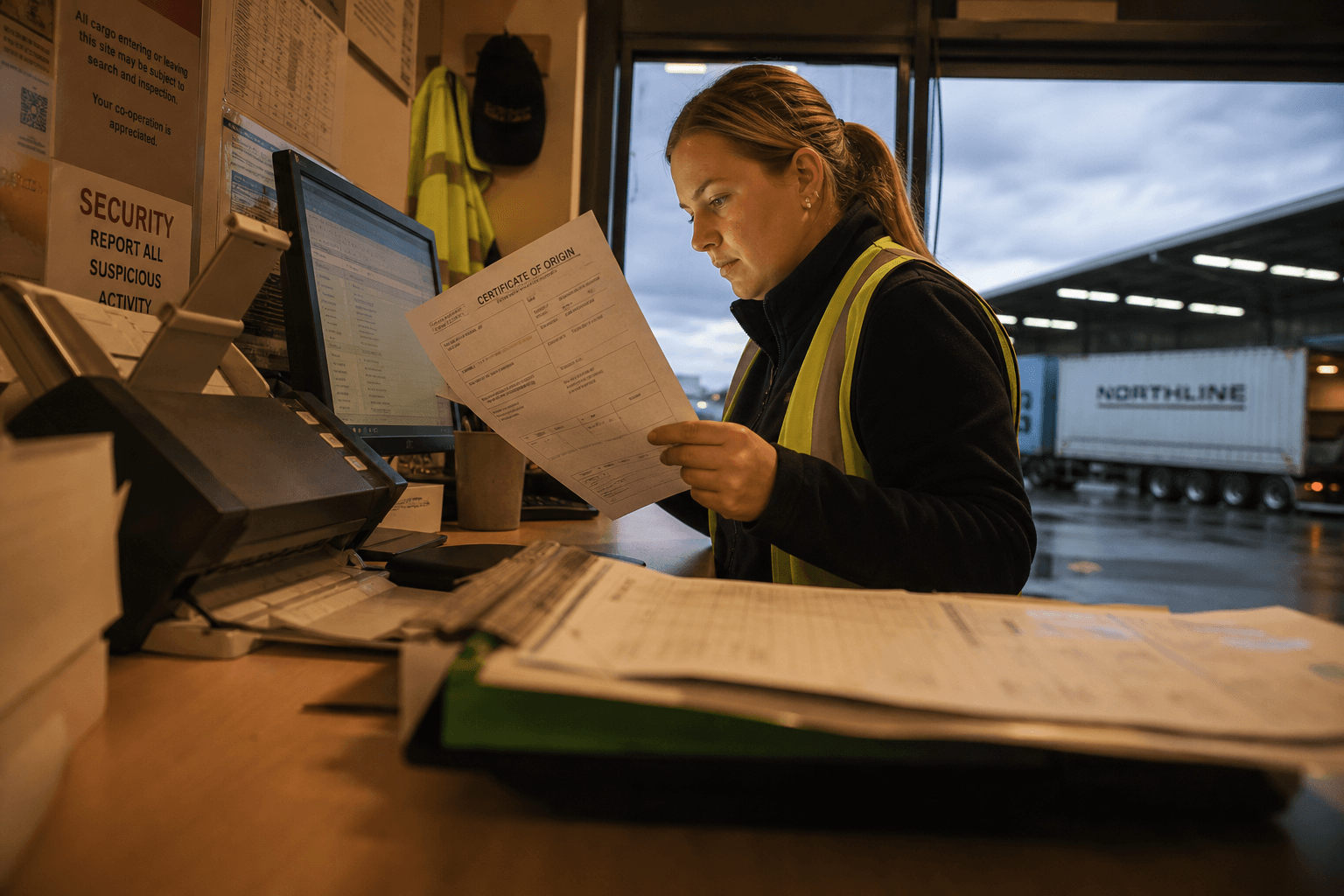
AI-assisted document intelligence helps Australian freight forwarders process Certificates of Origin (COOs) faster and more accurately by automatically extracting data from supplier invoices, packing lists and origin declarations, then checking it against the rules of origin for agreements like AANZFTA before the document is submitted. It doesn't replace the trade compliance specialist who signs off on the claim — it removes the manual re-keying and cross-referencing that currently eats up their time, and reduces the risk of a preferential tariff claim being rejected over a documentation error.
What is a Certificate of Origin, and why does it matter under AANZFTA?
A Certificate of Origin is a trade document that certifies where goods were manufactured or produced, used to determine whether a shipment qualifies for preferential tariff treatment under a Free Trade Agreement. For Australian freight forwarders moving goods under agreements like the ASEAN-Australia-New Zealand Free Trade Agreement (AANZFTA), getting the COO and supporting origin documentation right is the difference between a client paying the standard tariff rate and claiming a preferential one.
AANZFTA, like most FTAs Australia is party to, sets out specific rules of origin — tests such as Regional Value Content or Change in Tariff Classification — that determine whether a product genuinely originates in a member country. The Department of Foreign Affairs and Trade (dfat.gov.au) and the Australian Border Force (abf.gov.au) both publish guidance on these rules, and incomplete or inconsistent documentation is one of the more common reasons shipments are held up or preferential claims are rejected at the border.
Why is Certificate of Origin processing still so manual?
Most freight forwarders still process Certificates of Origin by manually keying data from supplier invoices, packing lists, and origin declarations into COO forms, then cross-checking tariff classifications by hand. This is slow, repetitive and error-prone — and it's compounded by the fact that origin rules differ by product, by agreement, and sometimes by exporting country.
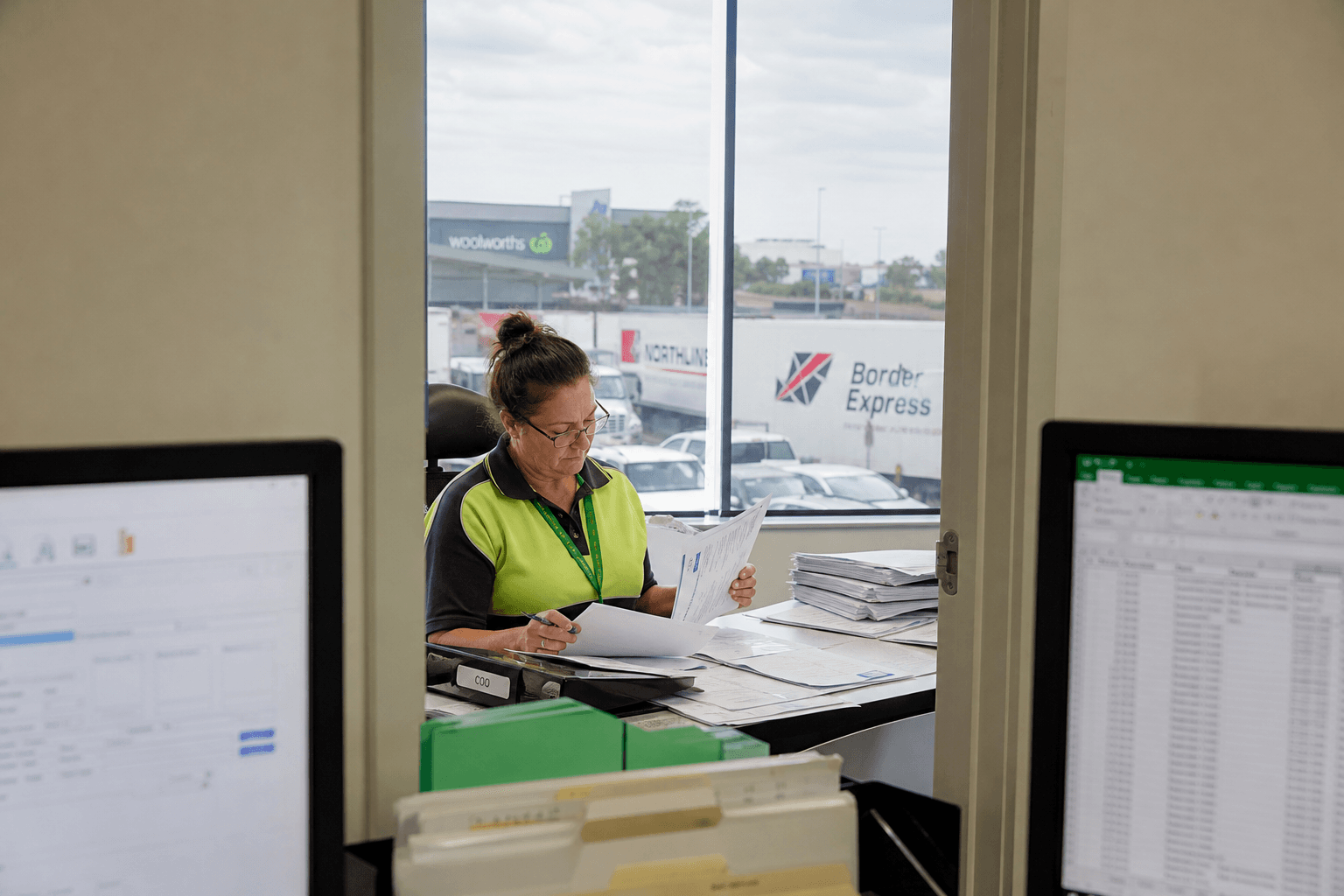
This isn't a criticism of how forwarders operate — it reflects the reality that most legacy freight management systems were never built with FTA compliance logic in mind. Documentation work like this typically sits outside the core TMS or WMS and ends up living in spreadsheets, shared inboxes, and the institutional knowledge of a handful of experienced staff. When that staff member is on leave, or volume spikes, errors creep in.
How can AI-assisted document intelligence help with COO and FTA documentation?
AI-assisted document intelligence extracts structured data — product descriptions, HS tariff codes, country of origin, invoice values — directly from supplier and shipping documents, and flags inconsistencies against the rules of origin for a given FTA before a Certificate of Origin is submitted. This doesn't replace the compliance judgement of a trained trade specialist; it reduces the manual re-keying and cross-referencing that currently consumes their time.
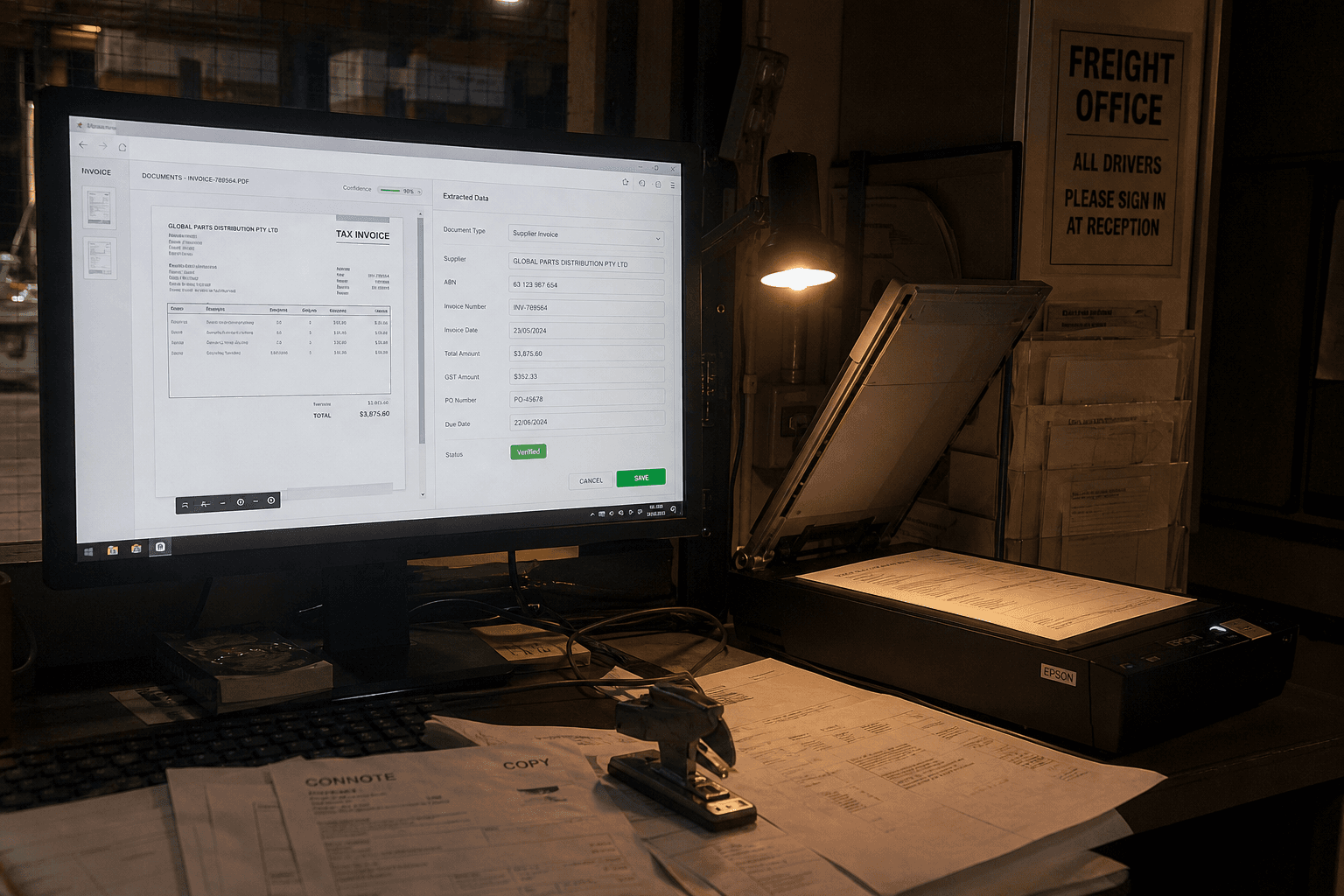
The underlying approach is the same one that applies to other document-heavy, paper-based workflows in freight operations — order entry, dispatch allocation, and proof-of-delivery processing are common examples. The same principle extends naturally to trade compliance documentation: layering AI-powered extraction and verification on top of existing systems, rather than replacing a TMS or customs platform outright. This is the kind of document intelligence work we build for Australian freight forwarders and 3PLs, and it sits alongside other operational AI work such as route optimisation and emissions reporting as part of a broader modernisation programme.
Manual vs AI-assisted COO workflow
| Aspect | Manual process | AI-assisted process |
|---|---|---|
| Data entry from supplier documents | Manual re-keying | Automated extraction |
| Cross-checking rules of origin | Relies on staff expertise | Flagged automatically against rule sets |
| Audit trail | Often inconsistent or paper-based | Consistent digital record |
| Error risk on high volume | Higher under time pressure | Lower, with human review retained |
| Staff dependency | High — tied to individual knowledge | Reduced, knowledge embedded in the system |
Note: this table reflects typical qualitative differences between approaches, not measured performance figures for any specific tool or client.
What should freight forwarders check before adopting AI for trade documentation?
Freight forwarders considering AI for COO and FTA documentation should start by mapping their current manual process end-to-end — where delays happen, which agreements are used most often, and where errors have previously caused shipment holds or preferential claim rejections. This groundwork matters more than the technology choice itself.
A few practical questions worth asking before engaging any vendor or consultancy:
- Does the system keep a clear, exportable audit trail for customs and audit purposes?
- Can it be configured or retrained as rules of origin change under different agreements?
- Does it integrate with your existing TMS or document management system, or does it require a full platform switch?
- Who retains final sign-off on a Certificate of Origin — a person should always remain accountable for the compliance decision.
These are the same questions we work through with clients during an ai readiness assessment, where we look at the data, systems, and process maturity that need to be in place before any AI tool is introduced into a compliance-sensitive workflow.
Where does this fit into a broader AI roadmap for forwarders?
Certificate of Origin and FTA documentation is one of several document-heavy compliance tasks that sit alongside customs pre-clearance paperwork and biosecurity documentation in a typical freight forwarder's operation. Treating these as a connected set of problems — rather than one-off automation projects — is usually a better starting point than tackling them in isolation. Forwarders already dealing with AASB S2 and Scope 3 emissions reporting obligations are often having similar conversations about data capture and audit trails, which is why we see document intelligence, emissions reporting and route optimisation increasingly discussed together as part of the same digital transformation logistics Australia operators are working through.
If you're weighing up where to start, our more insights section has further detail on how AI applies across freight and warehouse operations, and an ai readiness assessment is typically the most practical first step — it maps your current documentation workflow, data quality and systems before recommending where AI can realistically help.
If Certificate of Origin and FTA documentation is costing your team time or causing shipment delays, get in touch and we'll talk through whether an AI-assisted approach fits how your business actually runs.
Zero Footprint
The Zero Footprint team — AI modernisation for Australian logistics.