AI Spare Parts Inventory Optimisation for Fleet Workshops
Fleet workshops lose money two ways: stockouts on critical parts and shelves full of slow-moving stock. AI demand forecasting addresses both, and it's a different problem to predictive maintenance.
What causes stockouts and excess inventory in fleet maintenance workshops?
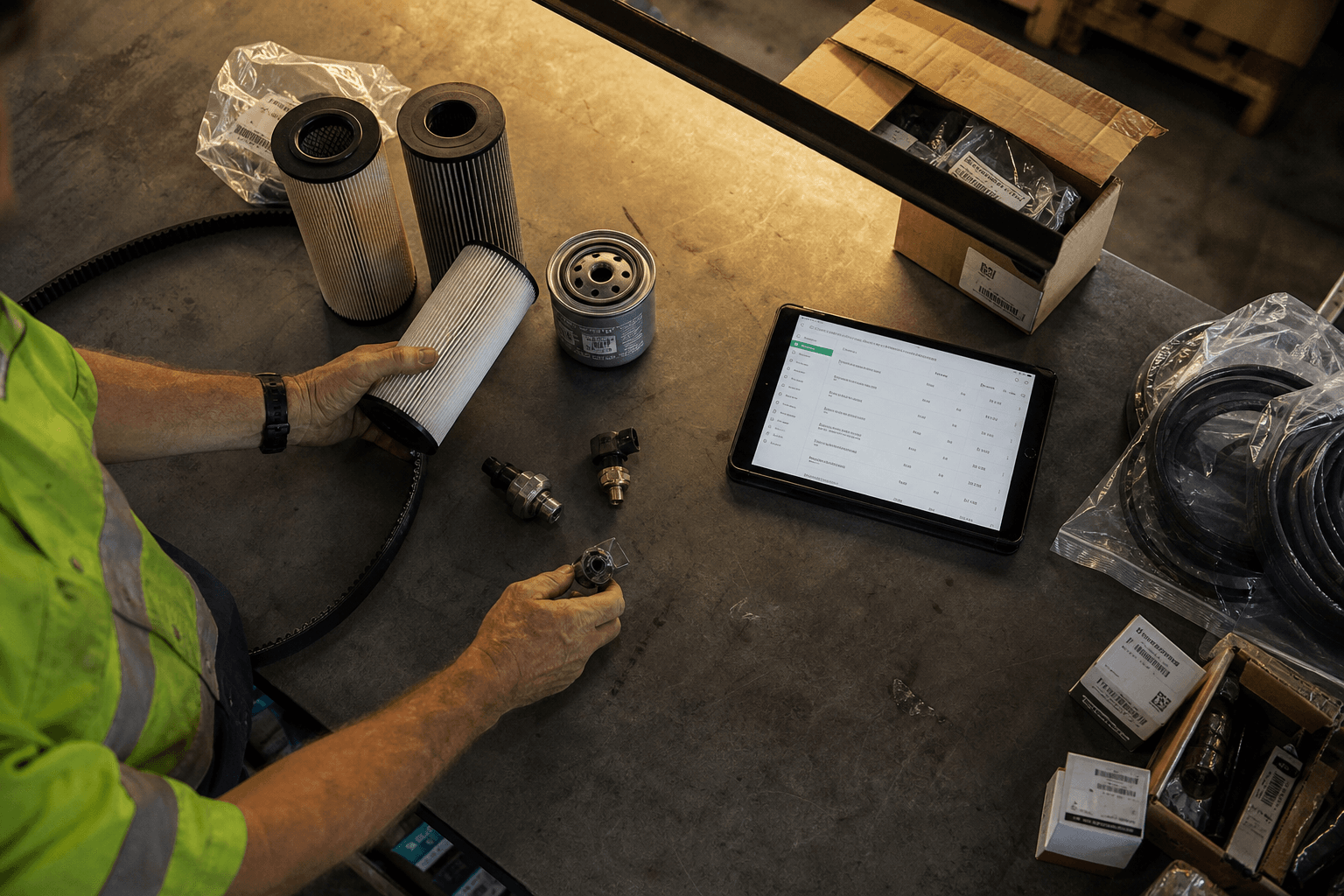
Most in-house fleet workshops run spare parts inventory on fixed reorder points set years ago, adjusted occasionally by gut feel. This causes two opposite problems at once: critical parts run out mid-job (grounding vehicles and blowing SLAs), while slow-moving parts pile up on shelves tying up working capital. Both problems come from the same root cause — stocking decisions aren't driven by actual usage patterns.

Workshops typically order parts based on supplier minimums, historical habit, or whoever happens to notice the shelf is low. There's rarely a system connecting fleet utilisation, maintenance schedules, vehicle age, and part failure rates back to what should be sitting in the parts room. The result is a workshop that's simultaneously under-stocked on the parts that matter and over-stocked on the ones that don't.
What is AI-assisted demand forecasting for spare parts?
AI-assisted demand forecasting for spare parts is the use of machine learning models to predict which parts a workshop will need, in what quantity, and by when — based on historical consumption, fleet composition, vehicle age and mileage, seasonal patterns, and maintenance scheduling data. Instead of a static reorder point, the model continuously updates its predictions as new data comes in.

This is a well-established pattern in other parts of logistics operations. The same underlying approach — using historical data to recommend optimal future allocations — is already applied to workforce scheduling in freight and warehouse operations, where AI models forecast labour demand from historical shift and volume data. Parts demand forecasting applies the same logic to a different resource: physical inventory instead of rostered hours.
How is this different from predictive maintenance?
Predictive maintenance and spare parts forecasting are related but distinct problems, and conflating them is a common mistake. Predictive maintenance asks "when will this specific vehicle or component fail?" Spare parts forecasting asks "given everything we know about the fleet, how many of this part should we be holding, and when should we reorder?"
Predictive maintenance models typically focus on telematics and sensor data for individual vehicles or components, flagging failure risk before it happens. Spare parts forecasting sits downstream of that — it aggregates demand signals across the whole fleet (including predictive maintenance alerts, if available) to answer a procurement and inventory question, not a failure-prediction question. A workshop can have excellent predictive maintenance and still run an inefficient parts room if the two systems aren't connected, or if parts stocking is left on manual reorder rules regardless of what the maintenance data is telling you.
How does AI-assisted forecasting compare to traditional reorder methods?
| Approach | Traditional reorder points | AI-assisted demand forecasting |
|---|---|---|
| Basis for stocking decisions | Fixed thresholds, supplier minimums, habit | Historical usage, fleet composition, maintenance schedules |
| Responsiveness to change | Manual review, infrequent | Continuously updated as new data arrives |
| Stockout risk on critical parts | Higher | Lower |
| Excess/slow-moving stock | Higher | Lower |
| Visibility across multiple depots | Limited, siloed by location | Consolidated, enterprise-wide |
| Integration with maintenance data | Rare | Possible, where maintenance systems are connected |
This is a qualitative comparison, not a guarantee of specific outcomes for every workshop — results depend heavily on data quality and how consistently the workshop records parts usage and maintenance activity.
What data do you need to get started?
You need consistent historical records of parts usage, work orders, and fleet composition before a forecasting model can produce useful output. At minimum, that means parts-out transaction history (what was used, on which job, for which vehicle), vehicle specifications and age, and some record of planned versus unplanned maintenance.
Many Australian workshops still record this information on paper job cards, in spreadsheets, or in legacy maintenance management systems that don't export cleanly. This is often the real blocker — not the forecasting model itself, but getting clean, structured data out of years of inconsistent record-keeping. Digitising paper-based job cards and invoices with document intelligence is frequently the first practical step, turning historical paper records into structured data a forecasting model can actually use.
How does this fit into a broader asset management approach?
Spare parts forecasting should sit within a workshop's broader asset management discipline, not run as an isolated spreadsheet exercise. The international standard for asset management, ISO 55000, frames inventory and maintenance planning as interconnected — a principle that applies directly to fleet workshops managing both vehicles and the parts that keep them running. Operators preparing maintenance and compliance documentation for the National Heavy Vehicle Regulator (nhvr.gov.au) also benefit from cleaner, more structured maintenance records as a byproduct of this kind of digitisation.
For transport and logistics businesses already modernising other parts of the operation — TMS replacement, EDI integration, route planning — spare parts forecasting is a natural adjacent step rather than a standalone project. It uses the same underlying discipline: consolidate scattered data, apply a forecasting model, and give operations staff a clear recommendation instead of a guess.
Is this worth doing for a mid-sized workshop?
It's worth evaluating if your workshop regularly experiences both stockouts on common parts and a parts room full of stock that hasn't moved in months — that combination is the clearest sign that reorder decisions aren't matched to actual demand. Industry experience across logistics and asset-heavy operations suggests that connecting historical usage data to stocking decisions typically reduces both problems simultaneously, though the scale of improvement depends on your current data quality and fleet size.
The practical starting point isn't a big-bang software rollout. It's an honest assessment of what data you already have, how clean it is, and whether a forecasting model could realistically improve on current practice. That's the kind of question an AI readiness assessment is designed to answer before committing to a larger build. For more on how AI is being applied across logistics operations more broadly, see our insights.
If you're exploring how AI demand forecasting could reduce stockouts and excess parts inventory in your fleet workshop, we can help assess whether your current data and systems are ready for it.
Zero Footprint
The Zero Footprint team — AI modernisation for Australian logistics.