AI-Assisted Weighbridge Reconciliation for Bulk Freight Billing
Weighbridge tickets and customer invoices don't always agree — and for bulk and break-bulk carriers, that gap means lost revenue or disputed billing. Here's how AI-assisted reconciliation catches discrepancies before they become write-offs.
What is weighbridge data reconciliation and why does it matter for billing accuracy?
Weighbridge data reconciliation is the process of matching gross, tare, and net weight records captured at the weighbridge against the quantities invoiced to customers, so that what was actually moved is what gets billed. For bulk and break-bulk carriers — grain, aggregates, scrap metal, mineral sands, fertiliser — this matters because billing is usually priced per tonne. A discrepancy between the docket and the invoice is not a paperwork issue. It is money left on the table, or money a customer can dispute.
This is a distinct problem from mass and dimension compliance. Compliance asks whether a vehicle is within its legal weight limit. Billing reconciliation asks whether the weight recorded at the bridge matches the weight charged to the customer, and whether both match what was actually delivered. A truck can be fully compliant and still be billed incorrectly.
Where do billing discrepancies actually come from?
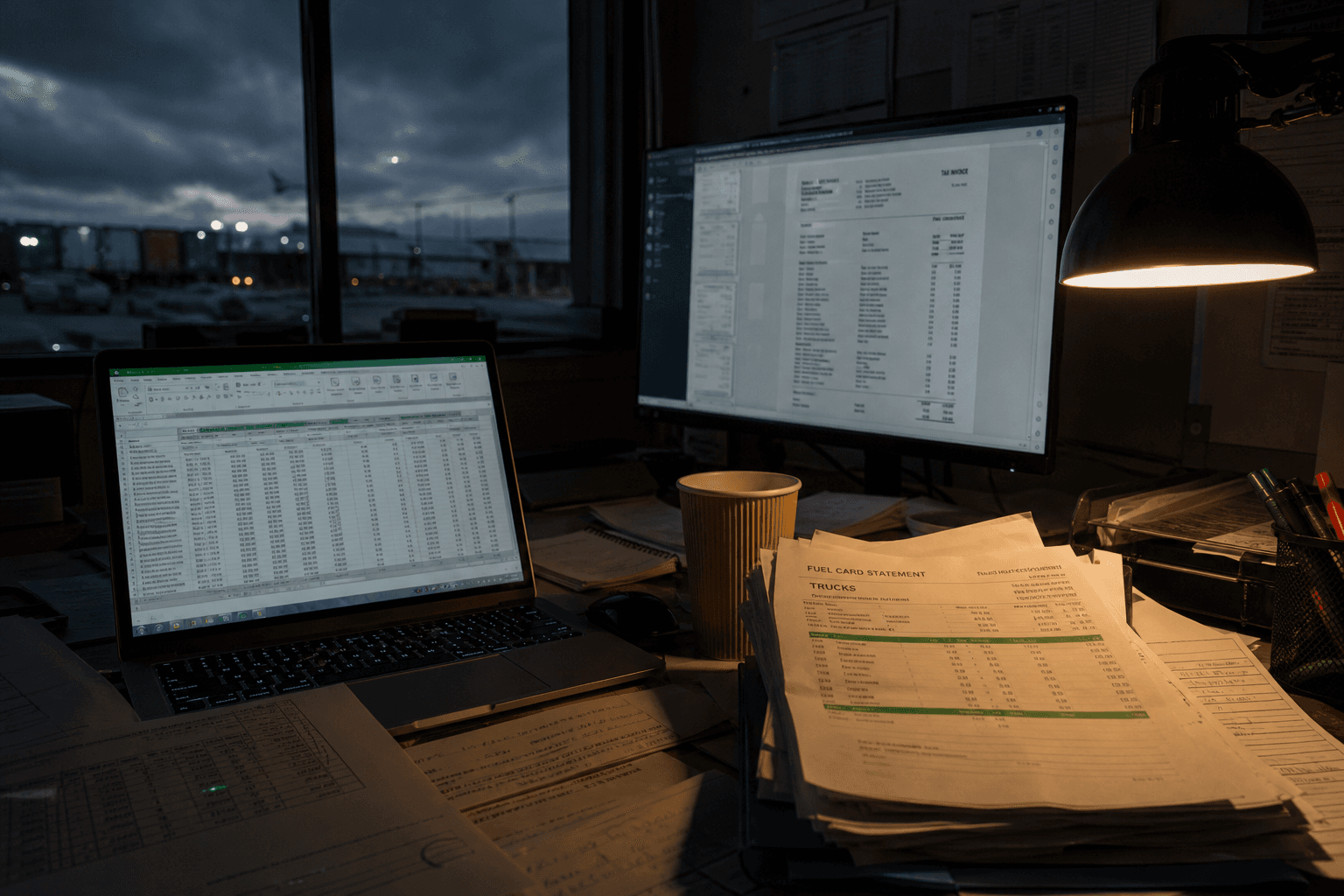
Most discrepancies come from manual handling of weighbridge data at multiple touchpoints — the docket is printed or handwritten at the bridge, re-keyed into a dispatch system, then re-keyed again into the invoicing system. Each transfer is a chance for a transposed digit, a missed ticket, or a tare weight that was never updated after a trailer swap.
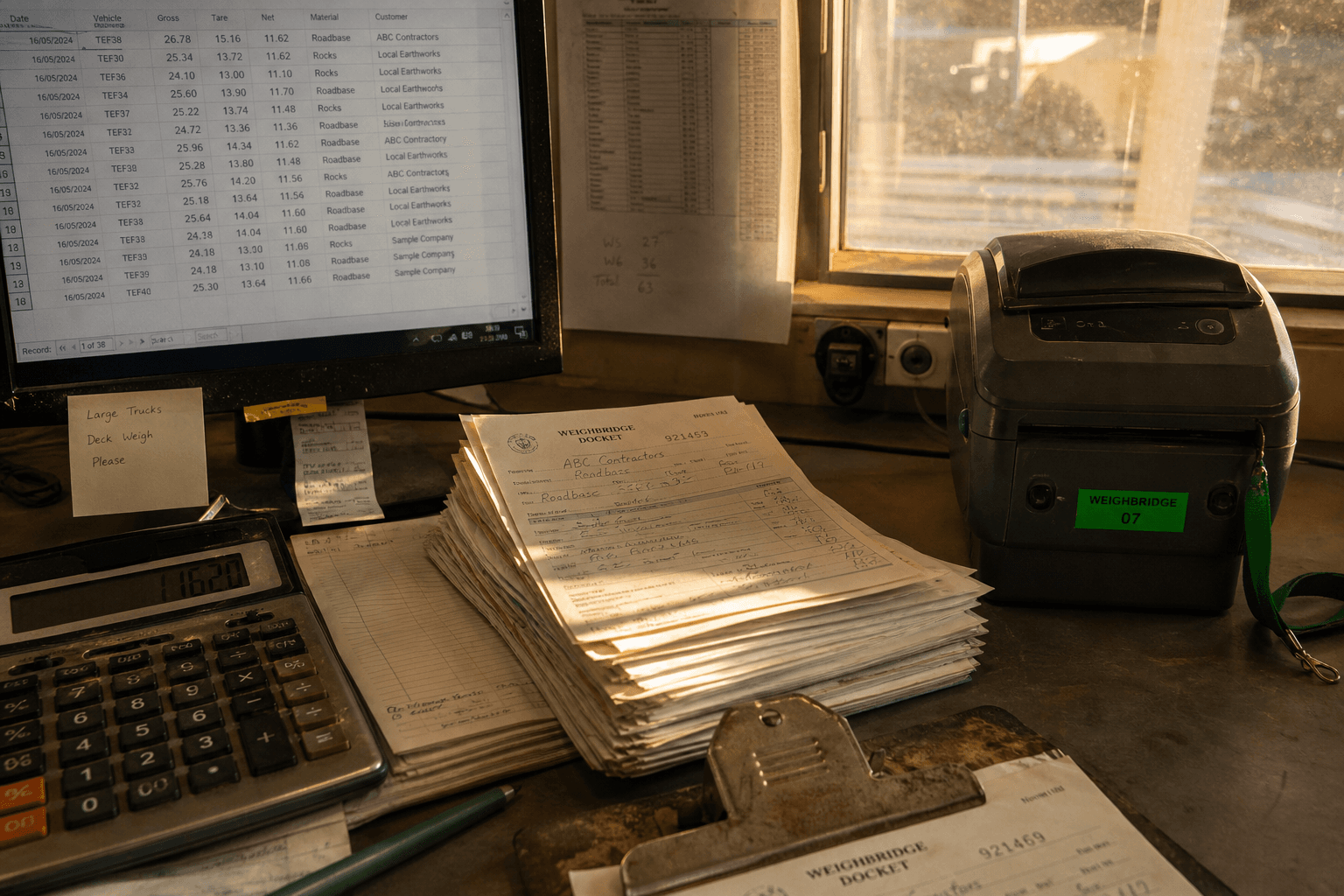
Common sources operators report include:
- Short-weighing: the delivered tonnage is less than the invoiced tonnage, often because the tare weight used in the calculation is stale or incorrect.
- Duplicate or missing tickets: a docket is logged twice, or a load is delivered but the ticket never makes it from the yard to the billing team.
- Manual transcription errors: weights are read off a printed ticket and typed into a spreadsheet or TMS, introducing simple keying mistakes.
- Mismatched reference numbers: a weighbridge ticket isn't linked to the correct purchase order or consignment, so it either isn't billed or is billed against the wrong customer.
- Rate and quantity mismatches: the correct tonnage is captured, but the wrong contract rate is applied at invoicing.
None of these require fraud or negligence to happen. They are the predictable result of a paper-and-spreadsheet process running across multiple sites, shifts, and systems. This is the same underlying issue that broader digital transformation in logistics tries to solve: replacing fragmented, manual data capture with a single, reliable source of operational truth.
How does AI-assisted reconciliation actually work?
AI-assisted reconciliation works by extracting structured data from weighbridge tickets — handwritten, printed, or digital — and automatically matching it against invoice line items, purchase orders, and delivery records, flagging anything that doesn't tie out for human review. Document intelligence tools use optical character recognition and machine learning to read dockets regardless of format, rather than relying on someone re-keying every field.
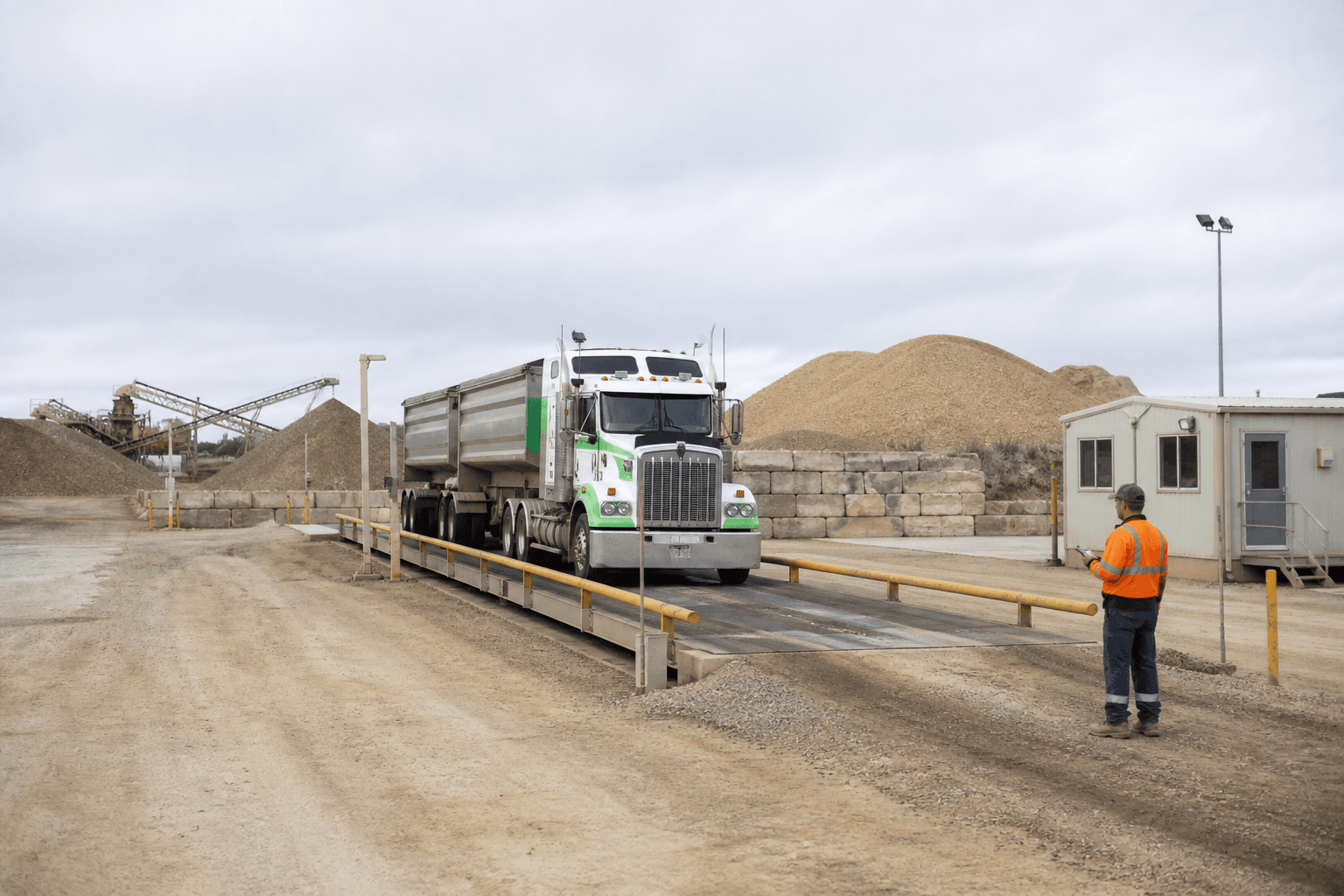
In practice, this typically involves three layers:
- Capture: the system ingests weighbridge tickets (scanned, photographed, or exported from the weighbridge software) and extracts gross, tare, net weight, date/time, vehicle ID, and reference numbers.
- Match: it cross-references each ticket against the corresponding invoice line, purchase order, or delivery docket, using reference numbers, vehicle registration, customer, and date as matching keys.
- Flag: where the ticket and invoice don't agree — on quantity, rate, or reference — the discrepancy is surfaced to a finance or operations team member for review, rather than being silently approved or silently lost.
This is the kind of problem our document-intelligence work is built for — taking unstructured paperwork that currently sits in filing cabinets or inboxes and turning it into data that can be checked automatically.
Manual reconciliation vs AI-assisted reconciliation
| Factor | Manual reconciliation | AI-assisted reconciliation |
|---|---|---|
| Data capture | Hand-keyed from printed or handwritten tickets | Automated extraction from scanned, photographed, or digital tickets |
| Discrepancy detection | Relies on someone noticing a mismatch, often after a customer dispute | Flagged automatically at the point of invoicing or before |
| Audit trail | Scattered across spreadsheets, emails, and filing cabinets | Centralised and traceable back to the source ticket |
| Time to investigate a dispute | Hours to days, searching paper records | Minutes, with ticket and invoice linked |
| Staff effort required | Ongoing manual checking, often deprioritised under time pressure | Review by exception — staff only look at flagged discrepancies |
The comparison here is qualitative rather than a promise of specific savings — the right benchmark depends on your current volume of tickets, number of sites, and how fragmented your existing process is.
Is this the same as mass and dimension compliance?
No. Mass and dimension compliance is about whether a vehicle's load is within legal limits under state and national heavy vehicle regulations. Billing reconciliation is a commercial accuracy problem — making sure the tonnage you invoice matches the tonnage you actually moved. A carrier can be fully compliant on mass limits and still be under-billing or over-billing customers because of a disconnect between the weighbridge ticket and the invoice. The two problems can share the same weighbridge data, but they answer different questions and sit with different teams — operations and safety for compliance, finance and billing for reconciliation.
Where does this fit for a bulk or break-bulk carrier getting started?
For most operators, this starts as a diagnostic question rather than a system purchase: how many of your current billing disputes trace back to a weighbridge discrepancy, and how long does it take your team to resolve one? An ai-readiness-assessment is a practical way to map your current ticket-to-invoice workflow, identify where manual handoffs introduce risk, and scope what an automated reconciliation layer would need to connect to — your weighbridge software, TMS, and finance system.
This sits within the broader pattern we see across mid-market Australian logistics businesses: legacy, paper-heavy processes that were built for a smaller, simpler operation and haven't been redesigned as volume grew. You can read more on this in our insights, including how digitisation projects are typically scoped and sequenced for operators with legacy TMS/WMS environments.
Get in touch
If billing disputes, short-weighing write-offs, or slow reconciliation cycles are costing your team time and revenue, we can help you work out what's actually fixable and what it would take. Get in touch to talk through your current weighbridge-to-invoice process.
Zero Footprint
The Zero Footprint team — AI modernisation for Australian logistics.