Automated Rate Card Extraction and Comparison with AI
AI-powered rate card extraction transforms freight procurement by automatically converting carrier PDFs and emails into structured data for systematic comparison. This eliminates manual transcription and enables automated benchmarking across carriers.

Automated Rate Card Extraction and Comparison with AI
Freight procurement teams waste countless hours manually extracting rates from carrier PDFs and emails. Automated rate card extraction uses AI to convert these documents into structured data, enabling systematic comparison and benchmarking. This transforms a weeks-long manual process into an automated workflow that runs in minutes.
What is automated rate card extraction?
Automated rate card extraction is the process of using artificial intelligence to identify, extract, and structure freight rates from carrier documents. The AI reads PDF rate cards, email attachments, and scanned documents to pull out base rates, surcharges, lane-specific pricing, and terms into a standardised format.
Most carriers still distribute rate cards as PDFs or embedded tables in emails. These documents contain complex pricing structures with base rates, fuel surcharges, accessorial charges, and zone-specific pricing. Manual extraction requires logistics teams to spend hours transcribing data into spreadsheets, often introducing errors in the process.
How AI extracts data from rate card documents
Modern document intelligence platforms use computer vision and natural language processing to understand the structure of rate cards. The AI identifies different types of content:
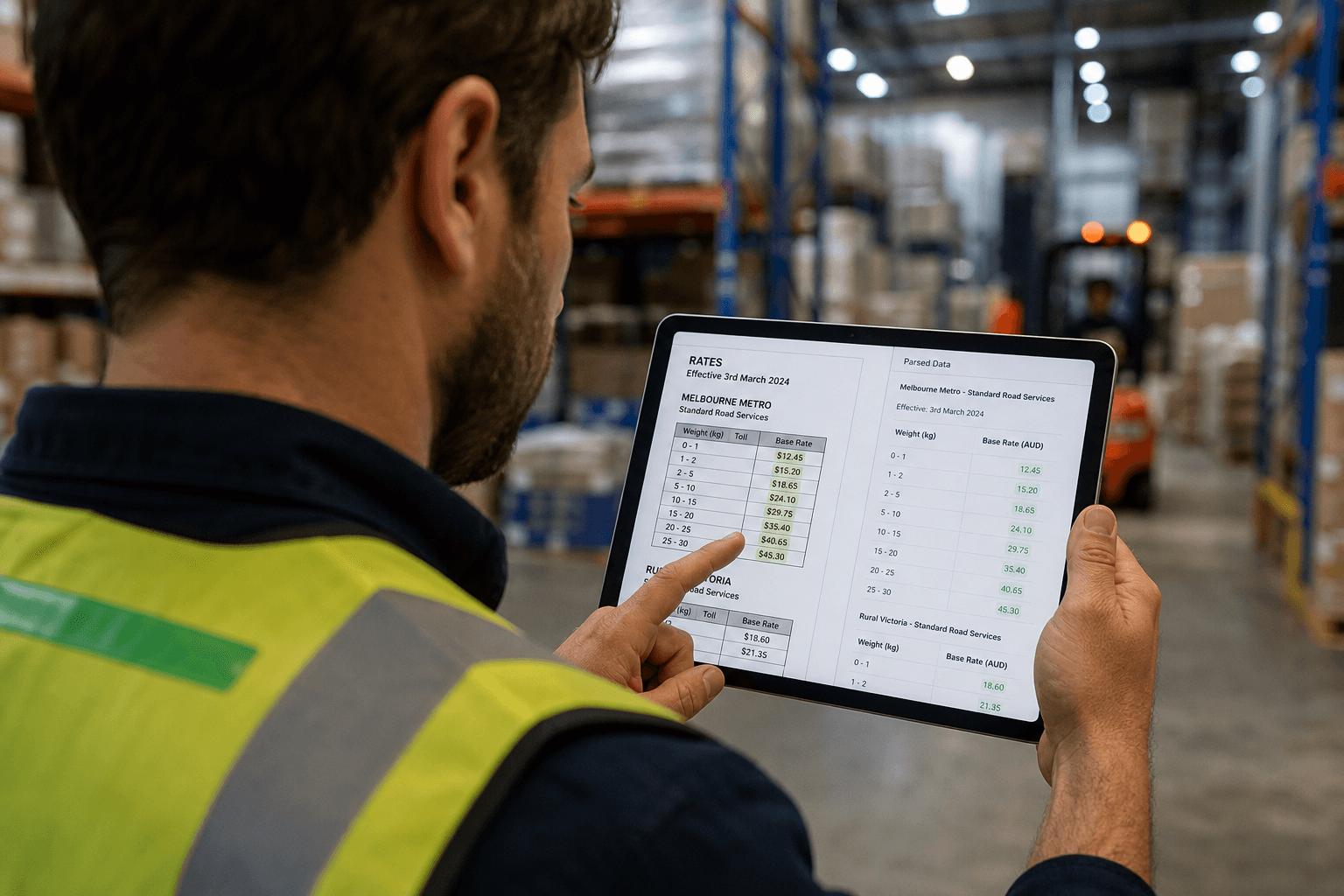
- Table extraction: Recognises tabular data even in scanned or poorly formatted PDFs
- Text parsing: Extracts surcharge descriptions, terms, and conditions
- Visual element detection: Understands headers, footers, and document sections
- Contextual understanding: Determines which numbers represent rates versus weights or zones
The AI learns to handle variations in carrier formatting. Some carriers use landscape tables, others use portrait layouts. Some embed rates in email text, others attach multi-page PDFs. The system adapts to these different formats while maintaining extraction accuracy.
Surcharge parsing and standardisation
Carrier rate cards include dozens of potential surcharges with inconsistent naming and calculation methods. AI surcharge parsing identifies and standardises these charges:
| Carrier A Term | Carrier B Term | Standardised Term |
|---|---|---|
| Fuel Adjustment Factor | FAF | Fuel Surcharge |
| Out of Area Delivery | Remote Area | Extended Area |
| Residential Delivery | Home Delivery | Residential |
The AI maps variant terms to standard categories, ensuring accurate comparison across carriers. It also extracts calculation methods—whether surcharges are percentage-based, flat fees, or weight-dependent.
Surcharge extraction goes beyond simple text recognition. The AI understands context, distinguishing between a fuel surcharge rate of "15%" and a service description mentioning "Route 15". This contextual understanding prevents data corruption during extraction.
Lane-based rate comparison
Once extracted, rates need comparison across carriers for specific shipping lanes. Lane-based comparison matches origin-destination pairs and standardises rate structures for direct comparison.

The AI handles different carrier zone systems by mapping postcodes and suburbs to standardised geographic regions. It converts weight breaks to common intervals and adjusts for different service types (standard, express, economy).
Comparison outputs show not just the lowest base rate, but total landed cost including all applicable surcharges. This prevents procurement teams from selecting carriers based on attractive base rates that become expensive once surcharges are applied.
Automated rate benchmarking for procurement
Beyond individual rate comparisons, AI enables systematic benchmarking against market rates and historical pricing. The system tracks rate changes over time, identifies seasonal patterns, and flags unusual pricing variations.
Procurement teams receive automated alerts when:
- Rates increase above predetermined thresholds
- New carriers offer competitive rates for existing lanes
- Market conditions suggest renegotiation opportunities
- Contract terms approach renewal dates
This ongoing benchmarking transforms procurement from reactive quote comparison to proactive market analysis. Teams can negotiate from a position of market knowledge rather than relying on carrier-provided benchmarks.
Implementation considerations
Successful rate card extraction requires careful system design. The AI needs training on your specific carrier mix and document formats. Integration with existing transportation management systems ensures extracted rates flow into routing and carrier selection processes.
Data validation remains important. While AI extraction is highly accurate, procurement teams should review extracted rates for unusual variations or obvious errors. Most implementations include human review workflows for high-value lanes or significant rate changes.
Security considerations are critical when handling commercial rate information. Extraction systems should include access controls, audit trails, and secure document storage. Many organisations prefer on-premises or private cloud deployment for rate card processing.
Beyond rate extraction: strategic insights
Automated extraction enables analysis that's impossible with manual processes. Procurement teams can identify:
- Carriers consistently offering competitive rates for specific lanes
- Geographic regions where rate competition is limited
- Surcharge trends that indicate changing carrier cost structures
- Opportunities for volume consolidation or route optimisation
This intelligence supports strategic procurement decisions beyond individual shipment cost optimisation. Teams can develop carrier relationship strategies based on comprehensive rate analysis rather than gut feel or limited sampling.
Modern document intelligence platforms make this level of analysis accessible to mid-market logistics operators. The technology that once required significant IT investment is now available as managed services.
Getting started with automated rate extraction
Most successful implementations begin with a pilot program focusing on major carriers and high-volume lanes. This allows teams to validate extraction accuracy and integration workflows before scaling to the full carrier base.
The pilot should include representatives from procurement, operations, and finance to ensure extracted data meets all stakeholder needs. Success metrics typically focus on time savings, data accuracy, and improved procurement outcomes rather than just technical functionality.
For more insights on modernising logistics operations, visit our blog for practical guidance on AI implementation in Australian logistics.
If you're exploring automated rate card extraction for your procurement team, we can help assess your current processes and design a solution that fits your carrier mix and operational requirements.
Zero Footprint
The Zero Footprint team — AI modernisation for Australian logistics.