Cold Chain Monitoring AI: Temperature Control for Australian Logistics
AI-powered cold chain monitoring is shifting Australian logistics operators from reactive incident reports to real-time, predictive temperature control. This guide covers how the technology works, what FSANZ and TGA standards require, and how to evaluate whether an investment makes sense for your operation.
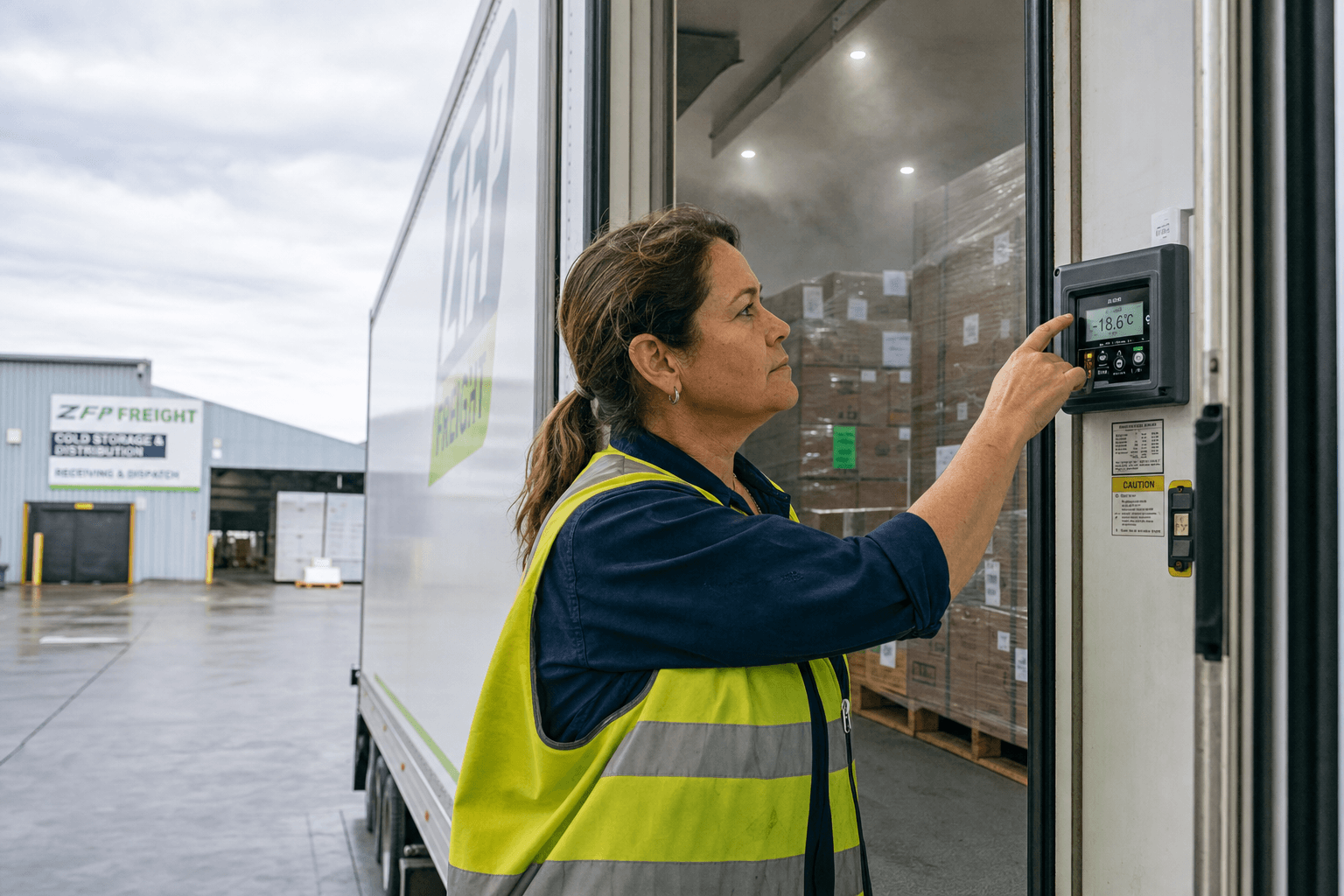
Cold chain logistics is one of the highest-stakes areas in Australian freight. A single temperature excursion can render an entire load non-compliant, trigger regulatory action, or destroy product worth tens of thousands of dollars. AI-powered cold chain monitoring is changing how carriers, 3PLs, and distributors manage that risk — moving from reactive incident reports to real-time, predictive temperature control.
This guide covers how AI monitoring works in practice, what Australian food safety and pharmaceutical standards require, and how to evaluate whether a technology investment makes sense for your operation.
What Is AI-Powered Cold Chain Monitoring?
AI-powered cold chain monitoring is the use of machine learning and real-time sensor data to detect, predict, and respond to temperature excursions before product is compromised. Unlike basic data loggers that record what happened, AI systems analyse patterns across sensors, routes, and environmental conditions to flag risk before a breach occurs.
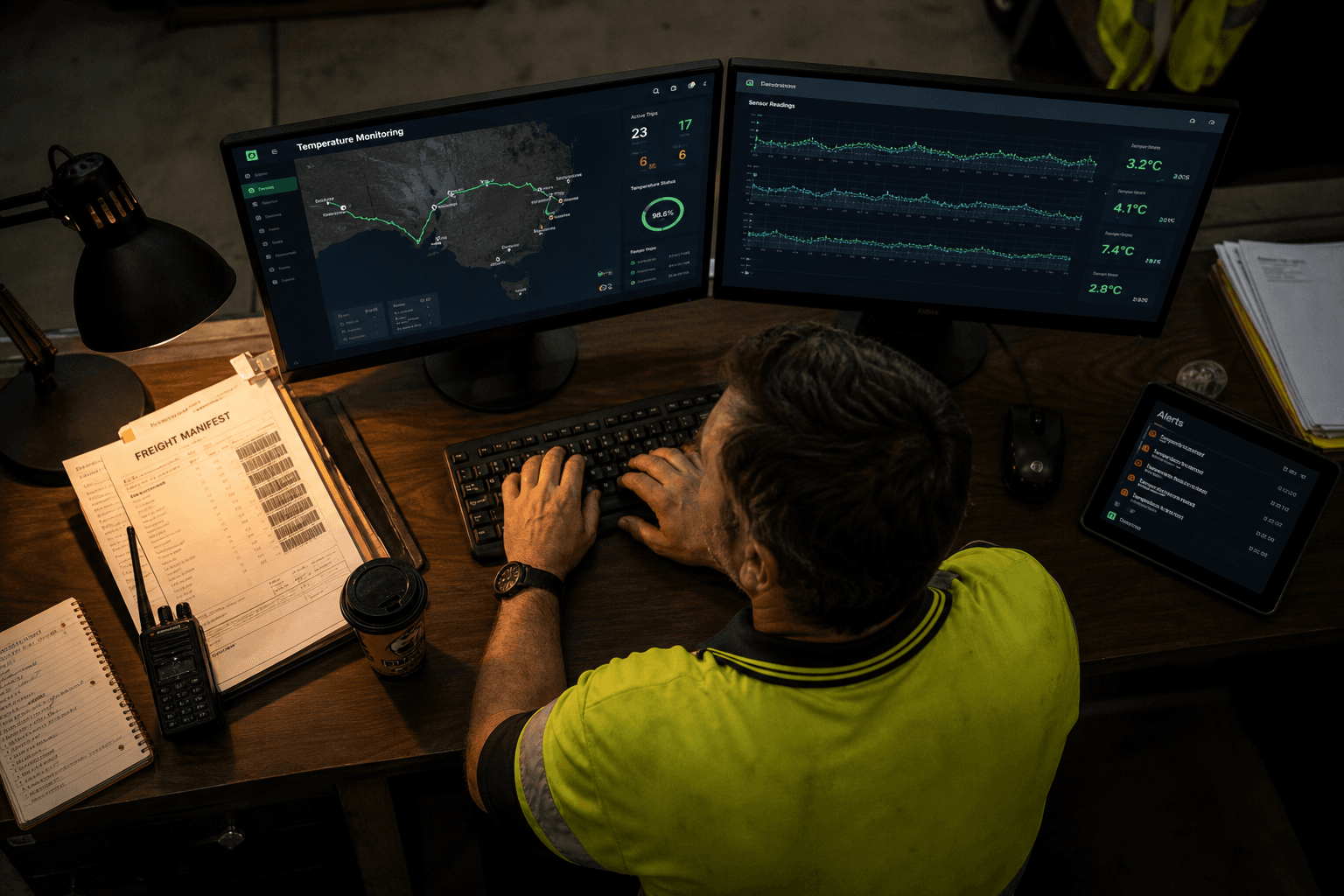
The core components are IoT temperature sensors placed in trailers, containers, or storage zones; a data platform that aggregates readings in real time; and an AI layer that identifies anomalies, predicts equipment failure, and generates alerts. The difference between a traditional logger and an AI-enabled system is the shift from recording history to predicting what happens next.
Why Cold Chain Failures Are Costly in Australia
Australia's climate creates particular challenges. Long-haul routes between major centres — Melbourne to Perth, Brisbane to Darwin — expose refrigerated freight to extreme ambient temperatures for extended periods. Urban last-mile delivery in summer adds further thermal stress.
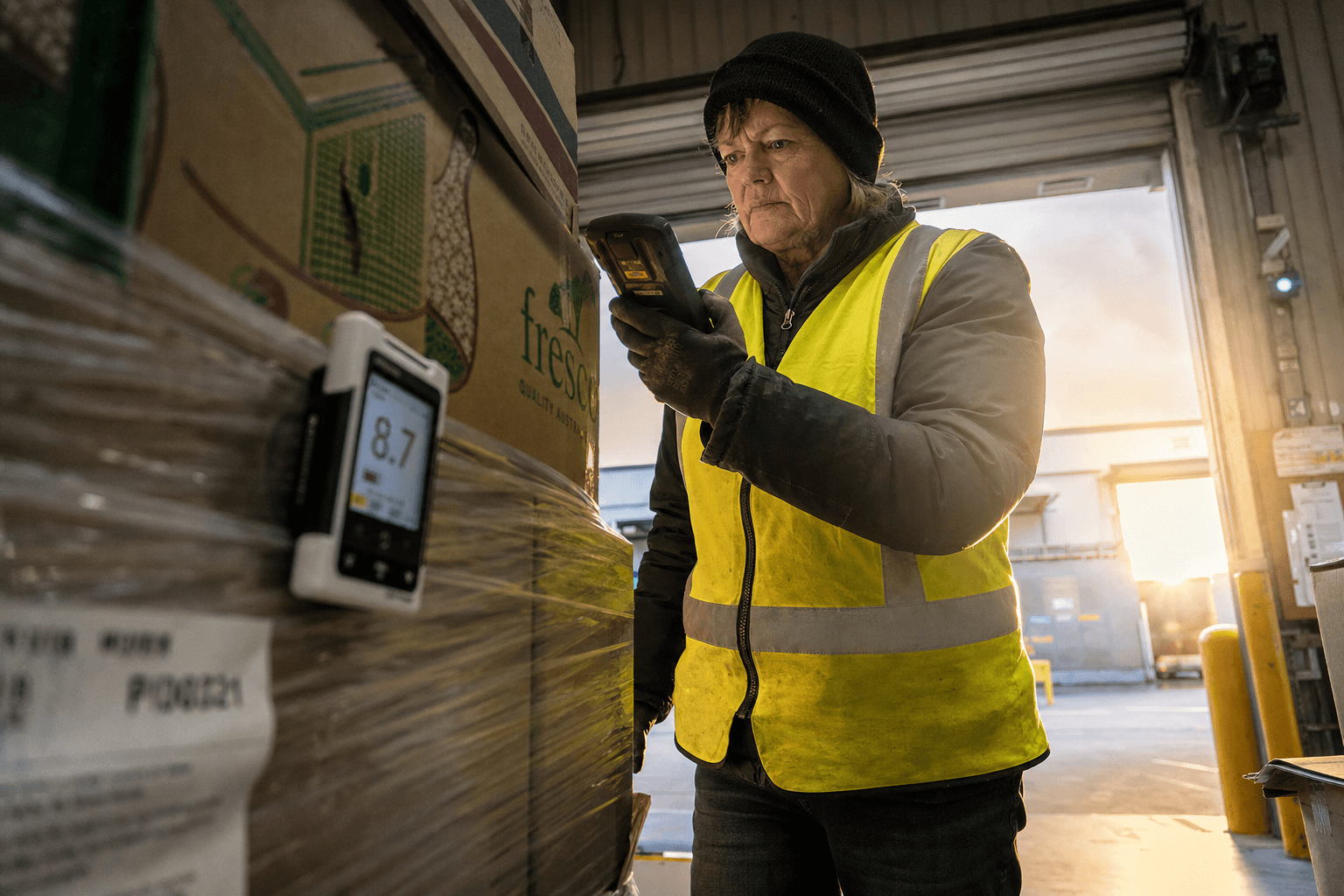
The regulatory environment adds financial risk to operational risk. Non-compliant product that breaches FSANZ food safety standards or TGA pharmaceutical guidelines may need to be destroyed, triggering insurance claims, customer disputes, and in serious cases, regulatory penalties. Manual temperature logs that are incomplete or inconsistent are a consistent finding in food safety audits.
The cost of a cold chain failure is rarely just the product. It includes the labour to investigate, the customer relationship impact, and the compliance liability.
Australian Regulatory Standards for Cold Chain
Understanding the regulatory baseline helps frame what your monitoring system actually needs to do.
Food Standards Australia New Zealand (FSANZ) sets requirements for temperature control of potentially hazardous food under the Australia New Zealand Food Standards Code. The general requirement is that food must be kept at or below 5°C or at or above 60°C, with documented evidence of compliance during transport and storage.
The Australian Cold Chain Guidelines, published by the Australian Food and Grocery Council (AFGC) and the Refrigerated Warehouse and Transport Association of Australia (RWTA), provide detailed industry guidance on temperature zones, excursion limits, and record-keeping expectations. These are not legally binding in the same way as FSANZ standards, but major retailers and food manufacturers reference them in supplier contracts.
TGA guidelines for medicinal products require continuous temperature monitoring during transport, validated cold chain processes, and documented excursion management procedures. GDP (Good Distribution Practice) obligations are particularly relevant for pharmaceutical 3PLs.
HACCP principles, which underpin food safety management in Australian facilities, require that critical control points — including temperature — are monitored with documented corrective actions.
A compliant AI monitoring system needs to support all of these: continuous logging, configurable alert thresholds, excursion documentation with timestamps, and exportable audit trails.
How AI Monitoring Works in a Cold Chain Context
Real-Time Sensor Integration
Modern cold chain AI platforms ingest data from multiple sensor types — wireless temperature probes, door open/close sensors, GPS location, and sometimes humidity or CO₂ sensors depending on the product type. Data is transmitted via cellular or satellite networks, with edge computing increasingly used to maintain monitoring capability in areas with poor connectivity.
The AI layer does several things with this data stream. It flags readings that deviate from expected ranges. It correlates temperature changes with events like door openings, vehicle stops, or ambient temperature spikes. And it builds baseline models for each route, vehicle, and product type so that anomalies are assessed in context rather than against a static threshold.
Predictive Alerts vs. Reactive Alerts
The practical difference between a data logger and an AI system is when you find out about a problem.
| Capability | Data Logger | AI Monitoring Platform |
|---|---|---|
| Records temperature history | Yes | Yes |
| Real-time alerts | Some models | Yes |
| Predicts excursion before it occurs | No | Yes |
| Correlates events (door open, ambient temp) | No | Yes |
| Automated audit trail | Manual export | Automated |
| Integration with TMS/WMS | Limited | API-based |
| Route-level performance benchmarking | No | Yes |
The value of predictive alerting is the ability to take corrective action — rerouting, pre-cooling a replacement vehicle, notifying a customer — before product is lost rather than after.
Excursion Management and Documentation
When a temperature excursion does occur, AI platforms generate structured incident records: the time of breach, duration, maximum/minimum temperature reached, the product affected, and the corrective actions taken. This documentation is exportable for audits and can be shared directly with customers or regulators.
For pharmaceutical logistics, some platforms support Mean Kinetic Temperature (MKT) calculations, which are used to assess whether a temperature excursion has actually compromised product stability — a critical capability for avoiding unnecessary product destruction.
Evaluating Cold Chain Monitoring Solutions for Australian Operations
Several established platforms operate in this space globally, including Sensitech, Controlant, and Roambee. When evaluating any solution for an Australian operation, the relevant criteria are more specific than a global feature list.
Key Evaluation Criteria
| Criteria | What to Look For |
|---|---|
| Connectivity in remote areas | Satellite fallback or store-and-forward for outback routes |
| Regulatory alignment | FSANZ, TGA, AFGC/RWTA guideline support built into alert thresholds |
| Audit trail format | Exportable, timestamped, tamper-evident records |
| Integration capability | API connectivity to your existing TMS, WMS, or ERP |
| Alert latency | How quickly does an alert reach the driver or dispatcher? |
| MKT calculation | Required for pharmaceutical and some food products |
| Local support | Australian-based support for regulatory and operational queries |
| Data sovereignty | Where is your data stored? Australian data residency matters for some clients |
Connectivity in the Australian Context
One of the most important and frequently underestimated requirements for Australian operations is connectivity. A platform that works well in European or North American logistics corridors may have meaningful gaps on routes like the Hume Highway at 2am, the Nullarbor, or regional Queensland delivery runs. Satellite connectivity options and store-and-forward capability (where the device logs data locally and transmits when connectivity resumes) are not optional features for many Australian operators — they are baseline requirements.
Integration with Existing Systems
For mid-market operators running a legacy TMS or WMS, the integration question is often the deciding factor. A sophisticated monitoring platform that cannot push alerts and records into your existing systems creates parallel workflows — which means manual reconciliation, duplicated data entry, and reduced adoption by operations staff. Before evaluating platforms on features, assess what integration your current systems support.
If you are uncertain about your systems' integration readiness, an AI readiness assessment can clarify what connectivity is feasible before you commit to a platform.
The Business Case for AI Cold Chain Monitoring
Building the business case for cold chain AI monitoring requires understanding the cost drivers in your specific operation. The categories to quantify are typically:
Product loss from temperature excursions. If you are experiencing excursions today — even occasional ones — quantifying the average cost per incident and annual frequency gives you a baseline. Reducing excursion frequency and severity through predictive alerting directly reduces this cost.
Labour for manual temperature logging and compliance documentation. Manual log reconciliation, audit preparation, and excursion investigation are time-consuming. Automated documentation reduces this overhead, though the saving varies significantly by operation size and existing process maturity.
Insurance and liability exposure. Some insurers offer preferential terms for operations with validated continuous monitoring. This is worth exploring with your broker if you carry high-value temperature-sensitive product.
Customer and contract requirements. Increasingly, major retailers and food manufacturers require suppliers to demonstrate continuous cold chain monitoring as a condition of supply. Winning or retaining contracts that require this capability has a direct revenue value.
Regulatory compliance cost avoidance. The cost of a serious food safety or pharmaceutical non-compliance event — product recall, regulatory action, reputational damage — is difficult to quantify in advance but substantial. Robust monitoring reduces this risk.
Qualitative Comparison: Manual vs. AI Monitoring
| Dimension | Manual / Data Logger | AI Monitoring Platform |
|---|---|---|
| Excursion detection speed | After delivery or manual check | Real-time during transit |
| Corrective action window | Often none | Before product is compromised |
| Audit preparation time | High (manual log collation) | Low (automated export) |
| Compliance confidence | Variable | Structured and consistent |
| Scalability as fleet grows | Degrades (more manual work) | Scales with platform |
| Customer reporting capability | Limited | Configurable, shareable |
Implementation Considerations for Mid-Market Operators
For operators in the 50–500 employee range, implementation sequencing matters. A phased approach typically works better than a fleet-wide rollout.
Start with your highest-risk routes or product categories. Pharmaceutical freight, high-value perishables, or routes with historically high excursion rates are the right place to begin. This limits initial cost, generates clear evidence of performance, and allows your team to develop familiarity with the platform before broader rollout.
Involve your drivers and operations staff early. Alert fatigue is a real risk if thresholds are poorly configured in the first weeks. Work with drivers to understand what in-cab alerts are useful versus disruptive. Operations staff who understand why the system exists and how to act on alerts will use it; those who feel monitored without context will find workarounds.
Plan your audit trail process before go-live. Decide in advance how excursion records will be stored, who reviews them, and how they will be provided to customers or auditors on request. The technology generates the data; your process determines whether it is actually useful for compliance.
Assess integration requirements before selecting a platform. If your TMS or WMS cannot receive API data from a monitoring platform, you will be managing two separate systems. This is solvable, but the cost and effort need to be in your business case.
For broader questions about how AI monitoring fits within your existing technology stack, explore our insights on logistics technology for mid-market operators.
Cold Chain Monitoring and Emissions Reporting
There is an underappreciated connection between cold chain monitoring and emissions reporting obligations. Refrigerated transport is a significant contributor to fleet emissions. More precise route and load data — captured as part of cold chain monitoring — can support more accurate Scope 1 and Scope 3 emissions calculations.
For operators approaching AASB S2 reporting obligations, the data infrastructure for cold chain monitoring and emissions reporting has meaningful overlap. Investing in connected fleet monitoring creates a data foundation that serves both operational and compliance purposes. Our emissions reporting service helps operators understand how their existing data assets can support AASB S2 compliance.
Summary: What Australian Cold Chain Operators Need from AI Monitoring
AI-powered cold chain monitoring is not a single product — it is a capability that needs to fit your routes, your product types, your regulatory obligations, and your existing systems. For Australian operators, the specific requirements around connectivity, FSANZ and TGA compliance, and data sovereignty mean that a global platform evaluation needs to be filtered through local operational realities.
The core value proposition is straightforward: move from finding out about temperature failures after the fact to having the information and the time to prevent them. For operations where a single compromised load can cost more than a year of monitoring subscription fees, the business case is often clear once the right data is on the table.
If you are exploring cold chain monitoring for your operation and want to understand what is feasible given your current systems and routes, get in touch and we can walk through the options with you.
Zero Footprint
The Zero Footprint team — AI modernisation for Australian logistics.