AI Document Intelligence for Australian Logistics
Document intelligence automates the extraction, validation, and routing of logistics documents — from bills of lading to dangerous goods declarations. This guide explains how it works, what Australian compliance obligations it supports, and how to evaluate your options.
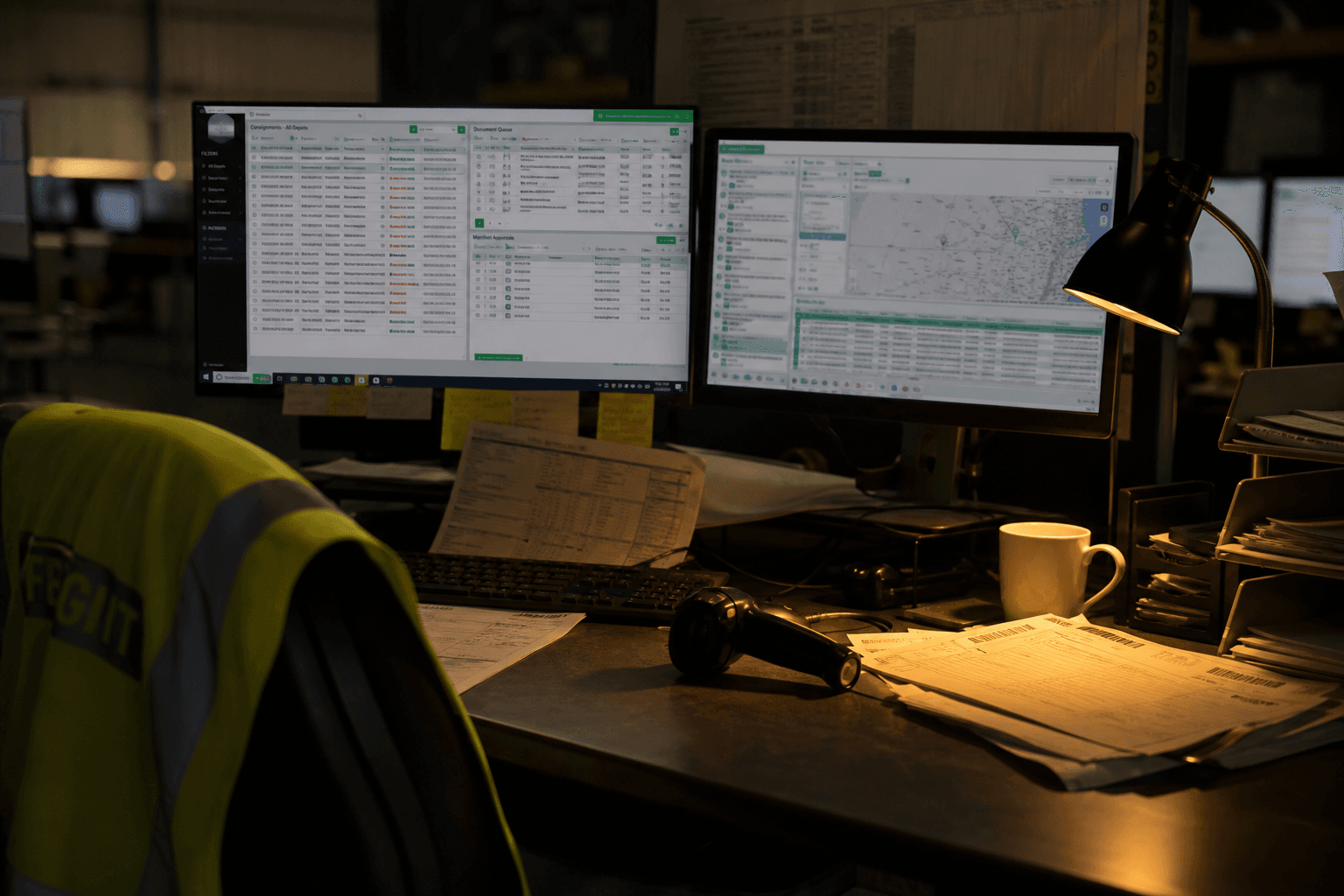
Document handling is one of the most labour-intensive parts of running a logistics operation. Bills of lading, proof of delivery, freight invoices, dangerous goods declarations, and customs entries flow through your business every day — and most of them are still processed by hand. Document intelligence changes that.
This guide explains how AI-powered document processing works in a logistics context, what Australian operators need to consider for compliance, and how to evaluate whether it's the right investment for your business.
What Is Document Intelligence in Logistics?
Document intelligence is the use of artificial intelligence — specifically optical character recognition (OCR), natural language processing (NLP), and machine learning — to automatically extract, validate, and route data from logistics documents. Rather than a staff member manually keying a bill of lading into a TMS, the system reads the document, identifies the relevant fields, and pushes the data where it needs to go.
Modern document intelligence platforms go well beyond basic OCR. They understand document structure, handle handwritten fields, learn from corrections, and flag anomalies for human review. In a logistics context, this means fewer data entry errors, faster document turnaround, and a complete digital audit trail.
Which Documents Are Most Commonly Automated?
The documents that deliver the most value when automated are those that are high-volume, structured, and downstream-dependent — meaning other processes can't proceed until the data is captured.

| Document Type | Typical Manual Effort | Automation Potential | Downstream Impact |
|---|---|---|---|
| Bill of Lading (BOL) | High | High | POD matching, invoicing, customer visibility |
| Proof of Delivery (POD) | Medium–High | High | Invoice release, claims management |
| Freight Invoice | High | High | Accounts payable, rate auditing |
| Dangerous Goods Declaration | Medium | Medium | Compliance records, route restrictions |
| Customs Entry / Import Declaration | High | Medium–High | Clearance, duty calculation |
| Packing List | Medium | High | Warehouse receiving, inventory update |
| Temperature Records (cold chain) | Low–Medium | High | HACCP compliance, SLA reporting |
For most mid-market Australian logistics operators, BOLs, PODs, and freight invoices represent the highest volume and therefore the fastest return on investment.
How AI Document Processing Works in Practice
Document intelligence for logistics typically follows a four-stage pipeline:
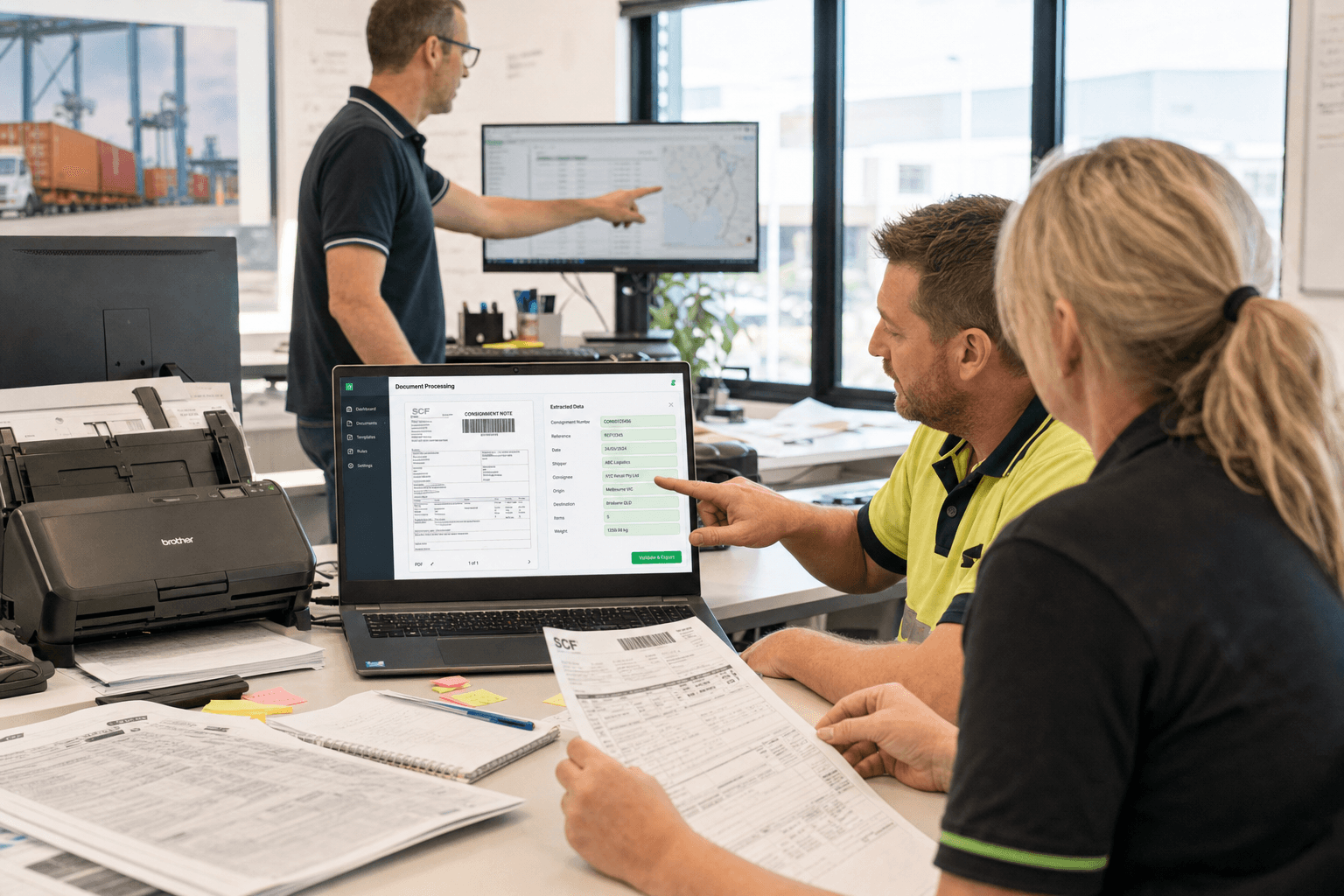
1. Ingestion Documents arrive via email, scanner, driver app, EDI, or customer portal. The system captures them in a central queue regardless of format — PDF, image, Word document, or structured data file.
2. Classification The AI model identifies what type of document it is. A BOL is treated differently from a freight invoice or a dangerous goods declaration. Good systems handle mixed batches without manual sorting.
3. Extraction and Validation Key fields are extracted — consignment number, shipper, receiver, weight, commodity, delivery date. The system then validates against your existing data: does this consignment number exist in your TMS? Does the weight match the booking? Mismatches are flagged, not silently passed through.
4. Routing and Integration Extracted data is pushed into your TMS, WMS, ERP, or accounts payable system via API or flat file. Exceptions go to a review queue with clear context so staff can resolve them quickly.
The key difference between document intelligence and older OCR tools is the validation and exception-handling layer. Raw OCR moves documents. Document intelligence moves correct data.
How to Evaluate Document Intelligence Options
The document processing market includes general-purpose cloud platforms, industry-specific solutions, and custom-built systems. Each has trade-offs worth understanding before you commit.
General-purpose cloud platforms from major technology vendors offer strong foundational OCR and extraction capabilities. They are well-suited to high-volume, standardised document types and integrate readily into broader cloud ecosystems. The investment required to configure them for logistics-specific document structures — consignment notes, CMRs, dangerous goods declarations — will vary depending on the complexity of your document formats and how much pre-built logistics support the platform includes.
Logistics-specific solutions are built around the document types, field structures, and validation rules common to freight and warehousing. They typically require less configuration for standard logistics documents, though they may offer less flexibility if your needs fall outside common use cases.
Custom-built systems give you the most control over how documents are classified, validated, and routed — but require ongoing technical ownership, whether internal or through a managed services partner.
When evaluating any option, the questions that matter most are practical ones: How does it handle your specific document formats, including handwritten fields and non-standard layouts? What does the exception-handling workflow look like for your team? How does it integrate with your existing TMS or WMS? What does retraining or model maintenance look like as your document types evolve? And who is responsible for that work?
An AI readiness assessment can help you clarify which approach is the right fit before you commit to a platform.
Australian Compliance Requirements That Document Intelligence Supports
Australian logistics operators work under a range of regulatory obligations where accurate, retrievable document records are essential.
Chain of Responsibility (CoR)
Under the Heavy Vehicle National Law (HVNL), all parties in the supply chain — not just the driver — share legal responsibility for breaches. This includes obligations around accurate consignment records, load documentation, and fatigue management records. Document intelligence creates a timestamped, searchable digital record that supports CoR audits.
AASB S2 and Scope 3 Emissions Reporting
From 1 July 2025, Group 2 entities under the Australian Accounting Standards Board's climate disclosure framework will need to report Scope 3 emissions, which include freight emissions from carriers. Accurate freight document capture — distances, vehicle types, load weights — is the foundation of defensible emissions calculation. If your document data is incomplete or inconsistent, your emissions numbers will be too. You can read more about how this affects logistics businesses in our emissions reporting service page.
NGER Reporting
For operators who report under the National Greenhouse and Energy Reporting scheme, document intelligence supports the data capture and audit trail requirements that underpin accurate NGER submissions. Freight operators with significant fuel consumption or fleet size should ensure their document systems can produce the activity data required for NGER calculations.
Dangerous Goods and Customs
Accurate capture and retention of dangerous goods declarations and customs entries is a legal requirement. Manual processing creates gaps. Automated capture with validation reduces the risk of records being incomplete, misfiled, or missing at audit.
What to Expect From Implementation
For a mid-market Australian logistics operator, a practical document intelligence implementation typically involves four phases: scoping and data audit, model configuration and testing, integration with existing systems, and staff training for exception handling.
The scoping phase matters more than most operators expect. The quality of your outcomes depends heavily on understanding which document types are highest priority, what your current error rates look like, and how documents currently move through your business. Operators who skip this step tend to build solutions that work for the easy cases and fall over on the exceptions — which are often the cases that matter most.
Integration complexity varies. Connecting to a modern TMS or cloud-based WMS is generally straightforward. Legacy systems may require middleware or flat-file interfaces. It is worth mapping your integration requirements before selecting a platform, not after.
Staff adoption is rarely the barrier people expect, provided the exception-handling workflow is well designed. If the system makes the easy work disappear and presents the hard work clearly, most teams adapt quickly.
Is Document Intelligence Right for Your Business?
Document intelligence delivers the most value when document volume is high, errors have downstream consequences, and staff time spent on data entry is a real cost. For most Australian carriers, 3PLs, and warehouse operators processing more than a few hundred documents per week, the case is straightforward.
The harder question is usually where to start and how to sequence the investment alongside other technology priorities. That depends on your current systems, your compliance obligations, and where the operational pain is greatest.
If you are unsure where document intelligence fits in your broader technology roadmap, our AI readiness assessment is a practical starting point. It maps your current state, identifies the highest-value opportunities, and gives you a clear picture of what implementation would involve.
For more on related topics, visit our route optimisation and emissions reporting service pages, or browse more insights on AI in Australian logistics.
Get in touch to talk through whether document intelligence is the right next step for your operation.
Zero Footprint
The Zero Footprint team — AI modernisation for Australian logistics.