FSANZ Compliance: AI Supply Chain Monitoring for Food Safety
AI-powered supply chain monitoring transforms FSANZ compliance for Australian food logistics operators through automated temperature logging, enhanced traceability, and predictive risk management. These systems reduce product losses by 15-25% while ensuring comprehensive food safety compliance.

FSANZ Food Safety and AI-Powered Supply Chain Monitoring: Complete Guide for Australian Logistics
AI-powered supply chain monitoring transforms how Australian food logistics operators meet FSANZ (Food Standards Australia New Zealand) requirements. These systems automate temperature logging, enhance traceability, predict contamination risks, and streamline recall management across the entire supply chain.
Food safety failures cost Australian businesses an average of $2.3 million per incident, including recall costs, brand damage, and regulatory penalties. With FSANZ requiring strict compliance across temperature-controlled logistics, traditional manual monitoring creates significant risk gaps.
Understanding FSANZ Requirements for Food Supply Chains
FSANZ food safety standards mandate comprehensive monitoring throughout the supply chain. Food businesses must demonstrate due diligence through documented temperature control, contamination prevention, and full product traceability from farm to consumer.
Key FSANZ requirements include:
- Continuous temperature monitoring for cold chain products
- Documented hazard analysis and critical control points (HACCP)
- Complete traceability records for recall purposes
- Contamination risk assessment and prevention measures
- Regular monitoring and verification procedures
The Australian Food Safety Standards (Chapter 3) specifically require food transport operators to maintain product integrity throughout the logistics chain. Non-compliance can result in prosecution, product recalls, and business closure orders.
How AI Temperature Monitoring Meets FSANZ Standards
AI temperature monitoring systems exceed FSANZ requirements by providing real-time alerts, predictive analytics, and automated compliance reporting. These systems continuously track temperature across multiple zones, vehicles, and storage facilities simultaneously.
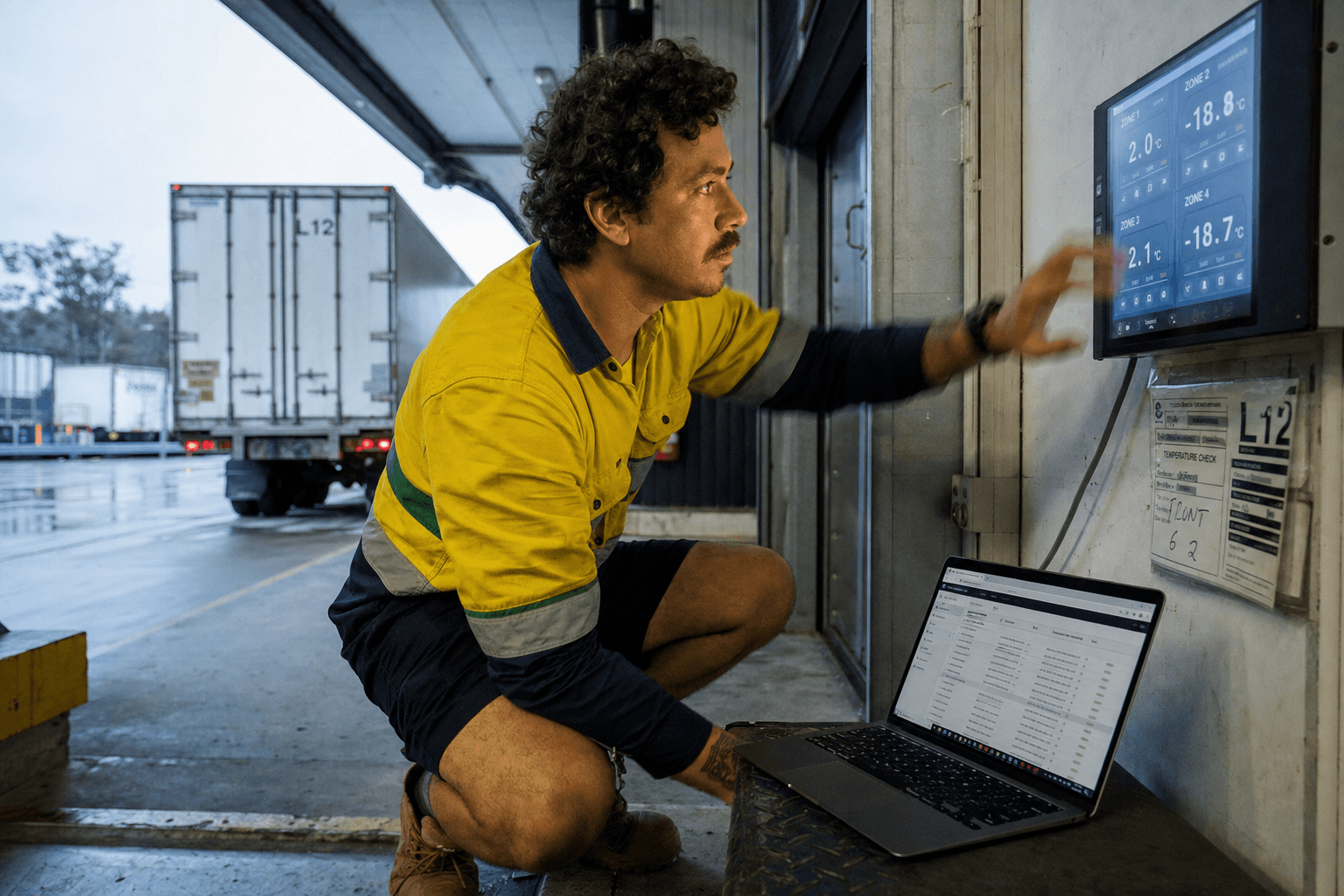
Traditional temperature logging relies on manual checks every 4-6 hours, creating compliance gaps. AI systems monitor every 30 seconds, detecting deviations within minutes rather than hours. This rapid response prevents product spoilage and ensures FSANZ compliance.
Key AI temperature monitoring capabilities:
| Feature | Traditional Method | AI-Powered System |
|---|---|---|
| Monitoring frequency | Every 4-6 hours | Every 30 seconds |
| Alert response time | 4-6 hours | Under 2 minutes |
| Compliance documentation | Manual logs | Automated reports |
| Predictive maintenance | Reactive only | Prevents failures |
| Multi-location oversight | Limited | Unlimited scalability |
AI systems also predict equipment failures before they occur, preventing temperature excursions that could compromise food safety. Predictive maintenance reduces cold chain failures by up to 75%.
AI-Enhanced Traceability for FSANZ Compliance
AI-powered traceability systems create comprehensive digital records that exceed FSANZ requirements for product tracking. These systems automatically capture data points throughout the supply chain, from supplier receipt to final delivery.
FSANZ Standard 3.2.2 requires food businesses to maintain records enabling rapid product identification during recalls. AI traceability systems capture batch numbers, supplier details, temperature history, and handling records in real-time.
Advanced AI systems integrate with existing warehouse management systems (WMS) and transport management systems (TMS) to create seamless traceability chains. This integration eliminates manual data entry errors that could compromise recall effectiveness.
AI traceability captures:
- Supplier certification and audit records
- Batch and lot number tracking
- Temperature history throughout transport
- Handling and storage conditions
- Delivery confirmation and customer details
Contamination Risk Prediction Using AI Analytics
AI contamination risk prediction analyses multiple data streams to identify potential food safety hazards before they occur. These systems examine temperature patterns, humidity levels, transport routes, and historical contamination data to predict high-risk scenarios.
Machine learning algorithms identify subtle patterns humans miss, such as temperature fluctuations that create condensation or route changes that expose products to contamination sources. Early warning systems alert operators to take preventive action.
AI risk prediction considers Australian-specific factors including extreme weather conditions, seasonal transport challenges, and regional contamination patterns. Systems learn from historical data to improve prediction accuracy over time.
Risk factors AI systems monitor:
- Temperature stability and excursion patterns
- Humidity and condensation conditions
- Transport route contamination sources
- Seasonal and weather-related risks
- Supplier performance and compliance history
Streamlined Recall Management with AI Systems
AI recall management systems enable rapid product identification and removal as required by FSANZ standards. When contamination occurs, these systems instantly identify affected batches, current locations, and distribution networks.
FSANZ requires recalls to commence within 24 hours of contamination identification. AI systems reduce this timeframe to under 2 hours by automating product tracking and customer notification processes. Faster recalls minimise health risks and reduce financial exposure.
AI systems also simulate recall scenarios during normal operations, testing traceability systems and identifying potential gaps before real incidents occur. This proactive approach ensures recall readiness and FSANZ compliance.
AI recall capabilities include:
- Instant batch identification and location tracking
- Automated customer and authority notifications
- Recall effectiveness monitoring and reporting
- Cost impact analysis and documentation
- Regulatory compliance verification
Australian Food Transport Regulations and AI Compliance
Australian food transport operates under multiple regulatory frameworks including FSANZ standards, NHVR requirements, and state-based food safety regulations. AI monitoring systems ensure compliance across all applicable regulations simultaneously.
The National Heavy Vehicle Regulator (NHVR) requires specific documentation for food transport, including temperature records and vehicle maintenance logs. AI systems automatically generate compliant documentation, reducing administrative burden while ensuring regulatory adherence.
State regulations vary across jurisdictions, with some requiring additional monitoring for specific products or transport routes. AI systems adapt to local requirements while maintaining national compliance standards.
Key Australian regulations AI systems address:
- FSANZ Food Safety Standards (Chapter 3)
- NHVR Chain of Responsibility obligations
- State food safety regulations and licensing
- Dangerous goods transport requirements (where applicable)
- Workplace health and safety compliance
Implementation Considerations for Australian Operators
Implementing AI food safety monitoring requires careful planning to ensure system integration and staff adoption. Most Australian logistics operators use legacy TMS or WMS systems that require API integration with AI monitoring platforms.
Successful implementations start with pilot programs covering specific routes or product categories. This approach allows operators to demonstrate ROI while minimising operational disruption. Full system rollouts typically occur over 6-12 months.
Staff training focuses on exception management rather than system operation, as AI handles routine monitoring automatically. This approach reduces training requirements while improving compliance outcomes.
Implementation timeline:
- Weeks 1-2: System assessment and integration planning
- Weeks 3-6: Pilot program deployment and testing
- Weeks 7-12: Staff training and process refinement
- Months 4-6: Full system rollout across operations
- Months 7-12: Performance optimisation and expansion
Implementing AI-powered monitoring systems requires careful planning and integration with existing logistics infrastructure. Our AI readiness assessment helps identify the best starting points for your supply chain transformation, while custom AI solutions can be tailored specifically for FSANZ compliance requirements. For businesses managing complex documentation workflows, document intelligence services streamline compliance reporting and audit trails across multiple regulatory requirements.
ROI and Business Benefits of AI Food Safety Systems
AI food safety monitoring delivers measurable ROI through reduced spoilage, faster recalls, and improved compliance. Australian operators typically see 15-25% reduction in product losses within the first year.
Insurance premiums may decrease by 10-20% when operators demonstrate comprehensive AI monitoring systems. Some insurers offer specific discounts for technology-enabled risk management.
Customer retention improves as AI systems provide detailed delivery confirmations and product condition reports. Major retailers increasingly require suppliers to demonstrate advanced food safety monitoring capabilities.
Typical ROI components:
- 15-25% reduction in product spoilage and waste
- 60-80% faster recall response times
- 10-20% reduction in insurance premiums
- Improved customer retention and contract wins
- Reduced regulatory compliance costs and penalties
AI-powered food safety monitoring represents the future of FSANZ compliance for Australian logistics operators. These systems transform reactive compliance into proactive risk management, protecting both public health and business sustainability.
Ready to implement AI food safety monitoring for your operations? Zero Footprint helps Australian logistics operators modernise food safety systems for FSANZ compliance. Book a consultation to discuss your specific requirements.
Zero Footprint
The Zero Footprint team — AI modernisation for Australian logistics.