AI-Powered Fuel Hedging for Australian Fleet Operations
Fuel costs represent 30-40% of operating expenses for Australian freight operators. AI-powered demand forecasting transforms fuel hedging from reactive purchasing to strategic risk management.

AI-Powered Fuel Hedging for Australian Fleet Operations
Fuel costs typically represent 30-40% of total operating expenses for Australian freight operators. With diesel prices fluctuating due to global market volatility, supply chain disruptions, and seasonal demand patterns, strategic fuel procurement becomes critical for maintaining profitability. AI-powered demand forecasting transforms fuel hedging from reactive purchasing to strategic risk management.
Understanding Diesel Price Volatility in Australia
Australian diesel prices reflect both global crude oil markets and local refinery capacity constraints. Terminal gate prices (TGPs) in major cities can experience significant week-to-week variations, driven by Singapore diesel cracks, currency fluctuations, and domestic supply dynamics.
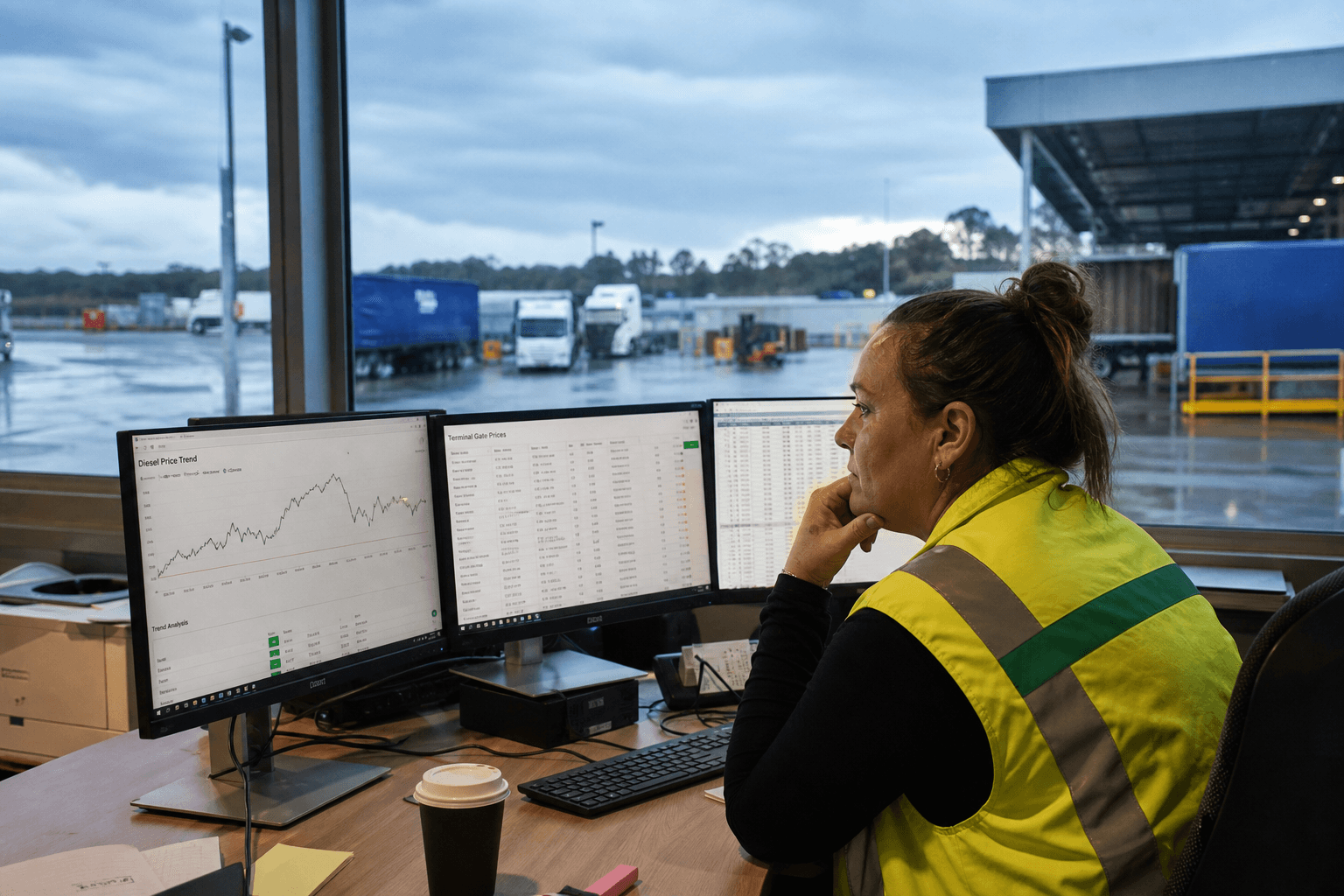
Key volatility drivers include:
- Global crude oil price movements affecting Singapore benchmark pricing
- Refinery maintenance cycles reducing local supply capacity
- Seasonal demand patterns during harvest periods and peak freight seasons
- Currency exchange rate fluctuations between AUD and USD
- Geopolitical events impacting global supply chains
For fleet operators consuming significant monthly volumes, price volatility can substantially impact operating costs. Traditional procurement approaches—buying spot market fuel or basic fixed-price contracts—expose operators to this volatility without strategic protection.
How AI Demand Forecasting Works for Fuel Planning
AI demand forecasting analyses historical consumption patterns, operational variables, and external factors to predict future fuel requirements with greater accuracy than spreadsheet-based planning.

Core Prediction Models
Machine learning models process multiple data streams:
- Historical fuel consumption patterns by route, vehicle, and season
- Operational factors including load weights, route characteristics, and driver behaviour
- Business pipeline data from TMS showing confirmed bookings and seasonal contracts
- Weather patterns affecting fuel efficiency and demand timing
- Economic indicators correlating with freight volumes in specific sectors
Consumption Pattern Recognition
AI identifies subtle patterns humans miss in consumption data. Traditional planning typically relies on broad quarterly adjustments and average consumption rates. AI-enhanced forecasting can identify week-level demand curves, vehicle-specific efficiency patterns by route, and precise consumption modelling based on load characteristics.
These advanced models provide the foundation for strategic fuel procurement decisions by offering more granular and accurate predictions than manual planning methods.
Contract Optimisation Strategies
Accurate demand forecasts enable sophisticated contract optimisation that balances price protection with operational flexibility.
Hedging Instrument Selection
Different fuel procurement instruments suit different operational profiles:
- Fixed-price contracts provide certainty but limit downside protection
- Price caps offer upside protection while maintaining downside flexibility
- Collar arrangements set both floor and ceiling prices
- Volume flexibility contracts accommodate demand variability
Portfolio Approach
Rather than single-contract procurement, AI enables portfolio optimisation. Industry best practices suggest covering core volume consumption with fixed-price contracts while maintaining swing capacity using flexible arrangements for demand variability. Operators typically maintain some unhedged volume for potential price declines.
Dynamic Contract Adjustment
AI demand forecasts update monthly or quarterly, enabling dynamic contract portfolio rebalancing. As consumption patterns shift or business volumes change, operators can adjust their hedging mix rather than being locked into annual fixed arrangements.
Integration with Fleet Management Systems
Effective fuel hedging requires seamless integration between demand forecasting models and existing operational systems.
Data Integration Points
AI forecasting systems connect with:
- Fleet management platforms for real-time consumption data
- Transport management systems for forward booking visibility
- Fuel card networks for transaction-level purchasing data
- Route optimisation tools for efficiency improvements that affect consumption
- Financial systems for budget planning and variance reporting
Real-Time Adjustment Capabilities
Integrated systems enable operational responses to market conditions:
- Route optimisation triggered by fuel price spikes in specific regions
- Load planning adjustments to maximise fuel efficiency during high-price periods
- Dispatch timing optimisation around daily price cycles at fuel terminals
- Strategic fuelling at lower-cost locations based on route planning
Operational Implementation Considerations
Deploying AI-powered fuel hedging requires careful consideration of existing processes and system capabilities.
Data Quality Requirements
Accurate forecasting depends on clean, consistent data streams. Fleet operators need systematic collection of consumption data, route information, and operational variables. Document intelligence systems can automate data capture from fuel receipts, delivery dockets, and maintenance records.
Change Management
Fuel procurement often involves established supplier relationships and manual approval processes. Successful implementation requires training procurement teams on AI-generated insights and developing clear decision-making frameworks for contract adjustments.
Risk Management Integration
Fuel hedging forms part of broader operational risk management. Companies must consider how fuel price protection aligns with other business risks, including customer contract terms, operational capacity, and cash flow requirements.
Building AI Capabilities for Fuel Management
Implementing AI-powered fuel hedging requires specific technical capabilities and organisational readiness.
Technical Infrastructure
Successful deployment requires:
- Data integration capabilities connecting fuel consumption, operational, and market data
- Analytics platforms capable of processing time-series forecasting models
- Reporting systems that translate AI insights into actionable procurement decisions
- Integration APIs linking forecasting outputs to existing fuel management processes
Organisational Readiness
Effective AI implementation depends on organisational factors beyond technology. Procurement teams need training on interpreting AI-generated forecasts, finance teams require visibility into hedging decisions, and operations teams must understand how fuel efficiency improvements affect contract requirements.
Getting Started with AI-Powered Fuel Hedging
Fleet operators considering AI-powered fuel hedging should begin with an assessment of current procurement processes and data readiness. AI readiness assessment evaluates existing systems, data quality, and organisational capabilities.
Key first steps include:
- Data audit of fuel consumption, operational, and market information
- Process mapping of current procurement workflows and decision points
- ROI analysis comparing current fuel cost volatility with potential hedging benefits
- Pilot program design for testing AI forecasting with a subset of fleet operations
Implementing AI for fuel hedging represents a strategic shift from reactive procurement to proactive risk management. For Australian freight operators facing ongoing cost pressures and market volatility, this capability can provide significant competitive advantages.
To explore how AI-powered fuel hedging might benefit your fleet operations, get in touch with our team for a detailed discussion of your requirements and implementation roadmap.
Zero Footprint
The Zero Footprint team — AI modernisation for Australian logistics.