Privacy Act Compliance for Customer-Facing AI in Logistics
AI phone, chat, and receptionist tools in logistics collect customer and driver personal information the moment they're switched on — which means Privacy Act obligations apply from day one. Here's what operations and finance leaders need to check before deploying customer-facing AI.
Why privacy law matters when you deploy AI phone or chat tools
AI phone systems, chatbots, and virtual receptionists in logistics businesses collect customer names, contact details, delivery addresses, freight details, and often driver information during every interaction. The Privacy Act 1988 (Cth) is the primary Commonwealth law governing how organisations collect, use, store, and disclose personal information in Australia, and it applies to these systems the moment they capture identifiable data — regardless of whether a human or an AI model is doing the collecting.
Many logistics operators evaluating AI dispatch, customer service, or driver-facing tools focus on functionality and cost, and treat privacy as a legal afterthought. That's a mistake. If your AI system talks to customers or drivers, records calls, transcribes conversations, or stores interaction history, it is collecting personal information under the Act — and your obligations don't disappear because a vendor built the tool.
This article explains, in plain terms, what to think about. It isn't legal advice — you should get that from a qualified privacy lawyer — but it gives operations and finance leaders enough grounding to ask the right questions before signing off on an AI deployment.
What is the Privacy Act 1988 and who does it apply to?
The Privacy Act 1988 is Commonwealth legislation regulating how Australian organisations handle personal information, enforced by the Office of the Australian Information Commissioner (OAIC). It applies to most businesses with an annual turnover above $3 million, though smaller operators can still be caught if they trade in personal information, provide health services, or are contracted to a Commonwealth agency.

Most mid-market logistics businesses — carriers, 3PLs, and warehouse operators in the $20M–$500M revenue range — sit well above the small business threshold and are covered in full. If you're a smaller freight operator sitting near that $3 million line, it's worth confirming your status directly, because the exemption has exceptions that catch data-heavy businesses.
What are the Australian Privacy Principles, and which ones matter for AI?
The Australian Privacy Principles (APPs) are the 13 legally binding rules set out in the Privacy Act that govern the collection, use, storage, security, and disclosure of personal information. For customer-facing AI in logistics, a handful matter more than the rest.
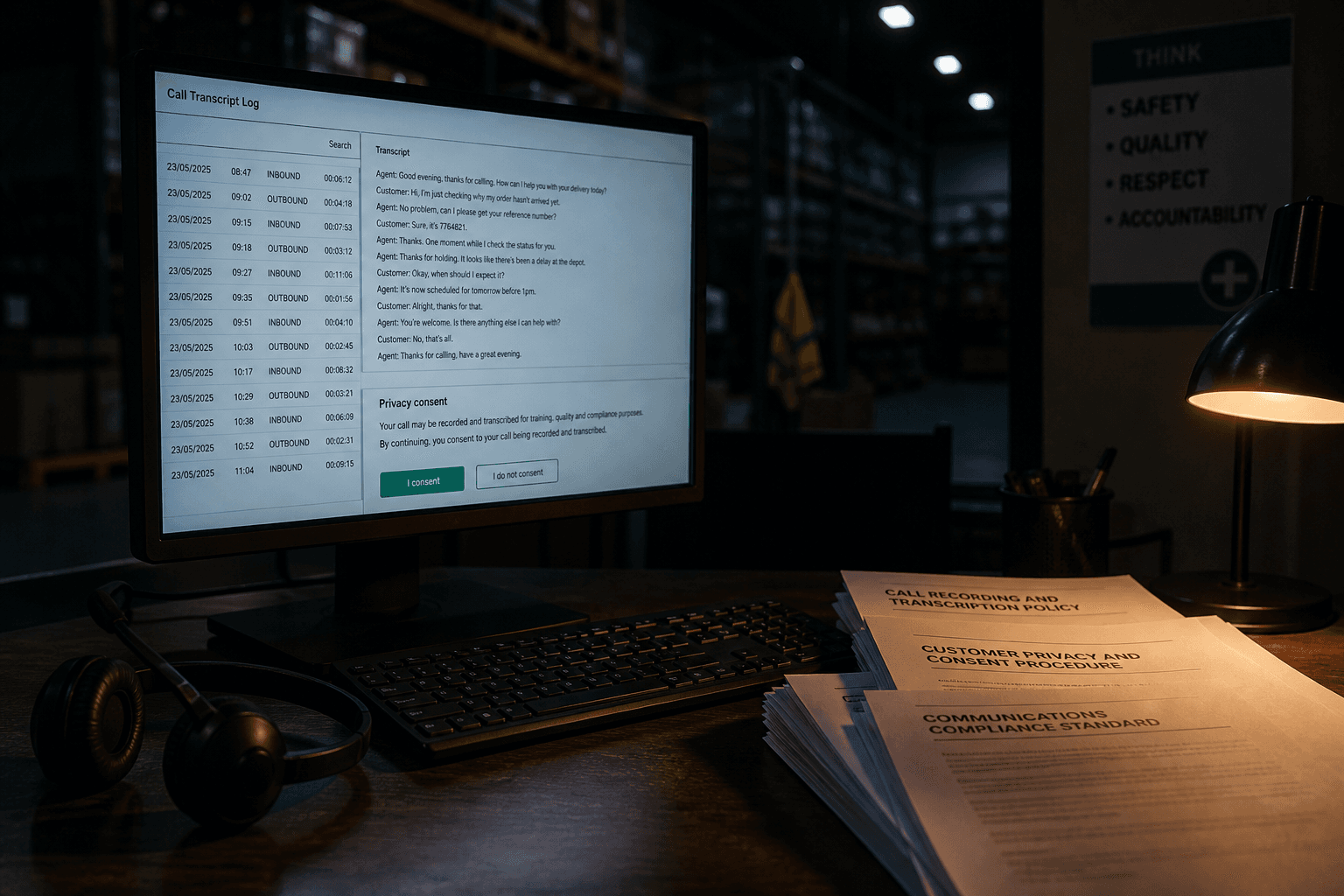
APP 1 (open and transparent management) requires a publicly available privacy policy that reflects how your AI tools actually work — not a generic template written before you deployed one. APP 3 and APP 5 govern collection and notification: if an AI phone system records and transcribes a call, customers generally need to be told this is happening and why. APP 6 restricts using data collected for one purpose (say, booking a delivery) for another (like training a model) without consent or a clear secondary purpose that a customer would reasonably expect. APP 8 covers cross-border disclosure, which is directly relevant if your AI vendor processes or stores data on overseas servers — common with many chat and voice AI platforms. APP 11 requires reasonable steps to keep personal information secure, which extends to how transcripts, call recordings, and chat logs are stored and who can access them.
How does AI change data handling compared to traditional customer service?
AI tools don't just automate existing processes — they often collect, retain, and process data differently to a human-staffed call centre or dispatch desk, which changes your risk profile even if your policies haven't changed.
| Aspect | Traditional phone/chat | AI-enabled phone/chat |
|---|---|---|
| Data captured | Notes taken manually, often incomplete | Full transcript or recording, typically retained by default |
| Consistency of disclosure | Varies by staff member | Consistent, but only if scripted correctly |
| Data used for training | Rare, requires deliberate action | Possible by default with some vendors unless configured otherwise |
| Storage location | Usually on local or Australian-hosted systems | Often on vendor's cloud infrastructure, which may be offshore |
| Retention period | Set by internal policy, loosely enforced | Set by vendor default, often longer than necessary |
| Access controls | Limited to relevant staff | Depends on vendor's platform permissions, can be broader |
The practical implication is that AI tools tend to capture more, retain it longer, and route it through more third parties than the process they replace. None of that is prohibited under the Privacy Act — but it does mean your existing privacy policy and vendor contracts may no longer reflect reality.
Does the Privacy Act treat driver data differently to customer data?
Driver data collected by AI systems — voice recordings from in-cab assistants, location data, performance metrics, or transcripts of dispatch calls — is personal information under the same Privacy Act framework as customer data, with the added complexity of employment relationships and, in some cases, workplace surveillance laws.
Several states, including NSW and the ACT, have separate workplace surveillance legislation that requires specific notice before recording employees, including drivers. Victoria's surveillance laws also impose consent requirements in some circumstances. If your AI system records driver-facing calls, in-cab conversations, or biometric data such as voice or fatigue-monitoring footage, you're likely dealing with both the Commonwealth Privacy Act and state-based surveillance obligations at once. This is an area where mid-market operators most commonly get caught out, because driver consent processes are often informal or buried in old employment contracts.
What is the Notifiable Data Breaches scheme, and why does it matter for AI vendors?
The Notifiable Data Breaches (NDB) scheme, part of the Privacy Act, requires organisations to notify affected individuals and the OAIC when a data breach is likely to result in serious harm. AI tools that centralise customer and driver data with a third-party vendor add a new point of failure that falls squarely within this scheme.
If your AI chat or phone vendor suffers a breach that exposes your customers' delivery details or your drivers' personal information, the notification obligation generally still sits with you as the entity that collected the data — not solely with the vendor. This makes vendor due diligence a genuine compliance step, not just a procurement formality. Before signing with any AI vendor, it's worth confirming where data is hosted, how long it's retained, whether it's used for model training, and what breach notification commitments are written into the contract.
What should logistics operators actually do before deploying customer-facing AI?
Before switching on an AI phone, chat, or receptionist tool, logistics operators should map what personal information the system will collect, update privacy policies and call disclosures to match reality, confirm data residency and retention with the vendor, and clarify who is accountable if something goes wrong.

A practical starting checklist:
- Identify every point where the AI tool collects, stores, or transmits personal information — including call recordings, transcripts, and any data passed to third-party APIs.
- Update your privacy policy and any call-start disclosures ('this call may be recorded and processed by an AI system') to reflect what's actually happening.
- Ask AI vendors directly where data is hosted, whether it's used to train models, and how long it's retained by default.
- Confirm your vendor contract includes clear breach notification obligations and data deletion rights.
- If drivers interact with the system, check state-based workplace surveillance requirements alongside the Privacy Act.
- Loop in a privacy lawyer for anything involving sensitive information, biometric data, or offshore processing.
This is exactly the kind of gap our ai-readiness-assessment is designed to surface — not as a legal audit, but as a practical review of what data your current systems collect, where it flows, and what needs to be addressed before you deploy customer-facing AI at scale. Getting the data foundations right also pays off elsewhere: tools like document-intelligence for BOLs and freight paperwork rely on the same clean, well-governed data pipelines that keep you compliant.
Where does this fit into a broader AI strategy?
Privacy compliance shouldn't be treated as a separate workstream bolted onto an AI project — it's part of the same data foundation work that makes AI in logistics actually reliable. Operators who get their data governance right before deploying AI tend to avoid the rework and vendor renegotiation that comes from bolting on compliance after the fact.
If you're planning AI-powered route optimisation, warehouse automation, or emissions reporting alongside customer-facing tools, the same data mapping exercise applies across the board. You can read more on how these pieces connect in our insights.
Get the data foundations right before you scale
Privacy Act compliance for customer-facing AI isn't complicated once you know what to check — but it does need to be checked, not assumed, before a chatbot or AI receptionist goes live. If you're exploring AI phone, chat, or receptionist tools for your logistics operation and want a practical, operations-first review of what that means for your data, get in touch and we'll talk through what's involved.
Zero Footprint
The Zero Footprint team — AI modernisation for Australian logistics.