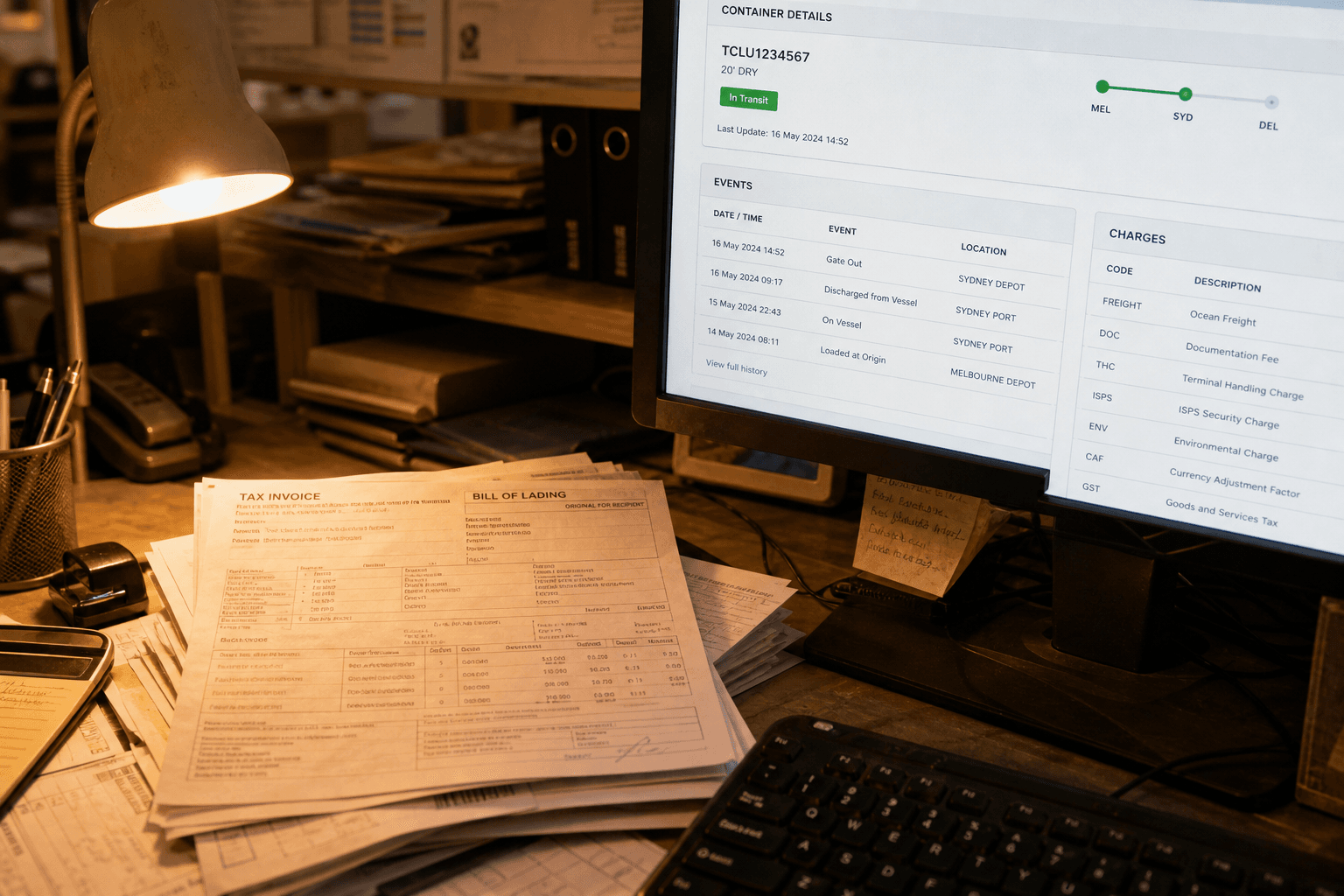
Unifying TMS, WMS and CRM Data for a Single 3PL Customer View
3PL account managers often juggle three or four disconnected systems just to answer a basic customer question. This guide explains how AI-driven data integration can unify TMS, WMS and CRM data into a single customer view without a full system replacement.

Why do 3PL account managers struggle to get a single view of their customers?
Most 3PL account managers can't answer a simple customer question — "where's my shipment and why was I invoiced twice?" — without opening three or four systems and cross-referencing manually. This happens because transport management, warehouse management and customer relationship data live in separate platforms that were never designed to talk to each other.
This is one of the most common operational pain points we see across Australian mid-market carriers and 3PLs. It isn't a people problem or a training problem. It's a data architecture problem, and it's almost always rooted in the age of the underlying systems.
What causes the fragmentation in the first place?
Legacy TMS and WMS fragmentation happens because most platforms in use at Australian logistics operators were implemented more than five years ago, before modern API integration and real-time data sharing were standard. These systems were built to manage freight movements or warehouse operations in isolation — not to feed a unified customer record.

A legacy TMS or WMS is a transport or warehouse management platform that lacks modern API integration, real-time visibility, and native reporting capability. Account managers and ops teams compensate with manual workarounds — exporting spreadsheets, copy-pasting shipment statuses into email, or re-keying invoice data into a separate CRM so sales and account management have something to look at. Every manual step is a point where data goes stale or gets entered incorrectly, and every disconnected system is a place where a customer issue can hide until it becomes a complaint.
The CRM compounds the problem rather than solving it. Sales and account teams often rely on the CRM as their "source of truth" for customer relationships, but if it isn't connected to live TMS shipment data or WMS inventory and exception data, it's really just a contact list with notes attached. Account managers end up maintaining their own shadow systems — personal trackers, email folders, sticky notes — to keep across accounts.
Do you need to replace your TMS and WMS to fix this?
No. Full platform replacement is rarely the right first move, and for most mid-market 3PLs it's not necessary to solve the single-customer-view problem. AI-driven data integration can be layered on top of your existing TMS, WMS and CRM to extract, normalise and unify data without ripping out systems your operations team already knows how to run.
This matters because system replacement projects are expensive, slow, and carry real operational risk — a failed TMS migration can disrupt dispatch for weeks. The more pragmatic path is to treat your existing systems as data sources rather than obstacles. AI tooling can extract data via available APIs, direct database connections, or intelligent document processing for systems that only output PDFs or flat files, then normalise that data into a consistent structure. From there, it can feed a modern analytics or reporting layer that gives account managers one screen showing shipments, invoices and service issues for a given customer — regardless of which underlying system each data point came from.
This approach is sometimes described as an integration or data layer strategy, as opposed to a rip-and-replace strategy. It's a form of legacy system modernisation that respects the reality that most 3PLs can't afford six months of disruption to fix a reporting problem.
What does a unified customer view actually look like in practice?
A unified customer view consolidates shipment status, invoice and billing records, and logged service issues for each customer account into a single interface, pulled automatically from the TMS, WMS and CRM. Account managers get one place to look, instead of three or four.

The comparison below illustrates the practical difference between the fragmented and unified states — not as a claim of specific performance improvement, but as a description of how the operational workflow changes.
| Aspect | Fragmented (current state) | Unified (integrated state) |
|---|---|---|
| Shipment status | Checked in TMS, often re-keyed into email or spreadsheet | Live in one dashboard, sourced automatically from TMS |
| Invoice and billing data | Held in finance system, manually matched to shipments | Linked automatically to the relevant shipment and customer record |
| Service issues | Logged inconsistently across CRM notes, email threads, or not at all | Centrally logged and visible against the customer account |
| Account manager effort | Manual cross-referencing across systems | Single screen, system does the matching |
| Customer escalation handling | Reactive, dependent on who has the context | Proactive, visible to anyone covering the account |
The goal isn't a flashy new interface. It's giving account managers and operations leaders the ability to answer customer questions accurately on the first call, and to spot patterns — like a customer with repeated late deliveries — before it shows up as a lost contract.
Where does document intelligence fit into this?
Many 3PLs still rely on paper or PDF-based bills of lading, proof of delivery, and invoices that never make it into a structured system cleanly. Document intelligence is the use of AI to extract structured data from unstructured documents such as scanned BOLs, delivery dockets and invoices, converting them into usable data fields.
For 3PLs where a meaningful share of customer and shipment data still arrives as paper or email attachments, document intelligence is often the missing link between legacy TMS/WMS records and a genuinely unified customer view. Without it, even a well-integrated system architecture still has gaps wherever data starts life on paper.
How should a 3PL approach this without disrupting operations?
The lowest-risk starting point is an assessment of what data exists, where it lives, and what's realistically extractable before committing to any integration build. This avoids the common failure mode of starting a data project before understanding the state of the underlying systems.
An AI readiness assessment typically maps your current TMS, WMS and CRM landscape, identifies which systems have usable APIs versus which require document extraction or database-level access, and scopes a realistic integration path. For operators also looking at broader efficiency gains alongside data unification, it's worth considering how connected data can support adjacent initiatives like route optimisation, since better visibility into shipment and customer data often surfaces operational inefficiencies that were previously invisible.
This is a practical, staged approach to digital transformation in logistics — one that works with the systems you already have rather than demanding you replace them on faith. You can read more operational breakdowns like this on our insights page.
If you're exploring how to unify fragmented TMS, WMS and CRM data into a single customer view, we can help — starting with an honest look at what your current systems can and can't do.
Zero Footprint
The Zero Footprint team — AI modernisation for Australian logistics.