Using AI to Reduce Freight Costs: A Guide for Australian Carriers
AI-driven freight rate intelligence is becoming one of the clearest ways Australian carriers and 3PLs reduce cost-per-shipment. Here's how it works, what data it actually requires, and what has to happen first.
What does AI actually do to reduce freight costs?
AI in logistics reduces freight costs primarily through freight rate intelligence — using machine learning to benchmark contract rates against market rates, detect invoice anomalies, forecast demand ahead of peak periods, and support pricing decisions. It doesn't replace your rate strategy; it gives your team the data to make better calls, faster.
For Australian carriers, 3PLs, and freight forwarders running on legacy TMS systems and manual rate reviews, this is often the first tangible use case for AI in logistics — because the impact is directly visible on a cost-per-shipment basis, rather than being one of the more abstract promises made about AI generally.
How does freight rate intelligence work?
Freight rate intelligence is the application of AI and machine learning to freight pricing data — spot rates, contract rates, capacity signals, and demand patterns — to improve forecast accuracy and support pricing decisions. It's the main mechanism through which AI supports cost-per-shipment reduction.
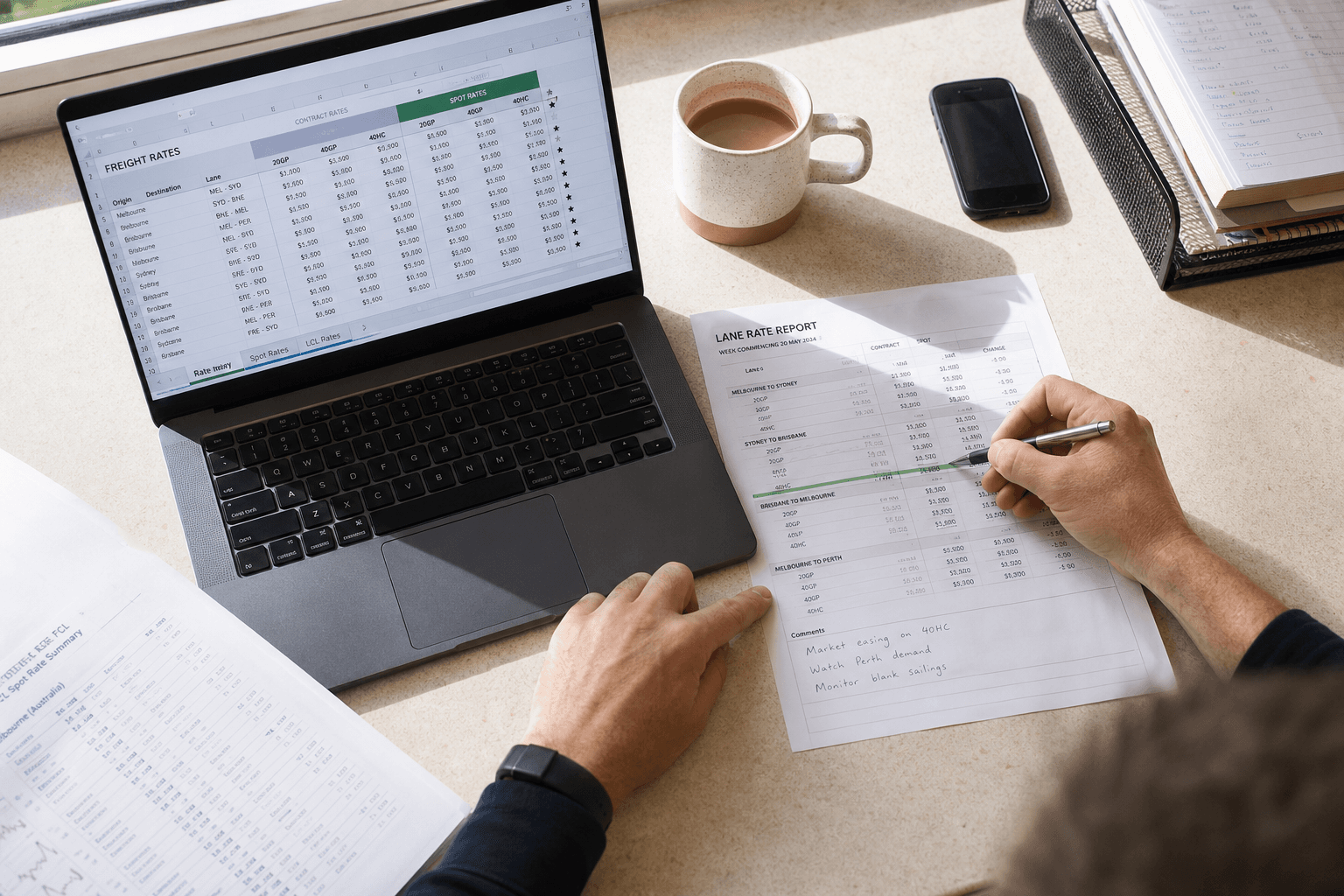
In practice, this covers four things:
- Spot rate tracking — monitoring live market rates on key lanes so you know whether your contract rates are competitive.
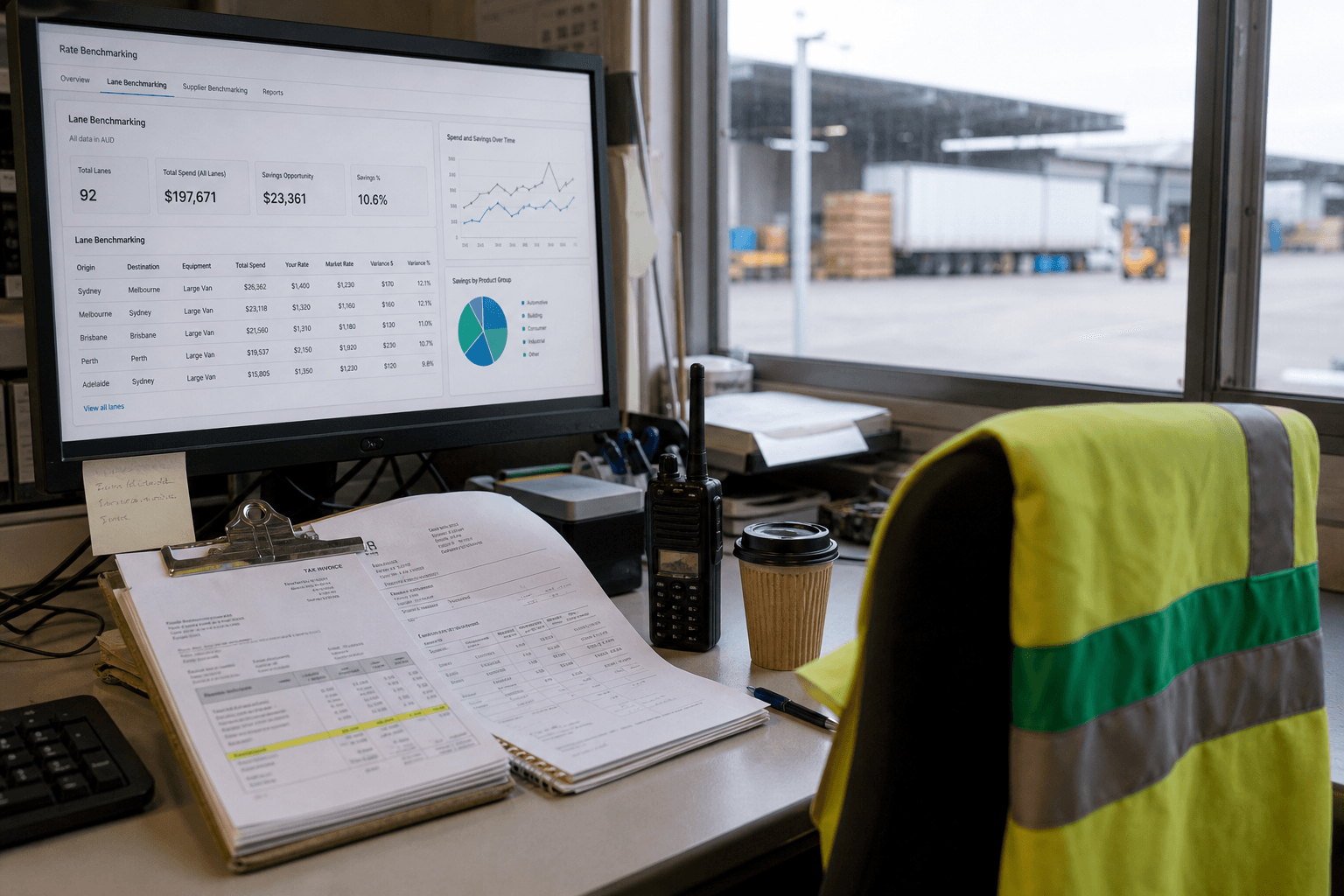
- Contract rate benchmarking — comparing what you're paying (or charging) against market data to catch over- or under-payment before it compounds across thousands of shipments.
- Capacity and demand signal monitoring — tracking network-wide capacity and demand shifts that can predict rate movements before they hit your invoices.
- Predictive pricing — using historical and real-time data to forecast rate movements and support negotiation with carriers or customers.
On top of this, AI models are typically applied to four tasks: dynamic pricing that adjusts quotes based on real-time capacity signals; anomaly detection that flags rate outliers in carrier invoices before they're paid (a form of document intelligence for logistics, applied to freight invoicing); demand forecasting ahead of peak periods (Christmas, EOFY, harvest season); and rate negotiation support based on benchmarked data rather than gut feel.
Each of these can reduce cost-per-shipment — either by catching overpayment, avoiding rate volatility, or improving the accuracy of quotes you put in front of customers. As with route optimisation, the value comes from applying the model to your actual operational data, not from the model itself.
Why can't Australian operators just buy an off-the-shelf freight intelligence platform?
Most of the well-known commercial freight data and rate intelligence platforms in the market today were built for the North American freight sector — its lane structures, carrier network dynamics, and regulatory environment. Australia's freight market runs on genuinely different fundamentals: long-haul interstate corridors, regional consolidation points, and a smaller number of major freight arteries compared to denser networks overseas. Rate quoting conventions (per-pallet, per-kilometre, per-tonne), tender structures, and carrier consolidation patterns also differ.
On the compliance side, Australian operators work within the National Heavy Vehicle Regulator (NHVR) framework, NGER reporting obligations, and increasingly AASB S2 climate-related disclosure requirements — none of which map onto data platforms designed for a different regulatory jurisdiction. This is a genuine structural gap rather than a reflection of any single vendor's product decisions, and it's one reason many mid-market Australian operators end up building rate intelligence capability internally, with support, rather than subscribing to a finished off-the-shelf tool.
The broader Australian logistics technology market includes providers focused on freight digitisation, TMS/WMS integration, and EDI connectivity — each solving real problems for operators. Freight rate intelligence built specifically around Australian lane structures and compliance obligations is a more specialised, less commoditised capability, which is why we treat it as a bespoke build for each client rather than a packaged product.
Where does the data for Australian freight rate intelligence actually come from?
Without a single dominant proprietary Australian freight data platform, carriers and 3PLs typically build rate intelligence from a mix of internal and industry sources rather than buying one off-the-shelf tool. This means the groundwork looks different here than it might in other markets.
The practical sources are:
| Data source | What it provides | Limitation |
|---|---|---|
| Internal TMS/WMS historical data | Your own actual rates, lanes, and volumes | Often trapped in legacy systems not built for analytics |
| Industry association data (e.g. Australian Trucking Association, industry benchmark surveys) | Aggregated market benchmarks | Less granular than a live commercial platform |
| Broker/forwarder market knowledge | Real-time qualitative rate signals | Not systematised or scalable |
| Bespoke analytics on operational data | Tailored to your specific lanes and customers | Requires build effort and data integration |
The common thread: useful Australian freight rate intelligence has to be built substantially from your own operational data, supplemented by industry and broker context, rather than subscribed to as a finished product. That's a legacy system modernisation logistics problem as much as it is an AI problem — the data has to be extractable and usable before any model can be applied to it.
What has to happen before AI can reduce your freight costs?
For most mid-market Australian operators running legacy TMS systems, a data integration layer needs to be built before AI models can be applied effectively to freight rate intelligence. This is the step that gets skipped when businesses jump straight to buying a tool, and it's usually why those projects stall.
In practice, this involves:
- Auditing what data actually exists — historical rates, lane volumes, invoice records — and in what state (spreadsheets, PDFs, legacy TMS exports).
- Building extraction and cleaning pipelines so that data trapped in legacy systems and paper-based processes becomes usable for analysis.
- Establishing a baseline of current rate performance by lane, customer, and carrier, before introducing any predictive model.
- Piloting a narrow use case — invoice anomaly detection is often the fastest to show a result, since it's a bounded, well-defined problem.
This is broadly the same groundwork required for other AI logistics use cases — route optimisation and Scope 3 emissions reporting under AASB S2 both depend on the same underlying data integration work. That's why an ai readiness assessment is usually the sensible starting point: it tells you what data you actually have, what state it's in, and which use case will show a result fastest — before you commit budget to a build.
Digital transformation in logistics doesn't have to mean replacing your entire TMS or WMS. For most of the operators we work with, it means building a data layer on top of what already exists, and applying AI to a specific, well-scoped problem — freight rate intelligence being one of the more immediately measurable ones.
If freight cost pressure, a legacy TMS nearing end-of-life, or an upcoming AASB S2 deadline is on your radar, it's worth understanding what your data can actually support before you commit to a platform or a build. Read more insights on how Australian carriers and 3PLs are approaching this, or get in touch to talk through where your business sits today.
Zero Footprint
The Zero Footprint team — AI modernisation for Australian logistics.