Carrier Booking Fraud Detection: How AI Helps 3PLs
AI helps 3PLs and freight brokers detect carrier booking fraud by continuously cross-referencing carrier documents, booking patterns, and payment communications — catching double brokering, load board identity theft, and payment redirection scams before freight or funds move. This article explains how each fraud type works and where AI-assisted verification genuinely closes the gap.
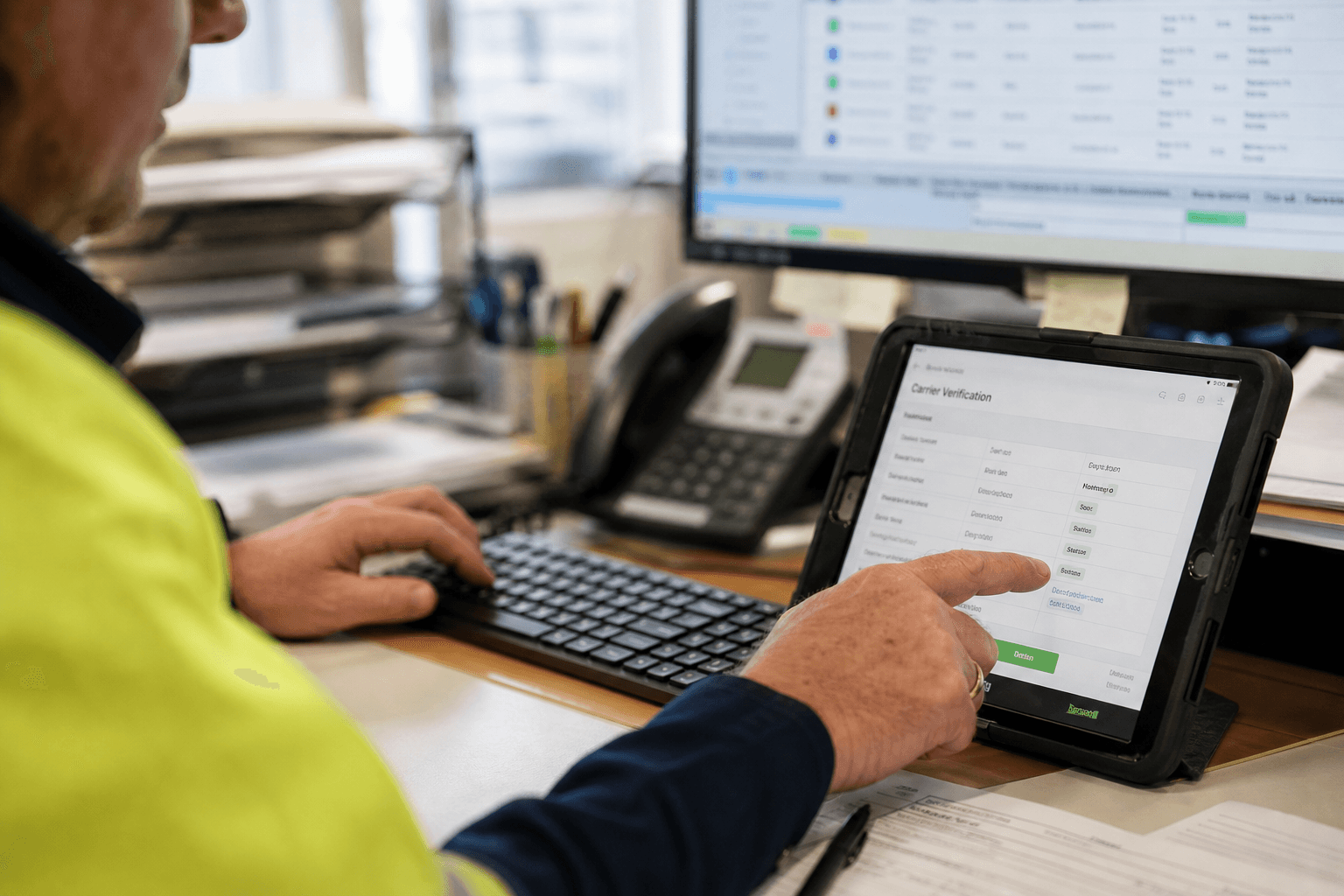
AI helps 3PLs and freight brokers catch carrier booking fraud by cross-referencing carrier documentation, booking patterns, and communication metadata continuously — not just at onboarding — and flagging anomalies for human review before a load is confirmed or a payment goes out. That's the short version. Document intelligence tools compare insurance certificates and accreditation documents against known formats and prior submissions, pattern-based anomaly detection flags unusual bidding or payment behaviour, and both close the specific window that manual, document-by-document checking leaves open. The rest of this article explains why that window exists, how double brokering, load board identity theft, and payment redirection scams actually work, and where AI-assisted verification fits alongside the checks brokers already do.
Carrier booking fraud is a different problem to the cybersecurity and vendor risk scoring issues most 3PLs already have on their radar. Double brokering, identity theft on load boards, and payment redirection scams exploit gaps in how carriers are verified and paid, not gaps in IT security. Freight brokers and 3PLs lose freight, money, and customer trust to this kind of fraud every year, and the fixes sit closer to operational process than to firewalls.
What Is Carrier Booking Fraud?
Carrier booking fraud is when a bad actor poses as a legitimate trucking company, or hijacks a legitimate carrier's identity, to secure a freight booking they have no intention of delivering honestly. The freight either disappears, gets re-brokered without authorisation, or the broker ends up paying the wrong party entirely. It sits at the intersection of identity verification, payment controls, and operational process — which is exactly why it slips through traditional vendor risk checks designed for financial and compliance risk rather than active impersonation.
What Is Double Brokering and Why Is It Hard to Catch?
Double brokering is when a carrier that has been awarded a load re-brokers it to another carrier without the original broker's knowledge or consent, often to pocket a margin or because the first carrier never had the capacity to run the load at all. It's hard to catch because the paperwork — rate confirmations, BOLs, insurance certificates — can look clean on the surface while the actual truck, driver, and insurance coverage on the road are completely different from what was booked. By the time a claim or late delivery exposes the mismatch, the freight may already be gone.

Manual checks typically rely on a dispatcher recognising a carrier name, MC number, or phone number from past dealings. That works until a fraudulent operator reuses a legitimate carrier's details — a real company's ABN, insurance certificate, or NHVR accreditation — to book loads the real carrier never agreed to.
How Does Identity Theft Happen on Freight Load Boards?
Identity theft on load boards happens when fraudsters copy a legitimate carrier's business details — ABN, company name, insurance documents, even driver photos — and use them to create a convincing but fake profile on a booking platform or load board. Because load boards generally verify documents at the point of upload rather than continuously, a stolen identity can pass initial checks and sit dormant until it's used to win a booking.
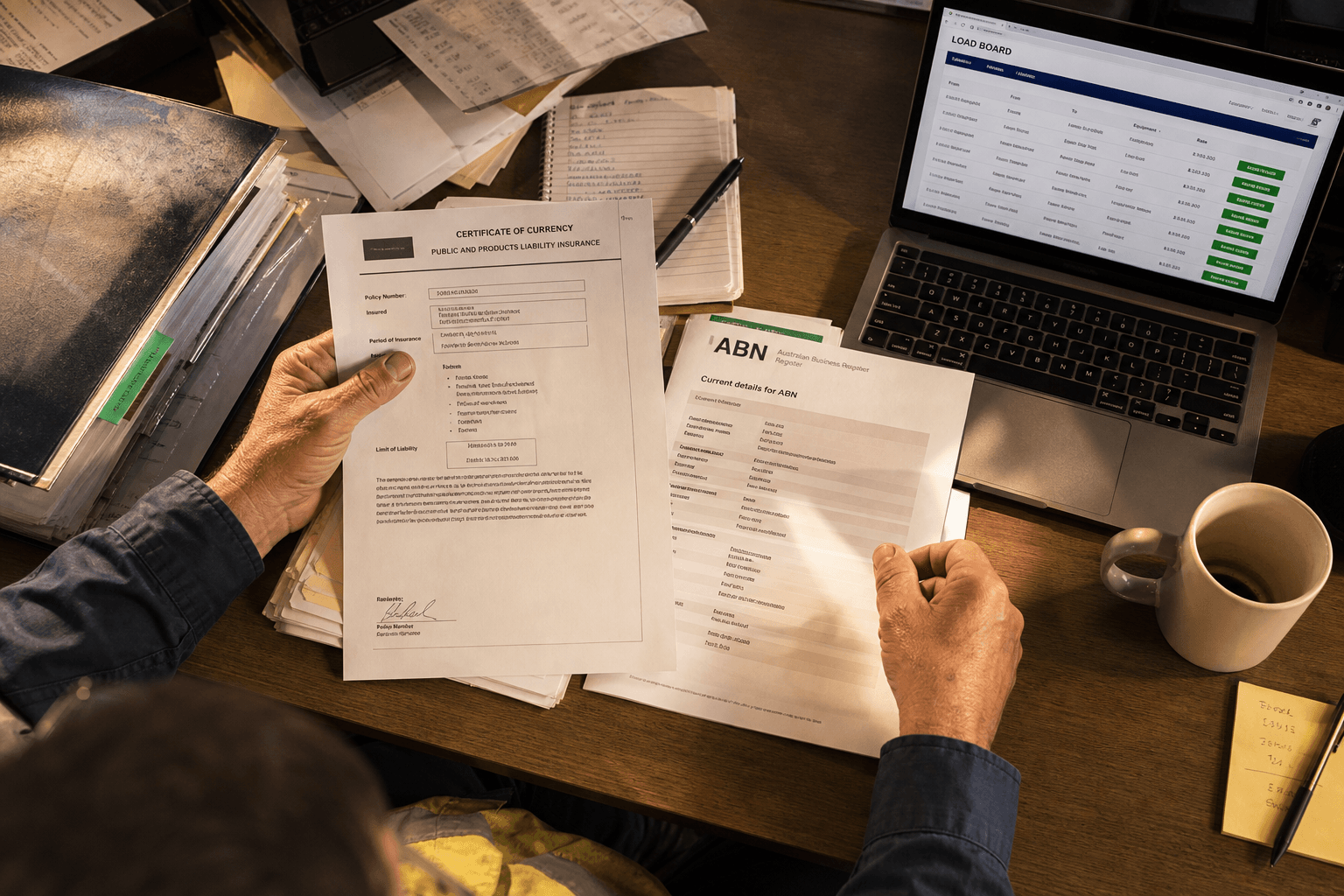
The Australian Business Register (abr.business.gov.au) lets brokers confirm an ABN is current and matches the registered business name, and the National Heavy Vehicle Regulator maintains accreditation records for compliant operators — but these are point-in-time lookups. They don't flag when a genuine carrier's details are being used fraudulently by someone else, because the underlying registration data itself hasn't changed.
What Is a Payment Redirection Scam in Freight Brokering?
A payment redirection scam is a form of business email compromise where a fraudster intercepts or spoofs communication between a broker and a carrier, then supplies new banking details and asks for payment to be redirected — usually timed around invoice due dates. The ACCC's Scamwatch (scamwatch.gov.au) tracks business email compromise as an ongoing scam category affecting Australian businesses across sectors, and freight brokers are a natural target because high-volume, time-pressured payment runs leave little room for manual verification of every bank detail change.
This is distinct from cybersecurity, which protects systems and networks, and vendor risk scoring, which assesses a counterparty's financial and compliance standing. Payment redirection exploits the process gap between when a carrier's details change and when that change is verified before funds move.
How Can AI Help Detect Carrier Booking Fraud?
AI helps by cross-referencing carrier documentation, booking patterns, and communication metadata at a speed and consistency no manual review process can match, flagging anomalies for human review rather than replacing judgement entirely. Document intelligence tools can compare an uploaded insurance certificate or NHVR accreditation against known formats and prior submissions from the same carrier, flagging inconsistencies in font, layout, or data fields that suggest tampering. The same underlying approach that extracts and validates data from freight documents — as used in our document intelligence work — applies directly to verifying carrier paperwork at the point of onboarding and booking.
Pattern-based anomaly detection can also flag behavioural red flags: a carrier suddenly bidding on loads far outside their usual lane history, a bank detail change submitted outside normal business hours, or a new carrier profile using contact details that closely resemble an existing, trusted carrier. None of these signals alone proves fraud, but surfacing them for a dispatcher or finance team to check before a booking or payment is confirmed closes the exact window that manual, document-by-document review leaves open. Industry risk and fraud-prevention bodies in Australia and the US generally describe this as a continuous verification problem rather than a one-off check — which is precisely why automated, always-on monitoring tends to outperform periodic manual review, even where the manual process is diligent.
For operators still relying on spreadsheets, email, and point-in-time ABN or NHVR lookups, the practical starting point isn't a fraud platform — it's understanding where your current booking and payment workflow actually has exposure. That's the kind of gap an AI readiness assessment is built to surface, alongside adjacent problems like manual dispatch planning, where route optimisation often delivers a faster, more measurable win, or emissions data collection, where our emissions reporting work helps carriers and 3PLs get ahead of AASB S2 and Scope 3 requirements. You'll find more on these topics in our more insights section.
Carrier booking fraud isn't going away, and it's not a problem a single tool or policy change fixes outright. But the brokers and 3PLs who treat verification as a continuous, automated process — rather than a one-off check at onboarding — are the ones who catch the fraudulent booking before the truck leaves the yard, not after the claim lands on their desk. If you want to understand where your own carrier verification and payment processes are exposed, get in touch and we'll walk through it with you.
Zero Footprint
The Zero Footprint team — AI modernisation for Australian logistics.