Cybersecurity Risk in AI-Enabled Logistics Systems
Connecting AI tools to legacy TMS/WMS platforms creates real cybersecurity exposure — this guide explains where the risk sits, what to ask vendors, and how to scope integrations safely.
Cybersecurity risk in AI-enabled logistics systems is the increased exposure created when AI tools are given access to operational data — consignment details, customer information, GPS and telematics feeds, financial records — typically through connections to legacy TMS or WMS platforms that predate modern integration standards. Every new connection point is a potential entry route for unauthorised access, and older platforms often lack the authentication, logging, and encryption controls that current systems build in by default. For operations and compliance leaders at Australian carriers, 3PLs, and warehouse operators, managing this risk properly — not avoiding AI altogether — is what determines whether adoption proceeds smoothly or creates an exposure that ends up on the desk of your insurer, auditor, or board.
This isn't a reason to avoid AI. It's a reason to treat integration architecture as a first-class decision, not an afterthought bolted on after a pilot succeeds.
What is the cybersecurity risk in AI-enabled logistics systems?
In practical terms, the risk sits at the connection point, not inside the AI model itself. When an AI tool is granted access to a TMS or WMS to read consignment notes, pull telematics data, or process bills of lading, it inherits whatever access level that connection was built with. If the underlying system predates modern security practice — as most legacy logistics platforms do — the AI integration can end up with broader access, weaker logging, and fewer controls than the rest of your technology stack.
This is a structural issue, not a reason to slow down. It means the questions worth asking are about scope, logging, and vendor accountability — not whether AI itself is inherently unsafe.
Why does connecting AI tools to legacy TMS/WMS increase exposure?
Most Australian carriers and 3PLs are running TMS or WMS platforms that are five, ten, or fifteen years old. These systems were built for on-premise servers and closed networks, not cloud-based AI services calling in via API. When you connect an AI tool, you're often exposing a system that has never been tested against modern attack patterns.
Three specific issues come up repeatedly in our work with logistics operators:
- Flat access models. Older TMS/WMS platforms frequently use a single admin-level credential for all integrations, meaning an AI tool gets far broader access than it actually needs.
- Weak audit trails. Legacy systems may not log what data was accessed, when, or by which service — a real problem if you need to demonstrate compliance during an insurance claim or breach investigation.
- Unpatched infrastructure. Vendor-sunset systems, common across road freight and warehousing, stop receiving security patches, so every new connection point inherits known, unfixed vulnerabilities.
The Australian Cyber Security Centre (cyber.gov.au) recommends the Essential Eight mitigation strategies as a baseline for any organisation handling sensitive operational or customer data — patching, application control, and restricting administrative privileges are all directly relevant when scoping an AI integration.
What data access risks should operations leaders understand?
Data access risk in this context means understanding exactly what information an AI tool can see, store, and transmit once connected to your systems — and whether that scope matches what the tool actually needs to do its job. A route optimisation engine doesn't need access to customer payment details. A document intelligence tool processing bills of lading doesn't need write access to your dispatch database.
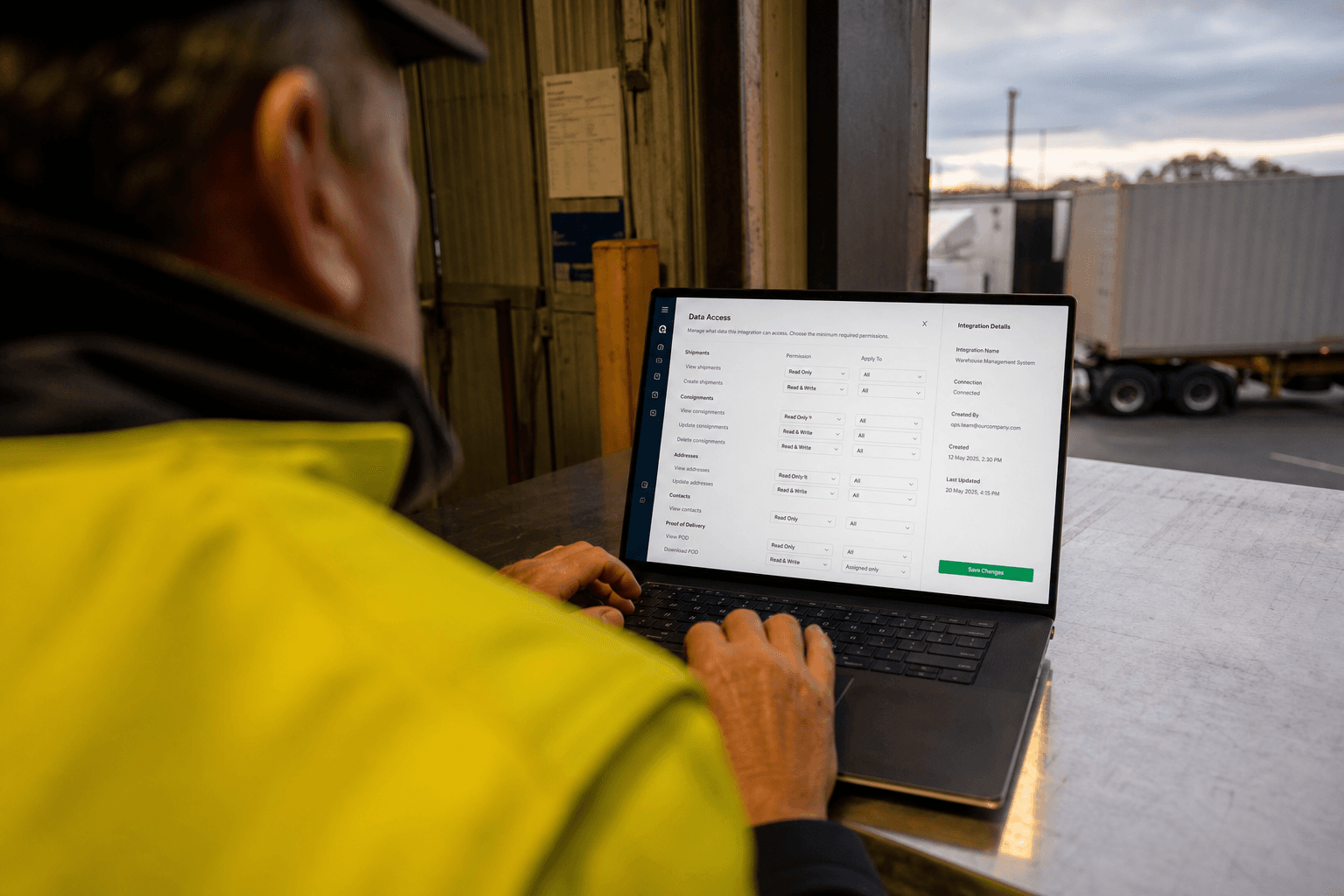
The practical test is the principle of least privilege: does this integration grant the minimum access required, or the maximum the vendor found convenient to build? In our experience running AI Readiness Assessments for mid-market logistics operators, this is one of the most common gaps — not malicious intent from vendors, but integrations scoped for speed rather than security.
Under Australia's Notifiable Data Breaches scheme, organisations are required to report eligible breaches involving personal information to the Office of the Australian Information Commissioner (OAIC). If a third-party AI tool with broad access to your TMS is compromised, your business — not just the vendor — carries reporting and reputational obligations. The same discipline applies if you're building out emissions reporting capability for AASB S2 or Scope 3 disclosures: any system that touches supplier or operational data needs the same access-scope scrutiny.
What questions should you ask AI vendors during due diligence?
Vendor due diligence for AI tools in logistics should focus on data handling, access scope, and incident response — not just feature lists. Before signing, ask vendors to answer these directly, in writing:
- What specific data fields does the integration access, and can that scope be restricted?
- Is data encrypted in transit and at rest, and to what standard?
- Where is data processed and stored — onshore in Australia, or offshore?
- Does the vendor hold an ISO 27001 certification or equivalent, and can they provide evidence?
- What is the vendor's breach notification timeline and process?
- Can access logs be exported for your own audit purposes?
- What happens to your data if you terminate the contract?
A vendor unable to answer these clearly isn't necessarily disqualified — but it tells you where the negotiation and contractual safeguards need to focus.
How should legacy system age factor into the risk assessment?
Older platforms generally carry higher integration risk because they were built before modern API standards, encryption expectations, and access controls were common practice. This doesn't mean AI adoption should wait for a full TMS/WMS replacement — for many operators that's neither realistic nor necessary. It does mean the integration method matters as much as the AI tool itself.
| Integration approach | How it works | Relative risk profile |
|---|---|---|
| Direct database connection | AI tool connects straight into the TMS/WMS database | Higher — broad access, weak isolation from core system |
| Middleware/API layer | A controlled layer sits between the AI tool and the core system, limiting what's exposed | Lower — access can be scoped and logged independently |
| Read-only replica or export | AI tool works from a copy of the data rather than the live system | Lower — no write access, limited blast radius if compromised |
For most mid-market operators, a middleware or read-only approach is the more defensible starting point, particularly for pilot projects. It allows the business case for AI to be tested — on route planning, document processing, or emissions data capture — without exposing the core operational system directly.
Getting this right doesn't require an in-house security team. It requires scoping the integration properly before it's built, asking vendors the right questions, and understanding where your legacy systems' weak points sit. That's the starting point of any AI Readiness Assessment we run with logistics operators, and it's worth doing before — not after — you commit to a platform. You can find more on how we approach this on our more insights page.
If you're weighing up an AI integration and want a clear-eyed view of the exposure it creates before you sign anything, get in touch and we'll talk through where the real risks sit for your systems.
Zero Footprint
The Zero Footprint team — AI modernisation for Australian logistics.