Document Intelligence for Logistics: A Practical Guide
Document intelligence uses AI to extract and validate data from BOLs, invoices, manifests, and PODs — replacing manual re-keying with structured, automated data flows. Here's a practical guide for Australian logistics operators on what's achievable today and where to start.
What is document intelligence in logistics?
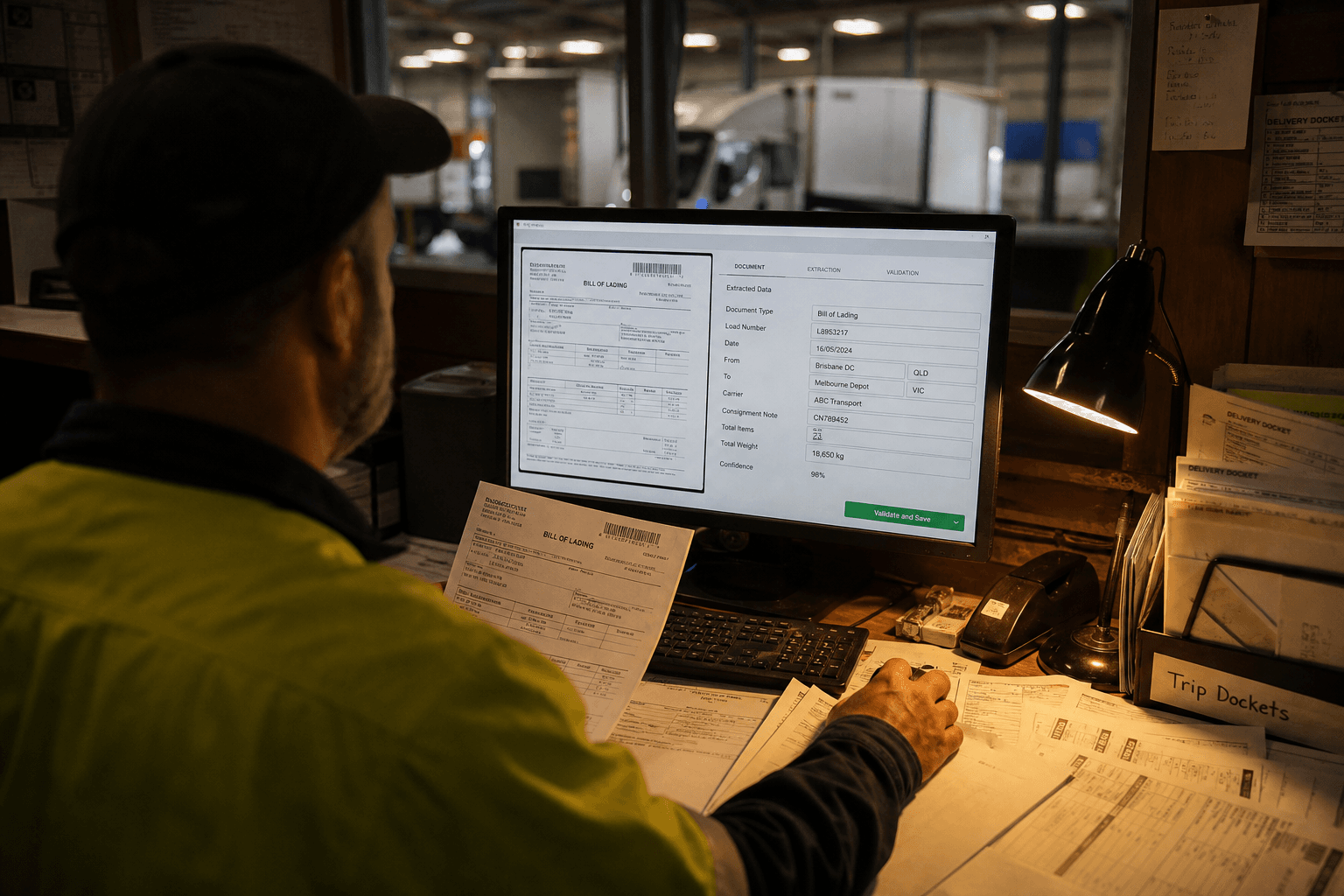
Document intelligence in logistics is the use of AI — combining optical character recognition (OCR), machine learning, and natural language processing — to automatically extract, validate, and route data from freight documents such as bills of lading (BOLs), invoices, manifests, and proof of delivery (POD) records. Instead of a person keying data from a scanned PDF into a TMS or ERP, the system reads the document and does it for them.
For most Australian carriers and 3PLs, this isn't a future concept — it's an overdue fix for a very old problem. Freight still moves on paper, PDFs, and photographed dockets, even when everything else in the supply chain has gone digital.
Why are freight documents so hard to automate?
Freight documents resist automation because they're unstructured and inconsistent — every customer, carrier, and warehouse partner uses a different invoice layout, BOL template, or manifest format. A rule-based script that works for one customer's paperwork typically breaks on the next.
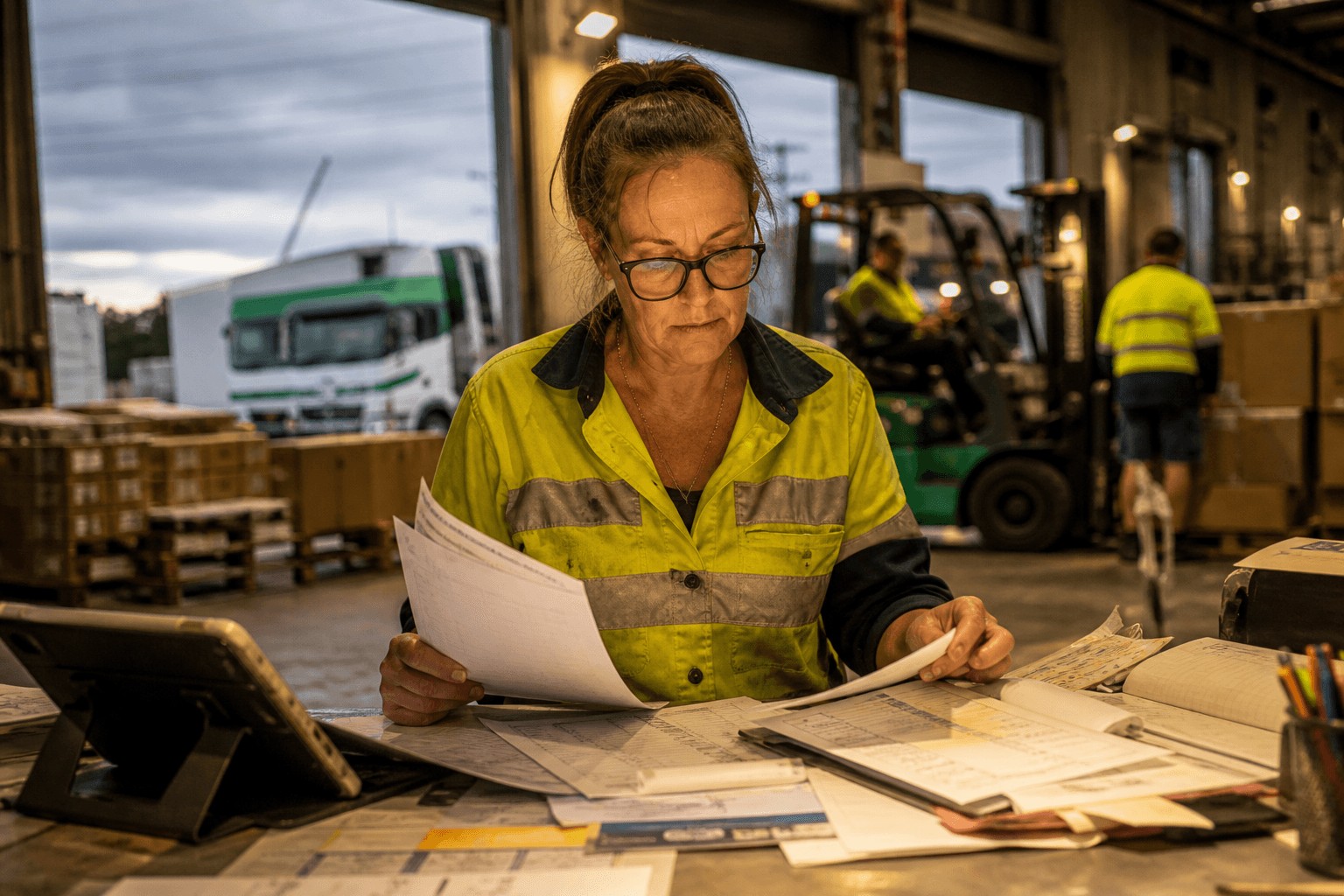
Add to that the real-world condition of these documents: handwritten signatures, smudged stamps, photos taken on a driver's phone in bad light, and multi-page manifests with line items that vary by consignment. Traditional OCR — the kind built for clean, structured forms — often fails here. Machine learning models trained on freight-specific document types handle this variability far better, because they learn to recognise fields (consignee, weight, item count, hazard class) regardless of layout.
What can actually be automated today?
At a practical level, document intelligence today can extract structured data from BOLs, freight invoices, customs paperwork, and delivery dockets, flag discrepancies (e.g. invoiced weight vs manifest weight), and push validated data straight into a TMS, WMS, or accounting system — removing manual re-keying almost entirely.
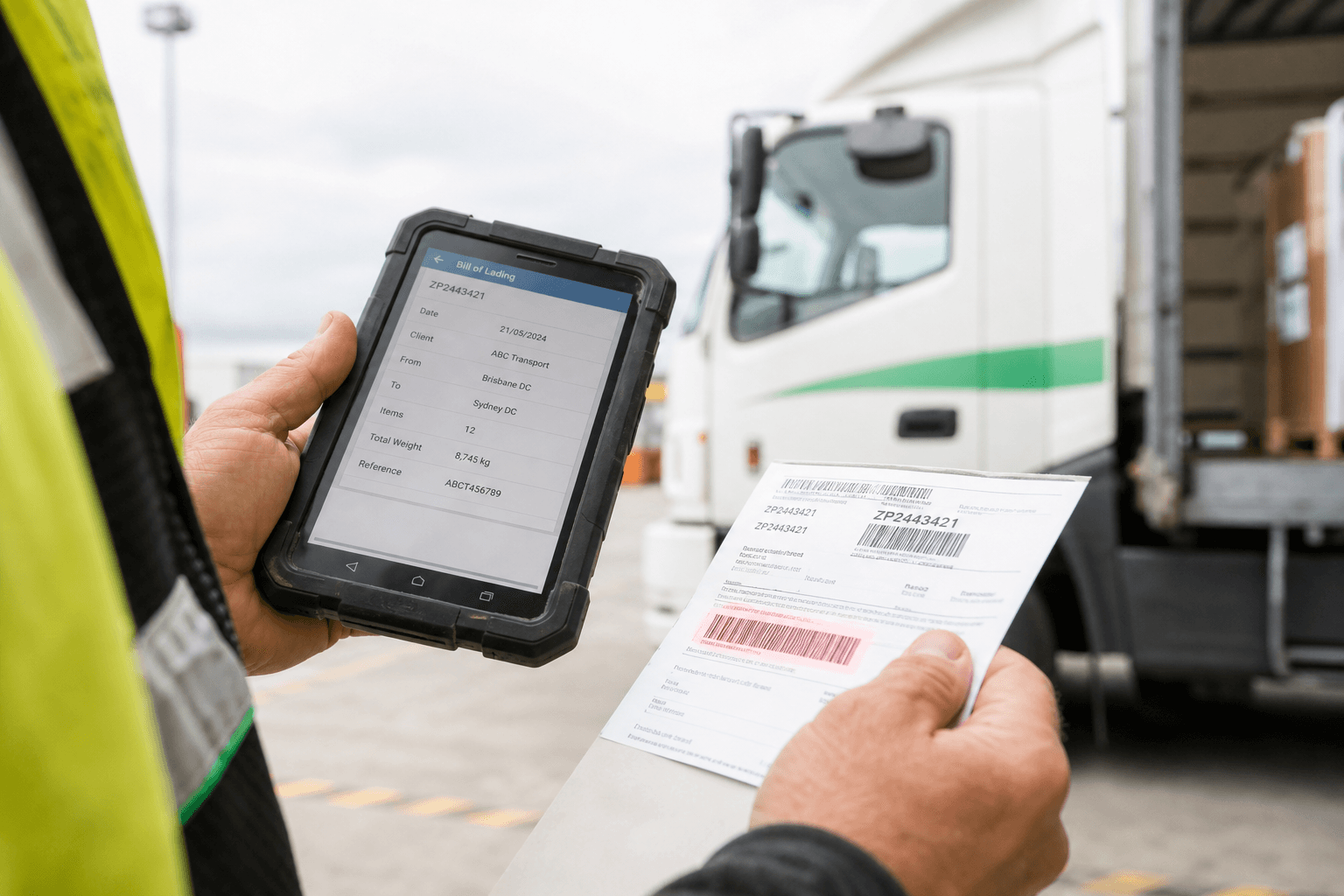
This sits alongside two related capabilities that Australian logistics operators are already investing in as part of broader modernisation programmes:
- Digitising paper-based workflows — replacing paper POD and inbound receiving processes with digital equivalents captured at the point of delivery or receipt.
- EDI integration — automating electronic data interchange with customers, carriers, and suppliers, so structured data (orders, ASNs, invoices) flows system-to-system rather than via email attachment.
Document intelligence is the layer that makes the unstructured remainder — the PDFs, scans, and photos that don't arrive as clean EDI messages — usable in the same way. It's the bridge between the paperwork that still exists in the real world and the structured systems your business runs on.
How does document intelligence fit into a digital transformation plan?
Document intelligence works best as one component of a wider digital transformation effort, not a standalone tool bolted onto legacy systems. Operators typically pair it with process digitisation (POD, inbound receiving) and EDI integration so that both unstructured and structured document flows end up in the same clean data layer.
This matters because the value of extracting data from a BOL is limited if it then sits in a spreadsheet. The real gain comes when extracted data flows automatically into dispatch, billing, and — increasingly — emissions and compliance reporting, where accurate freight and fuel data underpins Scope 3 calculations under AASB S2.
Manual vs semi-automated vs AI-driven document processing
| Approach | Data entry | Error rate | Scalability | Audit trail |
|---|---|---|---|---|
| Manual (staff keying data) | Fully manual | Higher, human-error prone | Poor — scales with headcount | Inconsistent, depends on record-keeping |
| Semi-automated (templates, basic OCR) | Partial | Improved for standard formats | Limited — breaks on format changes | Better, but gaps remain |
| AI-driven document intelligence | Automated extraction + validation | Lower, with flagged exceptions for review | High — adapts to new formats over time | Structured, traceable, exportable |
These are qualitative comparisons based on how each approach typically behaves in practice — actual results depend on document volume, quality, and existing systems.
Where should logistics operators start?
Most operators shouldn't start by buying a document intelligence tool off the shelf. They should start by understanding which documents, workflows, and systems are actually causing the bottleneck — because the fix for a 3PL drowning in invoice discrepancies looks different from the fix for a carrier still using paper PODs.
An AI readiness assessment is designed for exactly this: a structured review of your current document workflows, data quality, and system landscape, resulting in a clear view of what's worth automating first and what the realistic path looks like. From there, a document intelligence build can target the specific document types — BOLs, invoices, manifests, PODs — that are costing the most manual effort.
If you're evaluating document intelligence as part of a broader modernisation push, it's worth reading more from our insights on how digitisation, EDI, and AI extraction fit together for Australian logistics operators.
Is document intelligence the same as EDI integration?
No — document intelligence and EDI integration solve different problems. EDI integration automates the exchange of already-structured data between systems (orders, invoices, ASNs) in agreed formats. Document intelligence extracts data from unstructured documents — scanned BOLs, PDF invoices, photographed dockets — that never arrive as clean structured messages in the first place. Most logistics operators need both, because both formats of paperwork exist in their business simultaneously.
Getting started
Document intelligence isn't about replacing your team — it's about removing the hours they spend re-keying data that a machine can read faster and more consistently. For most Australian carriers and 3PLs still running manual dispatch, paper PODs, or spreadsheet-based invoice reconciliation, it's one of the more immediate, measurable wins available in a modernisation programme.
If you're exploring document intelligence for your operation, we can help — starting with an honest look at where your document workflows are actually costing you time and money.
Zero Footprint
The Zero Footprint team — AI modernisation for Australian logistics.