Multi-Currency Invoicing and FX Risk: AI for Freight Forwarders
AI doesn't remove FX risk for Australian freight forwarders, but it closes the gap between when currency exposure appears and when finance teams can see it. Here's where AI-assisted tools genuinely help with multi-currency invoicing — and where the limits still sit with your legacy systems.

AI helps Australian freight forwarders manage multi-currency invoicing and FX risk in two concrete ways: it flags currency exposure in near real-time instead of at month-end, and it automates the extraction and matching of multi-currency invoice line items so finance teams spend their time on exceptions rather than data entry. This doesn't remove FX risk — the exchange rate will still move between the day an invoice is booked and the day it's settled — but it closes the gap between when exposure appears and when your team can actually see it. That gap, more than the exchange rate itself, is usually what's eating margin. This article looks at where AI in logistics genuinely helps with multi-currency invoicing and FX exposure, and where the limitations still sit with the systems underneath it.
What is FX risk in freight forwarding?
FX risk (foreign exchange risk) is the financial exposure a business carries when it invoices, pays, or holds balances in a currency other than its reporting currency — in this case, Australian dollars. For a freight forwarder, that exposure shows up every time a carrier invoices in USD, an overseas agent bills in EUR, and the customer pays in AUD weeks later, by which point the exchange rate has moved. The gap between the rate booked and the rate settled is where margin gets eaten.
This is distinct from operational risk (late shipments, documentation errors) but the two are connected: the longer an invoice sits unreconciled because of manual processing delays, the longer the business is exposed to rate movement before it can act.
Why is multi-currency invoicing such a headache for Australian forwarders?
Multi-currency invoicing is difficult because most mid-market forwarders still reconcile carrier bills, agent statements, and customer invoices manually across spreadsheets, with exchange rates applied inconsistently or after the fact. A single shipment might touch a freight invoice in USD, a destination agent fee in local currency, and a customs disbursement in AUD — each needing separate conversion, matching, and margin calculation before anyone can see whether the job was actually profitable.

The Reserve Bank of Australia publishes daily exchange rates that many businesses use as a reference point, but the practical challenge isn't finding a rate — it's applying the right rate, at the right time, to the right line item, consistently, across hundreds of shipments a month. When that work is manual, errors compound and finance teams lose visibility into real-time FX exposure until month-end close, by which point it's too late to act.
How does AI help flag FX exposure?
AI-assisted tools can monitor open invoices and unsettled balances across currencies in near real time, flagging exposure as it builds rather than at month-end. Rather than waiting for a finance team to manually total outstanding foreign-currency liabilities, pattern-matching and anomaly-detection models can surface which shipments, agents, or trade lanes are carrying the largest unhedged exposure on any given day.
This doesn't replace the judgement calls — whether to hedge, when to convert, how much appetite for risk the business has — but it does give CFOs and finance directors something they often lack today: a live, consolidated view of currency exposure instead of a monthly snapshot built from exports and spreadsheets.
Can AI reconcile multi-currency invoices automatically?
AI-based document intelligence can extract line items, currencies, and exchange rate references from carrier invoices, agent debit notes, and customs documents, then match them against expected charges and flag discrepancies for review. This is the same underlying capability used for document intelligence in freight operations more broadly — reading unstructured PDFs, emails, and scanned documents and turning them into structured, matchable data.
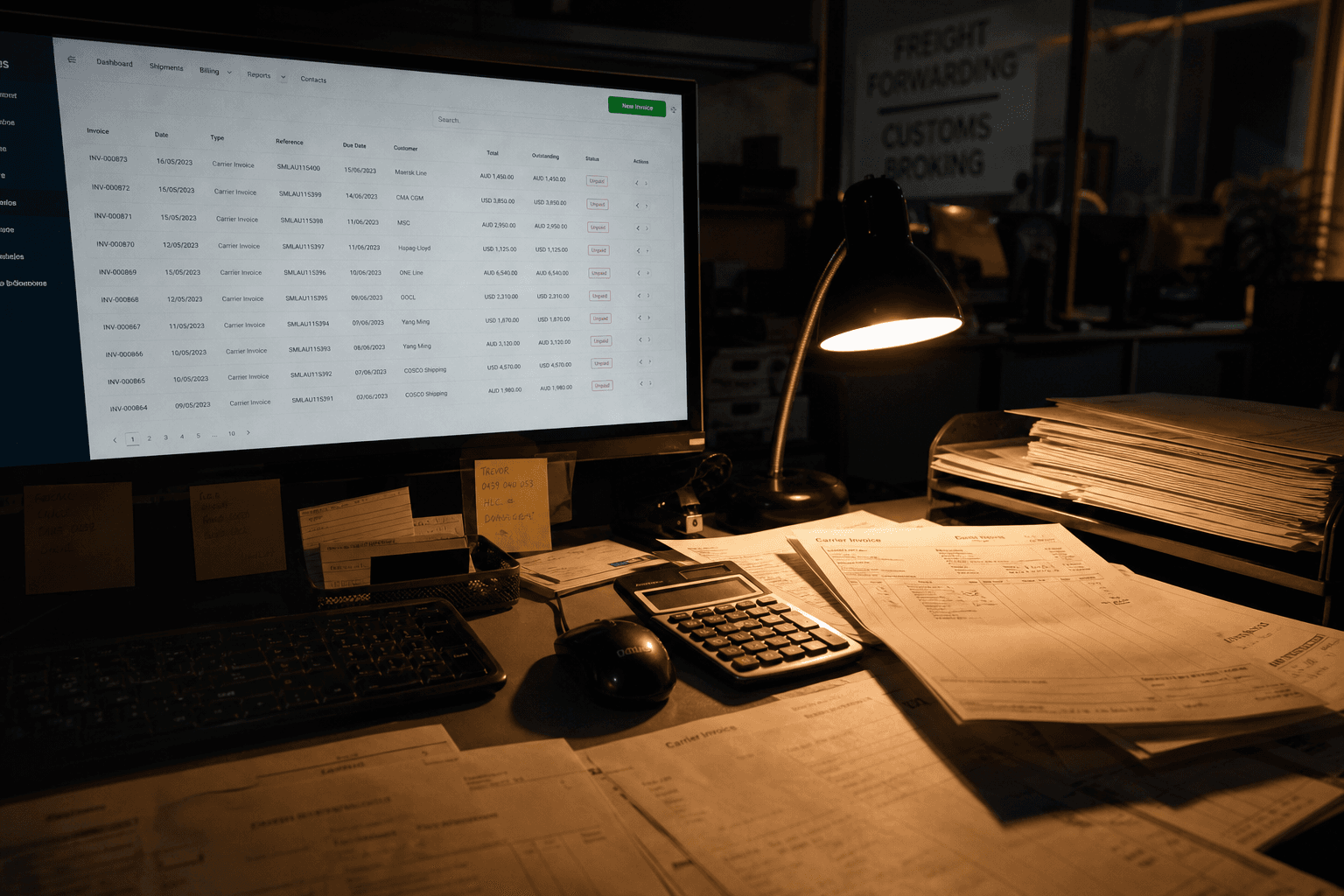
It's worth being precise about what "automatic" means here. The tools reduce the manual matching and data-entry burden and can catch discrepancies a tired person at 6pm on a Friday might miss. They don't eliminate the need for a finance team to review flagged exceptions, approve adjustments, or make the final call on disputed charges. The goal is to get your team spending time on the invoices that need judgement, not re-keying the ones that are routine and already reconciled correctly.
Manual vs AI-assisted multi-currency invoice management
| Factor | Manual process | AI-assisted process |
|---|---|---|
| Exposure visibility | Monthly or ad hoc, built from exports | Near real-time, continuously updated |
| Invoice matching | Line-by-line, by hand, across spreadsheets | Automated extraction and matching, exceptions flagged |
| Error detection | Found at reconciliation or audit | Flagged closer to the point of entry |
| Staff time required | High — scales with shipment volume | Lower — scales mainly with exception volume |
| Audit trail | Depends on individual record-keeping discipline | Structured, consistent, and traceable |
This is a qualitative comparison, not a guaranteed outcome. Industry benchmarks and vendor case studies suggest meaningful time savings are typical, but the actual improvement for any one business depends heavily on data quality, document consistency, and how well the tooling is integrated with your existing finance and operations systems.
What's holding freight forwarders back from automating this?
The biggest barrier for most mid-market Australian forwarders isn't the AI — it's the systems underneath it. Legacy TMS and WMS platforms that are five, ten, or fifteen years old typically can't integrate easily with modern APIs, cloud platforms, or data pipelines, and lack real-time reporting hooks that AI tools need to work from live data rather than overnight exports. This is the same legacy system modernisation challenge we see across road freight, 3PL, and warehousing operators — not just forwarders managing currency exposure.
Before investing in FX-specific tooling, most businesses are better served by an honest assessment of what their current systems can actually support, and where the real bottlenecks sit — finance, operations, or both. That's the starting point of our ai readiness assessment: a structured look at your data, systems, and processes before anyone talks about building anything.
It's also worth noting that FX exposure and currency reconciliation aren't the only areas where mid-market logistics operators are under pressure to modernise. Many of the same forwarders juggling multi-currency invoices are also facing emissions reporting obligations under AASB S2 and NGER, or looking at route optimisation to improve fleet utilisation on the domestic leg. The common thread is the same: manual processes that worked at a smaller scale are now the constraint on growth, compliance, and margin.
If you're weighing up where to start, the practical answer is usually wherever the manual workload is costing the most staff time or creating the most risk — for many forwarders, that's multi-currency reconciliation. For others, it's emissions data or dispatch planning. There's no single right order, but there is a right way to figure out which one matters most for your business first.
For more on how AI-assisted tools apply to other parts of freight and logistics operations, see more insights on our blog.
If multi-currency invoicing and FX exposure are costing your finance team real hours every month, get in touch and we'll talk through what's actually feasible given your current systems — no sales pitch, just a straight assessment of where the gaps are.
Zero Footprint
The Zero Footprint team — AI modernisation for Australian logistics.